

























































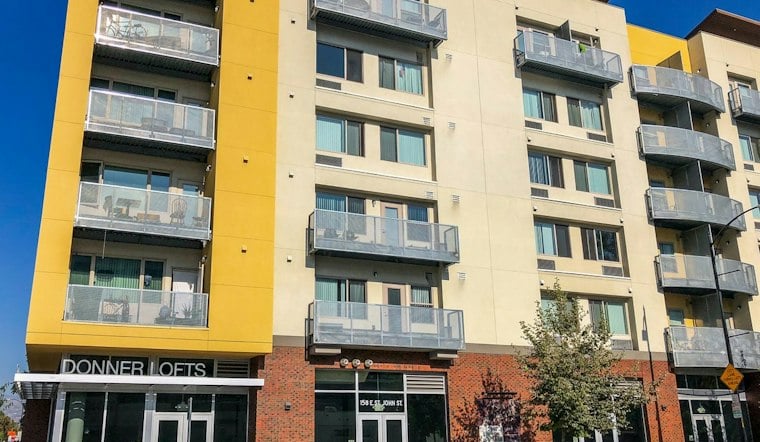
A preliminary application has been filed for an affordable senior housing complex at 55 Lapu-Lapu Street in SoMa, proposing 105 rental units on a site currently occupied by the Alice Street Community Gardens. The plan calls for 104 affordable apartments plus one two-bedroom unit reserved for an on-site property manager, with a mix of 52 studios and 52 one-bedroom homes.
According to San Francisco YIMBY, the Tenants and Owners Development Corporation is behind the application, with David Baker Architects handling the design. The affordable units would be designated for households earning less than 80% of the area's median income, the outlet reports.
The proposed structure would rise roughly 80 feet and yield around 64,850 square feet overall, including 46,320 square feet dedicated to housing. The design also includes 1,200 square feet for a community room and 240 square feet for a property manager's office, per the same report. Structurally, the building is expected to consist of a concrete mat slab, a single-story concrete podium, and five levels of wood-frame construction above it.
A Shrinking Garden, a New Facade
The project would replace the Alice Street Community Gardens entirely, though the plan still carves out a smaller community garden space as part of the new building. The outlet notes the design would feature green glazed brick, Corten steel planters for that reduced garden area, and full-height bay windows overlooking the narrow street. The 0.4-acre property sits in the center of a block bounded by 3rd Street, 4th Street, Folsom Street, and Harrison Street.
Location is central to the pitch: the site sits one block from the T Third Street light-rail station, two blocks from Yerba Buena Gardens, and three blocks from the Market Street transit corridor. No construction cost or timeline has been shared by the project team, and the preliminary details disclosed so far are subject to change, the report states.
Leaning on State Law to Speed Things Along
The application invokes California's state density bonus law along with Assembly Bill 130 and Senate Bill 330, aiming to streamline approvals and increase residential capacity on the site. Under AB 130, as written in the bill text from California Legislative Information, the existing parking requirement would be deleted and replaced with a cap of up to one space per unit, unless state law or a local ordinance sets a lower standard. California's density bonus law allows bonuses of up to 35% in some cases.
Those state tools exist in part because affordable housing in San Francisco has a track record of getting stuck. The city has more than 37,000 homes somewhere in its planning and permitting pipeline, with roughly a quarter of them intended to be affordable, according to The Frisc. Yet only 405 new housing units citywide were ready for occupancy in the first half of 2026, and the city's 'Under Construction' pipeline classification has fallen to about 3,300 units, down from 4,545 five years earlier.
Appeals Have Slowed Similar Projects Before
California housing laws are designed to limit city officials' ability to reject projects meeting certain objective standards and to largely restrict environmental appeals against them, per the San Francisco Chronicle's reporting on state housing policy. Even so, procedural challenges have tripped up comparable affordable developments elsewhere in the city. Residents contested a Department of Public Works approval for the 3333 Mission Street project earlier this year, pausing that development for almost three months before the Board of Supervisors voted unanimously to let the work proceed, the Chronicle reported.
A similar parcel-map appeal was also filed against a 136-unit supportive housing project at 16th and Mission streets, the newspaper noted. Developers and housing advocates have described these kinds of challenges as exploiting a loophole in the city's approval system, even as state law aims to accelerate affordable construction. Whether the 55 Lapu-Lapu Street proposal will encounter similar hurdles remains to be seen, since the application is still in its early, preliminary stage.



