

























































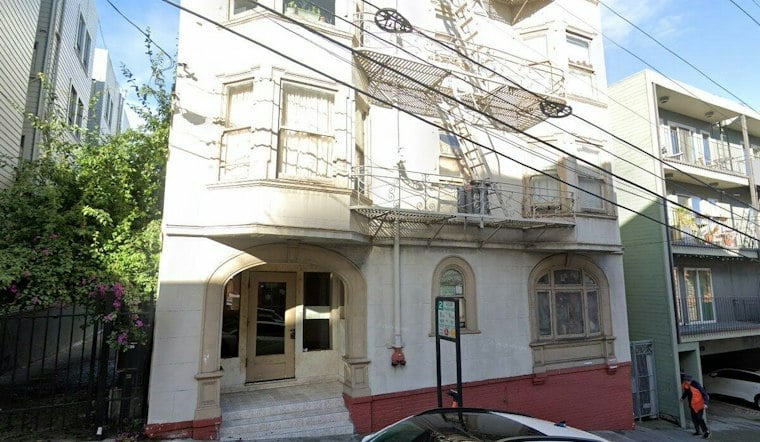
Sue Yeng Yan is 92 years old and has lived in her rent-controlled apartment at 1120 Jackson St. since 1982, paying $281.42 a month in a city where that kind of rent is almost unheard of. In March, she received an eviction notice claiming her cluttered apartment was a nuisance — one of six identical notices sent to tenants in the 16-unit Lower Nob Hill building. Now San Francisco supervisors are preparing legislation they say would stop cases like hers from happening in the first place.
A Building Along the Cable Car Line Becomes a Flashpoint
1120 Jackson St. sits along the Powell-Hyde cable car line in Lower Nob Hill, and it became a flashpoint after Los Angeles-based Nabob Hill LLC purchased the building last year. According to The San Francisco Standard, the company purchased the 16-unit building in July 2025 for $1.5 million. Eviction defense attorney Kit Wong said Yan “has not recovered” from the experience — and that under the current rules, Nabob Hill could restart eviction proceedings against her or her neighbors at any time. Wong also said tenants accused of nuisance conditions effectively must prove a negative, demonstrating they are not cluttering their homes once a landlord levels the allegation.
Nabob Hill served eviction notices on Yan and the occupants of four other units, claiming the tenants had dangerously cluttered their apartments. The company sent Yan a letter in June stating she had cured the alleged clutter conditions, allowing her to stay, but it also stated that future inspections may occur. One elderly tenant in the building reports the landlord is still refusing to accept her rent, and eviction cases against other tenants in the building could restart at any time under the current law. Nabob Hill representatives did not respond to a request for comment.
Supervisors Introduced an Eviction Proposal
Supervisors Jackie Fielder and Myrna Melgar introduced an eviction proposal on Sept. 1 concerning unpaid-rent evictions.
Under the proposal, tenants who caused damage through an honest mistake could avoid a nuisance claim by paying reasonable repair costs or stopping the accused activity, while evictions would still be allowed for disturbing other occupants’ peace or causing substantial building damage. The measure is modeled on similar laws in Berkeley and Oakland. Berkeley’s municipal code, for instance, requires landlords to show one of several specified grounds before recovering possession of a unit, and under its substantial-violation standard, a landlord must prove the tenant’s violation caused substantial actual damage and that the tenant’s behavior was unreasonable, according to Berkeley Municipal Code. Berkeley law also allows eviction for substantial damage only when a tenant willfully caused harm beyond normal wear and tear and then refused, after written notice, to pay for repairs.
Tenant advocacy groups have represented residents in the building. The Asian Law Caucus represented tenants there, and Shelby Nacino commented on the building’s eviction notices. No neighbors had complained about Yan.
Landlord Attorney Wants Narrower Limits, Not a Wholesale Rewrite
Not everyone in the real estate industry is on board. Dave Wasserman, a landlord attorney and vice president of the Coalition for Better Housing, said residents should not lose their housing over accidental mistakes or purely negligent acts. But he also said he supports confining nuisance evictions generally to intentional, malicious or reckless conduct that goes unrectified after written warnings — a narrower target than the bill’s backers but still a shift from current practice.
A Citywide Surge in Evictions and Rent
The proposal arrives as San Francisco evictions climb. San Francisco has filed more than 1,000 evictions in 2026, putting the city on pace for its most evictions in a decade. Mayor Daniel Lurie has declared a rent emergency in San Francisco and has thrown his support behind a proposal to prevent the eviction of tenants who owe less than one month of back rent, along with larger payouts for tenants displaced through Ellis Act evictions and more city funding for eviction legal defense.
Tenant advocates have described a rise in notices to quit. Peter Stevens of the San Francisco Tenants Union told sfpublicpress.org that notices to quit citywide have risen 141% since 2024.
Legal Assistance to the Elderly told KQED that eviction notices had increased roughly 25% over the prior year, while Zillow figures cited in that report put the average two-bedroom San Francisco apartment at about $5,800 — a 35% jump from a year earlier.




