

























































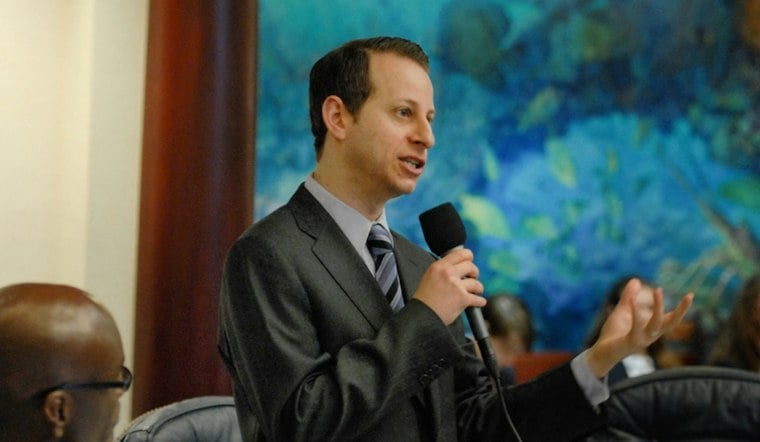
A political war chest built by some of Silicon Valley's biggest names is pouring money into a South Florida congressional race that has become a proving ground for the fight over how fast artificial intelligence should be regulated. In Florida's 25th Congressional District, which runs from Miami Beach to Delray Beach, Democratic incumbent Jared Moskowitz is facing off against former Republican Boca Raton Mayor Scott Singer in a contest tied to broader AI-industry political spending; rival AI-aligned camps together have spent about $78.5 million on federal candidates during the 2026 election cycle.
The district race, described as set to be the most expensive in the nation, according to CBS News Miami, sits at the center of a broader conflict documented by CNBC, which reports that AI-aligned political groups have spent about $78.5 million on federal candidates during the 2026 election cycle, based on an analysis of FEC filings through October 20. Of that spending, AI development and lighter-regulation groups put roughly $8 million into general-election congressional races, while safeguards-focused groups spent about $6.9 million in those same races, per the outlet's review, which excluded state races and nonprofit advocacy spending. Roughly 74 percent of total spending in the cycle went toward primary contests rather than the general election, CNBC's analysis found.
A $140 Million Network Built to Shape the Midterms
The spending in Florida traces back to Leading the Future, a political network co-led by Democratic strategist Josh Vlasto that launched in August 2025 with more than $100 million in commitments, according to the Washington Post. Backers of the effort have included Andreessen Horowitz, Greg Brockman, Anna Brockman and Joe Lonsdale, and the network has since amassed $140 million for pro-AI candidates, according to Wired. The group deployed two affiliated committees — the Democratic-aligned Think Big PAC and the Republican-aligned American Mission — with Think Big overwhelmingly funding Democrats and American Mission funding Republicans, Wired reported.
In the Florida 25th primary, Think Big spent $310,000 supporting Moskowitz, while a group called Defending Our Values spent almost $857,000 boosting Singer and another $740,000 opposing one of Singer's primary rivals, per CNBC's reporting. The network's stated aim, as described in a Politico newsletter, is to defeat candidates who support the strictest AI regulations while championing those who favor faster industry development — though Leading the Future has also said it supports a strong national regulatory framework for AI, according to Axios.
CNBC tallied roughly $26 million in primary independent expenditures and about $8 million in general-election expenditures, with plans to spend six figures in each district where it is backing a candidate in the general election, Axios reported. More than 170 Democratic organizers and campaign staff members called on party leaders this fall to refuse Leading the Future's money, according to Axios, reflecting friction even within the party the network has courted.
A New York Race Shows the Risk of Overreach
The clearest cautionary tale for the network came out of New York's 12th Congressional District, where Think Big spent $8.3 million trying to defeat Alex Bores while the rival Jobs and Democracy PAC spent about $15 million supporting him, per CNBC's analysis. Combined, the two committees spent $23.3 million in that single primary — about 40 percent of the two camps' nationwide primary spending — and Bores still lost to Micah Lasher by a narrow 39 percent to 35 percent margin. Sacha Haworth said the race showed that spending against safety-first candidates could trigger an industry counterattack, CNBC reported.
Bruce Freed, president and co-founder of the Center for Political Accountability, framed the stakes bluntly in comments to CNBC: “Money is flowing in all directions to be in the driver's seat of what happens.” Guardrails Alliance, a safeguards-aligned group, reported spending $412,500 opposing Jay Feely in Arizona and the same amount against Aaron Flint in Montana, with about $412,000 spent opposing Jimmy Gomez in California, according to CNBC's review of the filings. Safeguards-focused groups reported about $32.1 million in primary spending and $6.9 million in general-election spending overall, with safeguards groups also spending $825,000 opposing two Republicans this fall, per the same analysis.
Some Big Donors Are Already Pulling Back
Not every Silicon Valley player is leaning in harder. Anthropic committed $20 million in February and another $20 million in July to a public-facing initiative but has restricted that money to policy and public education rather than candidate elections, the company said, according to CNBC. OpenAI's chief strategy officer acknowledged internally that the company was taking reputational hits over its political spending, Semafor reported, and CEO Sam Altman told Politico, “I don't think spending money on politics is what's going to make people feel better about it.”
Meta has scaled back more dramatically. Political groups funded by the company returned $25 million in contributions over the summer, CNBC reported, including $22 million returned by the American Technology Excellence Project and $3 million returned by Meta's California political operation. Meta also cut its planned state-level political spending from $65 million to about $40 million, a reduction of nearly 40 percent.
Public Opinion and the Comparison to Crypto's Playbook
Polling cited by CNBC from its All-America Economic Survey found 52 percent of registered voters favor a pause in advanced AI development, compared with 32 percent who favor continued development. Protesters held “Freeze AI Now” signs outside OpenAI's San Francisco headquarters on October 20, according to CNBC's reporting.
The AI network's strategy echoes an earlier playbook from the cryptocurrency industry, where Fairshake and affiliated pro-crypto super PACs spent more than $130 million during the 2024 election cycle and saw their backed candidates win 53 of 58 races, a success rate reported by CoinDesk at 91 percent. Whether Leading the Future's spending can replicate that track record will become clearer as Florida's 25th District heads toward its own reckoning: Trump carried the district by about nine percentage points in 2024, while Biden won it by five points in 2020, according to WLRN, which also reported that the Cook Political Report currently rates the seat as leaning Democratic, with Moskowitz holding a slight edge. Moskowitz and Singer met in person Tuesday night at a forum in Boca Raton, the station reported, ahead of the midterm election scheduled for November 3.





