

























































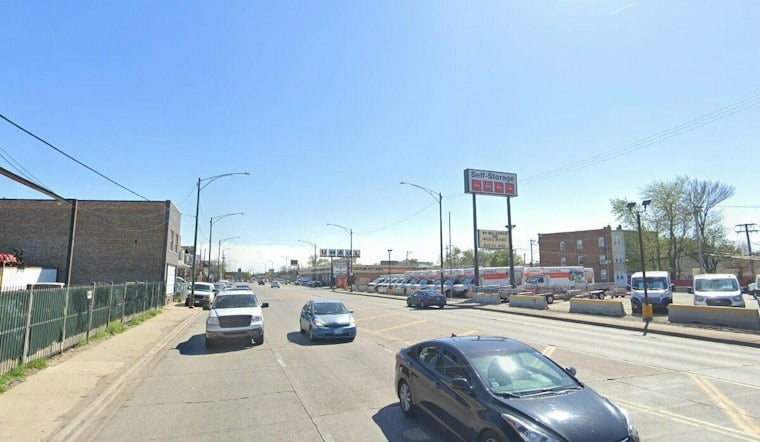
A vacant car scrapyard on the northwest edge of Austin could soon give way to a five-story apartment building with 36 units, eight of them designated affordable, just south of where North Cicero Avenue meets West Grand Avenue. The site sits a short walk from the Grand/Cicero Metra station, putting new residents within reach of the Milwaukee District West Line.
According to Chicago YIMBY, local developer 1749 NCA LLC is working with Barry Architecture on the design, which calls for a red and gray panel exterior with brick covering the lower level and cantilevered balconies jutting from the upper floors. The building would rise from a one-story podium spanning most of the 18,300-square-foot site, with a small residential entrance, tenant storage space, and a 34-vehicle parking garage tucked behind it, accessed off the north and west alleys. Official Chicago City Clerk records show the project was submitted under Matter ID E4E22B29-E9B5-F111-AAAC-001DD80FDA55, seeking zoning relief to convert the parcel from its industrial junk-yard use, as detailed on the SkyscraperPage Forum.
Unit Mix And Affordability Requirements
Per the same Chicago YIMBY report, the building would include 12 one-bedroom units, 20 two-bedroom units, and four three-bedroom units, ranging from roughly 700 to 1,390 square feet. Eight of the 36 apartments are set aside as affordable housing, a requirement that traces back to Chicago's 2021 Affordable Requirements Ordinance, which mandates that residential projects of 10 or more units seeking a zoning change set aside 10% to 20% of units for households earning at or below 60% of Area Median Income, according to Root Realty.
Those affordable units carry additional design obligations. Under Chicago Building Code accessibility mandates and updated ARO regulations, at least 20% of units in multi-family developments must meet Type A accessible design standards, and every ARO-designated affordable unit must meet that same Type A threshold, per Burnham Nationwide. That standard provides enhanced accessibility features for residents with mobility disabilities beyond baseline Fair Housing Act requirements.
A Junkyard's Path To Residential Use
Converting a former auto scrap yard into housing is not simply a matter of pouring a new foundation. The City of Chicago Department of Housing notes that such conversions require environmental soil testing and enrollment in the Illinois Environmental Protection Agency's Site Remediation Program before a developer can obtain a residential No Further Remediation letter, since sites once used for automotive salvage or heavy commercial storage often need mitigation or engineered barriers to ensure safe residential occupation.
Cook County public legal notices from December 2024 list 1749 NCA LLC as a corporate entity holding property interests near West Grand Avenue and North Cicero Avenue, as reported by Nadig Newspapers, indicating the developer had maintained site control along this stretch well before filing this year's zoning application.
Fitting Into A Broader Cicero Avenue Vision
The project lines up with the City of Chicago's Cicero Avenue Land Use Framework Plan, which calls for using zoning updates to encourage multi-story, mid-scale residential infill on underutilized commercial and industrial lots along the corridor, according to Chronicle Media. The framework plan envisions front-facing buildings with parking shifted to rear alleys, a layout this proposal mirrors with its garage entrances off the north and west alleys.
The Grand/Cicero Metra station next door currently operates as a rush-hour flag stop, meaning Milwaukee District West Line trains only stop there when passengers are visible on the platform or when riders onboard request it, according to the City of Chicago Department of Planning and Development. Local transit advocates have pointed to the station as an underutilized asset along the West Side rail corridor.
Context From A Shrinking Housing Stock
The proposal arrives as Austin and surrounding West Side neighborhoods continue to grapple with housing loss. DePaul University's Institute for Housing Studies found that Chicago lost nearly 12,000 housing units in two-to-four unit residential buildings between 2013 and 2019, largely due to demolitions in lower-income West and South Side neighborhoods including Austin, according to Hoodline's prior reporting. Those multi-family structures historically supplied much of the West Side's unsubsidized affordable rental housing.
Mayor Brandon Johnson's administration has also launched a $1.25 billion Housing and Economic Development bond to fund infill multi-family housing and convert vacant municipal and industrial lots into affordable residential units, a program that has already backed projects elsewhere in the city. Whether this Cicero Avenue development will draw on that bond funding to support its eight required affordable units remains an open question.
The site's industrial surroundings have drawn scrutiny before. A major scrap fire broke out on September 11 at 1257 North Cicero Avenue, sending heavy black smoke across Austin and drawing attention to environmental hazards along the Belt Railway industrial corridor, underscoring longstanding community concerns about scrapyards operating near residential blocks. The zoning application for 1759 North Cicero Avenue is now moving through the city process as the developer works to advance the project toward construction.





