

























































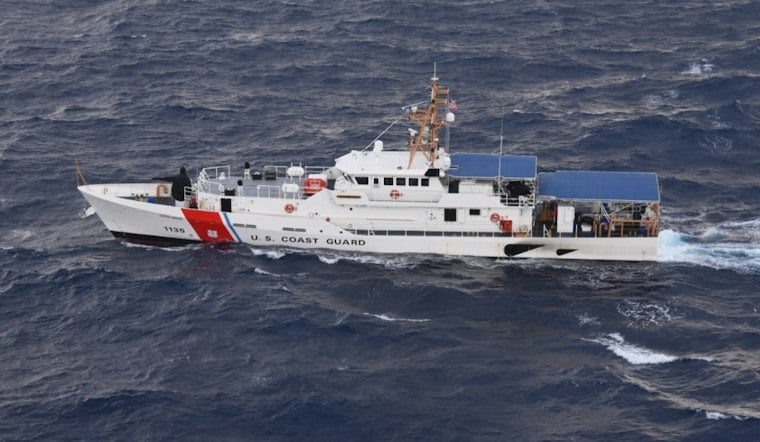
Federal agents arrested 57-year-old Bahamian national Earl Knowles on October 2, 2026, tying him to one of the deadliest migrant smuggling disasters in recent Florida history: the January 2022 capsizing of a 25-foot boat that killed 39 people roughly 45 miles off the Fort Pierce Inlet. Knowles was already serving a two-year federal sentence for illegally reentering the United States after a prior deportation when investigators moved to charge him in the smuggling case.
According to the Miami Herald, the boat's engines stopped about two hours into the trip from the Bahamas, and the vessel began taking on water in increasingly rough seas before capsizing. The lone survivor, 22-year-old Juan Esteban Montoya, told federal agents that roughly 40 people had been aboard when the engines failed. His 18-year-old sister, Maria Camila Montoya Caicedo, was among the dead; the U.S. Coast Guard later recovered her body floating off Brevard County.
A Harrowing Night Clinging to the Hull
Montoya revealed during a January 31, 2022 press conference that at least 15 migrants initially survived the capsizing and clung to the overturned hull, but gradually slipped into the ocean from exhaustion, dehydration, and lack of food before he was finally rescued, according to CBS News. He was left alone on the hull when a Jacksonville-based tugboat crew spotted him 45 miles off the Fort Pierce Inlet, per the Herald's account. The U.S. Coast Guard had officially suspended its search and rescue operation at sunset on January 27, 2022, after recovering five bodies and determining that no additional survivors among the remaining 34 missing passengers were likely to be found, the Tribune reported. Search crews had repeatedly overflown the overturned vessel across thousands of square miles before calling off the effort.
The Montoya siblings had lived in Colombia, and their mother paid smugglers to take them through Panama and the Bahamas, hoping they would eventually join her in Houston, Texas, and escape violence back home, per the Herald. Montoya said at a January 2022 press conference that he and his sister chose the Bahamian maritime route because online research led them to believe it was safer than traveling overland through Central America and Mexico, according to the Tribune. The siblings had been separated from their mother in Texas for over a decade before the trip.
How Knowles Fit Into the Smuggling Network
Per the Herald's reporting on the federal complaint, the siblings stayed about 10 days in a house with Knowles and other passengers in Nassau before flying to Bimini, where a smuggling crew was waiting. Knowles reportedly provided housing for Esteban and Maria in Bimini until their departure, and a Colombian man had asked Knowles to help smuggle his niece and nephew to Florida from the Bahamas. Knowles facilitated a phone call between that Colombian man and a figure identified in court records only as Co-conspirator 1, who organized the smuggling venture, the Herald reports.
Knowles told investigators he found migrant clients for Co-conspirator 1 on several occasions and would be paid $1,000 per referral, though he denied being paid for introducing Esteban and Maria to the smuggler, according to the complaint cited by the Herald. Esteban and Maria reportedly paid the smuggler between $10,000 and $12,000 for the trip; that smuggler did not go on the fatal voyage. Esteban later identified Knowles in a six-man photo lineup in September 2022, and Knowles separately identified Co-conspirator 1 in a photo lineup, telling agents that the man had simply continued smuggling operations after the boat sank.
Homeland Security Investigations in Miami launched its federal criminal inquiry immediately after the January 2022 rescue, publicly vowing to prosecute every member of the smuggling syndicate that organized and profited from the venture, the Tribune reported at the time; federal agents treated Montoya as a victim rather than a suspect during the early stages of the inquiry.
A Long Road From Prison Sentences to Arrest
Knowles has a lengthy history with U.S. immigration enforcement. He was deported in 1995, 2006 and 2019, and was convicted of bank robbery in New York in 2016. On July 22, 2025, a migrant boat carrying 10 people, including Knowles, ran aground on the beach at Fort Pierce; Knowles admitted he was a Bahamian national without authorization to enter the country and told agents he had paid smugglers $7,000 to take him to South Florida. He pleaded guilty in February 2026 to illegally reentering the United States after a prior deportation and is serving his sentence in Sandstone, Minnesota.
Federal law under 8 U.S.C. § 1324 makes alien smuggling resulting in death punishable by up to life imprisonment or the death penalty, with penalties applied on a per-person basis for each migrant smuggled rather than per incident, according to the Esfandi Law Group. Sentencing enhancements can also apply when a voyage endangers 10 or more people or operates as a commercial venture, which explains why federal authorities are pursuing the case years after the sinking even though Knowles was already behind bars.
South Florida federal courts have a track record of imposing lengthy sentences in similar fatal smuggling cases. A Bahamian smuggler was sentenced in Miami federal court to 14 years in prison in March 2015 after his Bimini-to-Florida boat capsized and drowned four migrants, according to the U.S. Department of Justice. In an earlier case in September 2010, two Haitian boat captains were sentenced to 14.5 years and 13 years in prison after their overloaded vessel sank off Palm Beach County, killing nine migrants and an unborn fetus, that venture having drifted at sea for three days following a mechanical breakdown.
A Corridor Under Heavier Watch
Bimini, the Bahamian island chain where the doomed vessel departed, lies roughly 50 to 55 miles east of South Florida across the Gulf Stream, making it a primary launching point for maritime smuggling operations into the U.S., per the Tribune; high-powered vessels can make the crossing in under two hours in calm weather. Migrant interdictions along the Bahamas-Florida corridor have since fallen sharply, dropping from 3,201 in 2023 to 2,019 in 2024 and then to just 440 in 2025, according to Royal Bahamas Defence Force tracking cited by The Watch. Authorities attributed the decline to expanded Coast Guard patrols and altered federal migration policies.
In January 2025, the U.S. Coast Guard deployed a strategic surge of cutters, aircraft, and specialized personnel to bolster maritime security along the same corridor where the 2022 tragedy unfolded, aiming to intercept overloaded rustic and commercial craft before they could make the crossing. Whether that broader crackdown played any role in finally bringing Knowles into custody remains unaddressed in the record, and it is still unclear whether prosecutors will seek the harshest penalties available under federal law given the 39 deaths tied to the voyage.





