

























































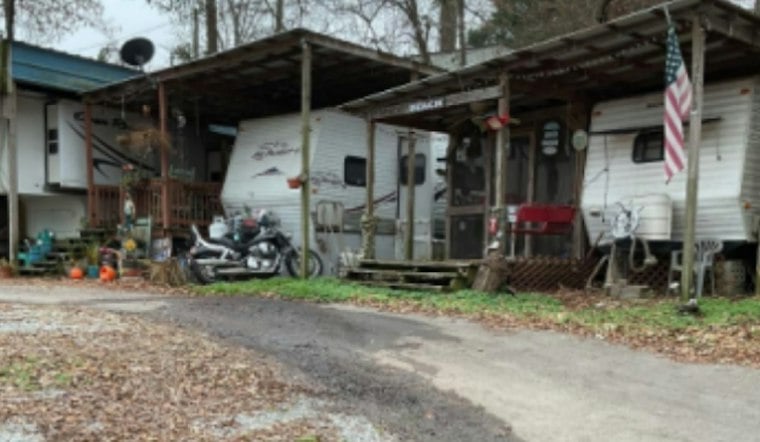
An RV parked at a campsite near Beaverdam Marina in Benton County has gone more than four years without a working sewage disposal system, according to a lawsuit the State of Tennessee filed in Davidson County Chancery Court on September 30. State inspectors say raw sewage has been surfacing and draining across a nearby road, flowing toward Kentucky Lake, one of the region's most heavily used recreation waterways.
The case, first reported by WKRN News 2, names Tennessee Attorney General Jonathan Skrmetti and Tennessee Department of Environment and Conservation Commissioner David Salyers as plaintiffs. According to the lawsuit, the Tennessee Department of Environment and Conservation's Division of Water Resources has known about the sewage problem since September 21, 2022, but enforcement dragged on for years as the agency repeatedly mailed compliance letters to a property owner who had already died. The RV's previous owner died in 2019, and TDEC did not stop trying to contact him until 2025, after confirming his death.
Deceased Owner, Estate and Marina Named in Complaint
With the original owner gone, the state is now going after whoever it believes bears responsibility for the site. The lawsuit identifies the deceased owner's estate, the estate's executor, and Beaverdam Restaurant & Rockin' Marina as the parties responsible for maintaining the subsurface sewage system, according to the complaint. Naming all three reflects an effort by the state to pin down legal accountability after the original titleholder was no longer around to answer for the failing septic infrastructure.
A Land.com listing places Beaver Dam Restaurant and Marina in Benton County near Camden. Kentucky Lake is a hub for regional boating, crappie and bass fishing, and broader tourism. It is the largest artificial lake by surface area in the United States east of the Mississippi River, spanning more than 160,000 surface acres and over 2,000 miles of shoreline across West Tennessee and western Kentucky, according to Wikipedia.
Inspectors Found Sewage Still Surfacing in December
Williamson County Government guidance says subsurface sewage systems must not pollute or contaminate surface or ground water, as described in its subsurface sewage system information.
TDEC's enforcement process typically relies on these kinds of physical, on-site evaluations by field inspectors, whose reports become the core evidence used in administrative orders and chancery court filings, according to state rules published through TN.gov. In this case, that on-site documentation of waste flowing across a public road appears to form the backbone of the state's legal case.
Tennessee's Water-Pollution Penalties
Tennessee Code Annotated § 69-3-115 allows civil penalties of up to $10,000 per day for violations of water quality standards, according to Justia.
This is not the first time TDEC has pursued lakeside property owners in court over failing septic systems. In May 2026, the agency filed a court enforcement action against a trailer park owner along Boone Lake in East Tennessee, as reported by the Kingsport Times News. The state has also gone after municipal violators: in February 2026, TDEC assessed a $146,000 civil penalty against the City of Manchester after officials reported 108 sanitary sewer overflow events that released more than 25 million gallons of untreated sewage in 2025, according to Thunder Radio.
Tennessee regulators have shown a willingness to pursue even larger wastewater cases with federal backing. In September 2023, Attorney General Skrmetti and TDEC partnered with federal authorities to secure a Clean Water Act settlement requiring $598,490 in civil penalties and system-wide sewer overhauls from the Hamilton County Water and Wastewater Treatment Authority, according to the U.S. Environmental Protection Agency. Separately, conservation groups including the Southern Environmental Law Center and Tennessee Riverkeeper have filed their own lawsuits in 2025 and 2026 against Middle Tennessee wastewater operators over systems leaking sewage into Old Hickory Lake and nearby tributaries, the Southern Environmental Law Center notes, pointing to a broader pattern of failing wastewater infrastructure across the state's lake basins.
For now, the Beaver Dam case remains in Davidson County Chancery Court, where the state is pressing for a court order to force repair or replacement of the subsurface system rather than simply collecting a penalty. With sewage still surfacing near the road as of the December 2025 inspection, the central question is how quickly the responsible parties named in the suit — the estate, its executor, and the marina — will be compelled to act.





