

























































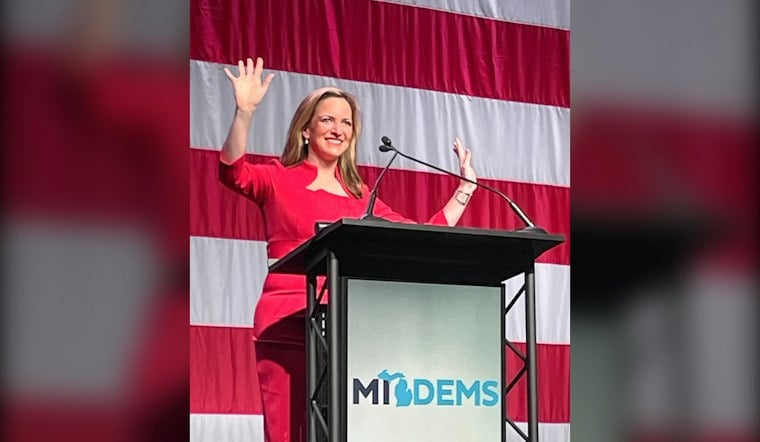
Michigan's governor race is no longer close, according to a new statewide survey, while the fight to replace retiring Senator Gary Peters remains a dead heat with Election Day fast approaching. Jocelyn Benson now leads John James 53.3% to 40.9% among likely voters, while Abdul El-Sayed holds a far tighter edge over Mike Rogers in the U.S. Senate race, with figures ranging from 48% to 45.5% in the MSU survey to 46% to 44% in a Rasmussen poll.
The numbers come from Michigan State University's Institute for Public Policy and Social Research, which released its latest State of the State Survey on Monday. According to ippsr.msu.edu, YouGov conducted the interviews for the Office for Survey Research and IPPSR between October 2 and 19, with 1,000 interviews in each wave. The institute reported the Senate race at El-Sayed 48% to Rogers' 45.5%.
Benson, the Michigan secretary of state from Detroit, has opened up a lead that dwarfs her Senate counterpart's margin. James, a Republican U.S. representative from Shelby Township, trailed her by more than 12 points among likely voters. The Senate race, by contrast, was much closer.
A Tighter Fight for Peters' Seat
El-Sayed, the Democratic nominee and former Wayne County and Detroit health director from Ann Arbor, and Rogers, a former congressman, are both vying to replace Peters, a retiring Democrat. Per the Lansing State Journal, voters will choose between the two on November 3.
The race has stayed close across multiple surveys throughout October. The Lansing State Journal's roundup found El-Sayed ahead of Rogers 50% to 48% in an October 15-18 Marist poll, 47% to 46% in an October 21-22 InsiderAdvantage poll, 46% to 44% in an October 12-14 Rasmussen Reports poll, and 47.6% to 46.5% in an October 5-6 Quantus Insights poll. A YouGov poll conducted September 22 through October 4 had El-Sayed up 49% to 48%.
The RealClearPolitics polling average gave El-Sayed a 1.9-point overall lead based on polls completed between September 28 and October 22, down from a 2.6-point lead in the prior average, the same report noted. El-Sayed led in all six October polls included in that average, and Rogers has not led in the RCP average since August, nor in an individual poll since a September 3 Detroit News Glengariff survey.
Who's Driving Each Lead
The MSU survey found Benson outperforming El-Sayed among independents, Wayne County residents, Catholics, Black voters and ideological moderates — groups where her advantage was especially pronounced, according to the institute's report. Voters under 30 were the exception: El-Sayed ran ahead of Benson among that age group.
That pattern echoes an earlier MSU survey from September, which found El-Sayed with stronger support than Benson among likely voters under age 45, while Benson led among older voters. A separate Marist Poll conducted September 24-27 found El-Sayed leading Rogers 51% to 44% and Benson leading James 53% to 41% among registered voters, and that same poll found 41% of Michigan voters approved of President Trump's job performance while 57% disapproved.
How the Race Has Shifted Since August
Benson has widened her lead since the institute's August survey, which had her up 9 points on James, while El-Sayed's lead has narrowed from 5.5 points in August to 2.5 points in the current survey. The September MSU survey then found Benson leading James 52% to 43% and El-Sayed leading Rogers 50% to 45% among likely voters, suggesting some narrowing in the Senate race even as the governor's contest has kept growing.
Matt Grossmann, director of Michigan State's Institute for Public Policy and Social Research, said the gap between the two races has grown, with centrist voters more likely to back Benson than El-Sayed. MSU did not immediately release additional survey data, including demographic breakdowns, beyond what has already been published.




