

























































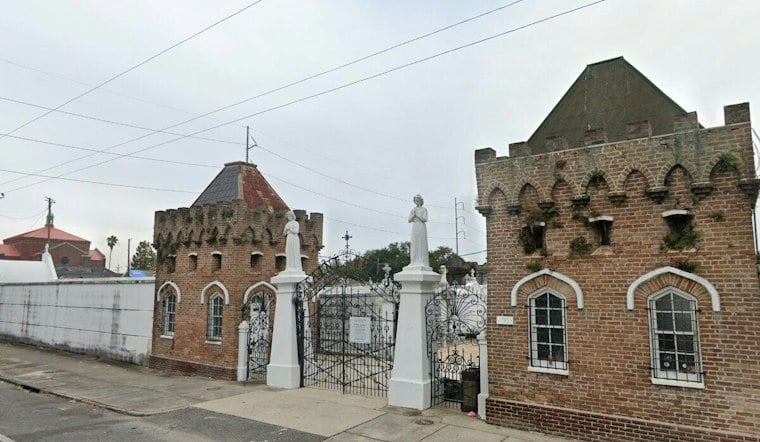
Giant puppet skeletons, a rolling altar covered in photographs of the deceased, and an enormous monarch butterfly prop will move through the Bywater and St. Roch neighborhoods Monday night as Krewe de Mayahuel stages its annual Día de Muertos procession. The march begins at 7 p.m. at the corner of Royal and Piety streets and winds its way to St. Roch Cemetery No. 1, where mourning and celebration are meant to meet in equal measure.
The Mexican Día de Muertos holiday blends remembrance with festivity, honoring loved ones who died in the past year through an annual procession that mixes grief and joy rather than separating them, according to NOLA.com. Krewe de Mayahuel presents the event, which the outlet reports includes a rolling altar bearing photos of the dead alongside four giant puppet skeletons and the oversized monarch butterfly figure. Many marchers paint their faces with white makeup and colorful flourishes inspired by sugar skulls, carrying the visual language of the holiday into the New Orleans streets.
This year's procession falls on a Monday, a shift from the Saturday and Sunday dates of the two preceding years, and krewe co-founder Tete Rodriguez told NOLA.com she expects the weeknight timing could thin the crowd compared with recent turnout, which reached an estimated 4,000 marchers last year. Still, Rodriguez said the gathering remains open to all comers. “Everyone who loves, likes or supports Mexican culture” is welcome to join, she said, adding simply that the krewe welcomes everybody.
From a Shopping-Cart Altar to a City Tradition
The procession's roots are humble. Rodriguez and her late husband, Roberto, started an informal Día de Muertos bar crawl with eight or ten friends a couple of years before the krewe staged its first official procession in 2018, per NOLA.com. That early gathering carried its altar atop a shopping cart — a far cry from the puppet-and-altar spectacle the krewe now fields. The procession is produced by the Krewe de Mayahuel Carnival marching group, which travels through the Bywater and St. Roch neighborhoods, according to nola.com, and is named for Mayahuel, the Aztec goddess of the agave plant.
What started small has grown considerably. By 2022, the parade had swelled to include thousands of candle-lit celebrants, a leap from the scores of marchers who turned out for the first procession in 2018, nola.com reported. That year, krewe leader Roberto Corrillo estimated roughly 5,000 people took part. The event's organizers have described it as deliberately blending the traditional Mexican Day of the Dead memorial observance with New Orleans's own parading customs — part funeral rite, part street party.
Monday's Route and Pre-Procession Festival
This year's march is set to be preceded by a festival at Mickey Markey Park from 4 p.m. to 7 p.m. in the 3300 block of Royal Street, featuring face painting, crafts, food, beverages and a Mexican music DJ, per NOLA.com's reporting. Other listings describe the event's timing differently: OffBeat states the fiesta begins at 4 p.m. at Markey Park, while Where Y'at reports a pre-procession gathering starting at 3 p.m. at Mickey Markey Park ahead of the 7 p.m. march. OffBeat also describes the procession itself as featuring hundreds of calacas, or skeletons, moving toward an ofrenda at the cemetery.
From Royal and Piety, marchers head along Royal Street to Franklin Avenue, then turn onto St. Claude Avenue before reaching St. Roch Avenue, according to NOLA.com — a route that nola.com's coverage of a prior year's procession also described as turning right on Franklin, left on St. Claude and right on St. Roch. The march is expected to last roughly 45 minutes before concluding at St. Roch Cemetery No. 1, located at 1725 St. Roch Ave. A mariachi band is scheduled to perform on the St. Roch Avenue neutral ground outside the cemetery once the procession arrives.
An Altar Open to Everyone's Grief
At the cemetery, participants may add photographs of late friends and family to the altar, folding their own private losses into the krewe's larger, public memorial. Where Y'at describes this as central to the event, noting that the procession allows participants to add offerings and sentimental items to an altar at the cemetery entrance to commemorate their loved ones. The custom echoes what NOLA.com and other accounts describe as the dual nature of the march — solemn in purpose, joyous in execution.
Past processions have carried their own small, telling details: a 2024 gallery of the march, shot by Sophia Germer of the Times-Picayune, captured then-four-year-old Sebastian Hugh Wolf Barbre and nine-year-old Zappa Haglund, visiting from Michigan, among the crowd that year, while another participant, Alejandro Salazar, sounded a conch shell as the krewe led marchers to St. Roch Cemetery through the Bywater. After Monday's procession winds down, a Día de Muertos party is set for the Hi-Ho Lounge at 2239 St. Claude Ave., giving the night an afterlife beyond the cemetery gates.





