

























































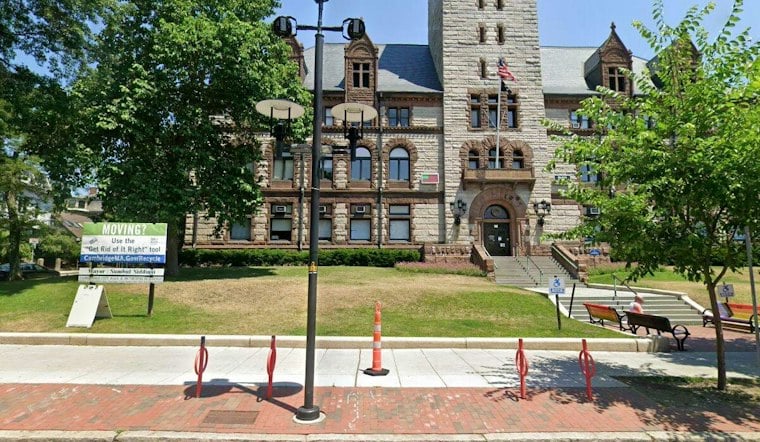
More than 350 people signed up to speak before the Cambridge City Council, but after hours of public testimony, two proposals to boycott and divest city funds from companies tied to Israel were tabled in less than half an hour. The council session, which began Monday night and stretched into the early hours of Tuesday, ended with both measures referred to committee rather than put to a vote.
Vice Mayor Burhan Azeem and Councilor Patricia M. Nolan exercised their charter right to postpone discussion of both orders to a future meeting, according to The Harvard Crimson. The outlet reported that both orders were tabled in less than half an hour once the council resumed its meeting. Councilor Ayah Al-Zubi had introduced the two proposals, according to Boston.com.
What the Orders Would Require
The first policy order called for Cambridge’s pension and Other Post-Employment Benefits Trust Fund to withdraw investments from a specified list of companies, per Boston.com’s reporting. That list, compiled using the American Friends Service Committee’s divestment shortlist, identified nearly $24 million across the two funds tied to companies on the AFSC’s roster, the Crimson reported. The holdings reportedly included $2.6 million invested in Palantir, $18.2 million in weapons manufacturers, and $3 million in GE Aerospace through the OPEB Trust Fund.
The second order proposed a municipal ordinance barring Cambridge from contracting with companies on the boycott list, with the proposed ordinance headed to the council’s Ordinance Committee for a hearing if the order passed. Per the Cambridge | Somerville Independent, both orders now move to the Ordinance Committee, with the proposals seeking a feasibility report and implementation timeline of no more than six months after enactment. The city’s agenda lists the item as divestment from companies complicit in the genocide, apartheid, and occupation of Palestinians, and also directs the city manager to have the city solicitor weigh in on the boycott ordinance under Massachusetts General Laws chapter 30B and applicable federal law before any Ordinance Committee hearing.
Hours of Testimony, Split Opinion
The hearing drew 352 registered speakers, with more than 260 actually taking the floor — roughly 165 in support of the measures and more than 100 opposed, the Crimson reported. That marathon stretch echoed a 2021 Cambridge divestment debate in which public comment alone ran 7.5 hours with 486 speakers, according to the Cambridge | Somerville Independent, which also noted that a related special-meeting proposal passed 8-1, with Al-Zubi opposed because that order disallowed spoken public comment.
Al-Zubi told fellow councilors she did not want responsibility for bloodshed and argued that international politics are linked with domestic affairs, per Boston.com. She also said the proposal concerns about 1 percent of the pension fund and that the order requests action without spending money or binding anyone — a figure the Crimson similarly reported councilors described as making up only about one percent of the fund.
Divided Councilors, Divided Arguments
Azeem said he hoped a special meeting could develop language the council could pass, while also saying Cambridge should not involve itself in foreign policy, according to Boston.com. Nolan expressed concern that the proposals singled out one country rather than examining the city’s investments across the board, telling colleagues any divestment effort should, in the Crimson’s words, be just and fair and include all problematic companies. Nolan added she could support divestment in principle but not the proposed language, per Boston.com.
Mayor Sumbul Siddiqui floated the possibility of a special meeting before the council’s next regularly scheduled session on Nov. 2, Boston.com reported, though the Crimson noted only that the city may call such a meeting sooner — no date has been set.
A City With a History of Divestment Fights
Cambridge has waded into these waters before. The council voted in 1980 to divest from companies doing business in apartheid-era South Africa, the Crimson noted, and the city has previously voted to exclude funds from fossil fuels and private prisons as well, according to Boston.com. In 2021, the council rejected an effort to discourage contracts with Hewlett-Packard and other companies doing business with Israel, instead adopting a substitute measure committing to review city contracts for ties to companies that perpetuate violations of international human rights laws, per The Times of Israel.
Cambridge isn’t alone in wrestling with the question right now. In nearby Somerville, councilors and the city solicitor delayed final action on an Israeli divestment proposal to allow more research into which businesses would be affected and what the financial impact might be, according to the Jewish Telegraphic Agency. That city’s council voted last November to find a way within a year to implement a ballot question that passed with 55.7 percent of the vote, and any resulting ordinance would need both council passage and mayoral approval, with a veto override requiring eight council votes.
Elsewhere in Massachusetts, Easthampton City Council members were scheduled to consider their own divestment resolution targeting companies advocates say are complicit in human-rights violations in Israel and Palestine, according to WWLP. That city had roughly $454,000 invested in companies identified by advocates, including GE Aerospace, RTX, and Palantir, and passage would make Easthampton the second community in Hampshire County to adopt this kind of municipal divestment measure.
For now, Cambridge’s path forward remains in committee. The Ordinance Committee will take up both the divestment and contracting orders, with no date yet set for the special session some councilors have floated ahead of the council’s Nov. 2 meeting.



