

























































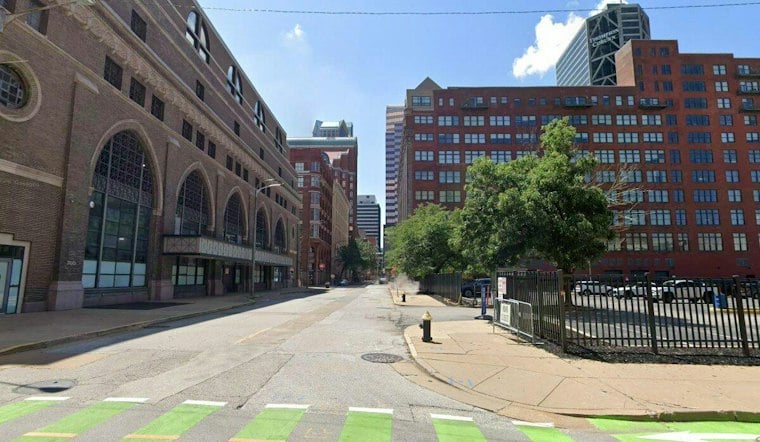
Mattresses, televisions, artwork and a 50-year-old chandelier that once lit the lobby are all for sale inside the shuttered Pear Tree Inn at 711 N. Broadway, as the roughly century-old downtown St. Louis hotel liquidates its contents following its closure this spring. The 170-room property sits directly across from America's Center, and the sale has drawn not just bargain hunters but people simply curious about the building itself.
The liquidation is being run by International Content Liquidations Inc., an Ohio-based firm, according to the St. Louis Business Journal. Nicole Cabealo, a member of the family that owns the liquidation company, said people have been curious about the building itself, not just the deals inside, as reported by First Alert 4. The sale will continue until all of the inventory is sold.
Ari Miller, who works for a property management company with buildings downtown and in the Central West End, visited the liquidation to look for furnishings, First Alert 4 reported. Miller said her company manages historic properties and wants to maintain their charm, a sentiment that underscores just how much history is packed into the building now being emptied out room by room.
From Public Market to Hotel Lobby
The structure at 711 N. Broadway wasn't always a hotel. Built in 1925 as Union Market and designed by the architecture firm Mauran, Russell & Crowell, it replaced an 1866 public market and served as one of St. Louis's principal municipal food markets, complete with an early indoor parking garage, according to Picture This STL. The market closed in the late 1980s, and the building was added to the National Register of Historic Places in 1984, earning the designation of St. Louis City Landmark No. 103 as one of only four surviving historic public market structures left in the city.
Drury Hotels bought the vacant building in 1990 and converted it into a hotel by adding a two-story addition atop the original four-story structure, per the company's own account of its historic renovations. The conversion preserved original interior terrazzo floors and Gothic entry arches even as new guest rooms were built above. The hotel also once housed a long-standing restaurant.
The property has operated under several different company brands since Drury took ownership in 1990, and in 2022 the hotel was listed for sale before later being pulled off the market, according to a LoopNet listing from that period. The listing also noted a parking garage at the hotel. Drury, which is based in St. Louis, still holds title to the Broadway building despite closing the Pear Tree Inn.
No Redevelopment Plans Announced Yet
Drury has not announced any plans for the building's future, First Alert 4 reported. Explore St. Louis has been in talks with the city and with Drury about possible future uses of the site, though Brad Dean said nothing has been announced about what might come next.
The closure comes even as downtown hotel performance has been trending upward. Downtown St. Louis hotel occupancy rose nearly 6% over the past year, outpacing both the roughly 2% increase seen regionally and the 1.5% national uptick, per the Business Journal. Dean said St. Louis is performing really well, crediting events like the VEX Robotics Competition and the U.S. Figure Skating Championships for contributing to the occupancy gains, and he said the city needs to maintain its momentum by promoting its brand and telling its story in new ways.
That new-era hospitality push is already visible on Washington Avenue: the 142-room Hyatt Centric Downtown St. Louis is set to open on October 15 inside the historic 1909 former International Shoe Co. building, following a $4 million renovation, according to STL.News. The property, previously known as The Last Hotel, was acquired by investors associated with Singh Investment Group before its rebrand.
Part of a Broader Downtown Push
The Pear Tree Inn's vacancy lands amid a wider municipal effort to address long-vacant or distressed downtown landmarks. City leadership has targeted properties including the Millennium Hotel and the Railway Exchange Building for public-private redevelopment, exploring land clearance tools as part of that strategy. Hoodline previously reported on that revival push.
For now, the Union Market building's next chapter remains unwritten. What's certain is that its lobby chandelier, guest room furnishings and decades of downtown history are headed out the door piece by piece, even as the surrounding blocks see fresh hotel investment take shape.





