

























































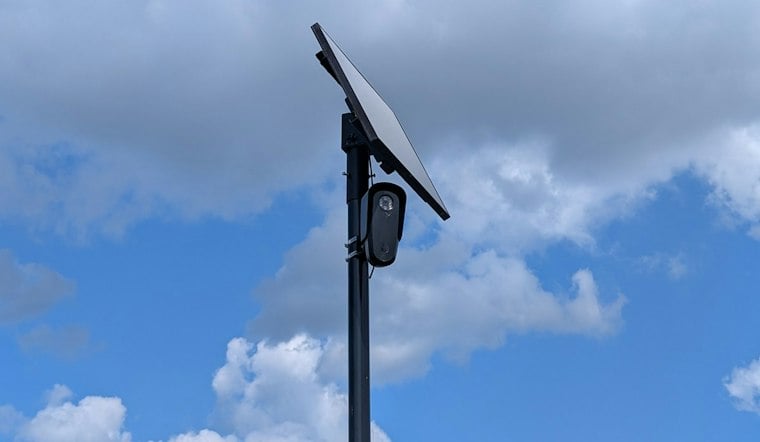
Chicago police officers ran more than 23,000 searches through Flock Safety's license plate camera database between May and July 2026, accessing the privately owned network through a city agreement rather than a direct contract with Flock Safety.
The arrangement, reported by FOX 32 Chicago, has raised fresh questions about how the department accesses and oversees Flock's surveillance data. Audit logs obtained by the station and detailed by Wirepoints show Chicago police searches of the camera network.
A City Agreement for Camera Access
The city agreement matters because it provided Chicago police access to privately owned Flock cameras without a direct city contract with Flock. The arrangement has drawn scrutiny over how the department accesses and oversees Flock's surveillance data.
That gap sits inside a broader set of state rules written specifically to constrain how license plate data gets used. Under a 2023 Illinois law, automated license plate reader operators are barred from sharing vehicle location data with out-of-state or federal agencies seeking to enforce immigration law or investigate reproductive healthcare access, according to the Illinois General Assembly. The restrictions address concerns about immigration enforcement and reproductive healthcare access.
Enforcement of that law, though, has leaned on audits rather than built-in penalties. Illinois Secretary of State Alexi Giannoulias began an investigation into Flock Safety in August 2025 amid allegations that the company had allowed U.S. Customs and Border Protection and out-of-state police to access Illinois plate data in violation of state law, NPR Illinois reported. The outlet noted the 2023 privacy statute carries no explicit financial or criminal penalties for vendor violations, leaving enforcement reliant on agency review and contract terms.
Flock Tightens Its Own Rules Nationwide
Flock Safety itself announced platform-wide changes on August 13, cutting its default data retention window from 30 days down to seven and requiring search case codes from every law enforcement user by the end of the year.
Momentum for tighter rules is building in Congress, too. U.S. Representatives Raja Krishnamoorthi of Illinois and Michael Cloud of Texas introduced the bipartisan No FLOCK Act on September 15, which would withhold 10% of federal surface transportation funds from states that fail to restrict automated plate reader use to five specific public safety purposes: toll enforcement, stolen vehicle recovery, missing person searches, and felony warrant or crime investigations.
At the state level, the ACLU of Illinois backed House Bill 5151, the Auto License Plate Recognition Act, in March 2026 to set statewide standards for retention and transparency. The organization has argued existing Illinois law lacks comprehensive rules governing how local departments query and store daily motorist location data.
Existing State Camera Network Predates the Controversy
None of this is happening on a blank surveillance slate. Governor J.B. Pritzker signed a $20 million expansion of the Tamara Clayton Expressway Camera Act in June 2022, deploying state-funded license plate readers across Cook County expressways and Chicago's DuSable Lake Shore Drive, according to the Illinois State Police. The law, named for a postal worker murdered on Interstate 57 in 2019, authorized those cameras to investigate expressway shootings, vehicular hijackings, and violent felonies.
Misuse cases elsewhere in the region have sharpened the stakes. Prosecutors charged two former suburban Chicago police officers with official misconduct in October for allegedly misusing Flock camera networks and law enforcement databases to conduct unauthorized personal searches, according to reporting tied to the same FOX 32 Chicago investigation. A separate West Chicago case also involved alleged misuse of a Flock network.
The broader network helps explain why advocates keep pushing back. The American Civil Liberties Union says AI-powered cameras catalog vehicle make, model, color, bumper stickers, and body damage, building detailed movement profiles of ordinary drivers.
Suburbs Pull Back While Chicago Expands Access
Some Chicago-area municipalities have reconsidered their Flock arrangements. Evanston deactivated its cameras in August 2025 and had begun the process of canceling its contract, while Bartlett planned to let its contract expire over a lack of support and concerns about Flock's safeguards. Hoodline reported on Bartlett's plan to let its contract expire.
The contrast is stark: Evanston deactivated its cameras and began canceling its contract, while Bartlett planned to let its contract expire; meanwhile, Chicago police have run tens of thousands of searches through a system accessed under a city agreement rather than a direct contract with Flock. That contrast between local camera pullbacks and Chicago police access is likely to remain a central question as state lawmakers, members of Congress and local officials continue weighing how much oversight automated surveillance networks need.





