

























































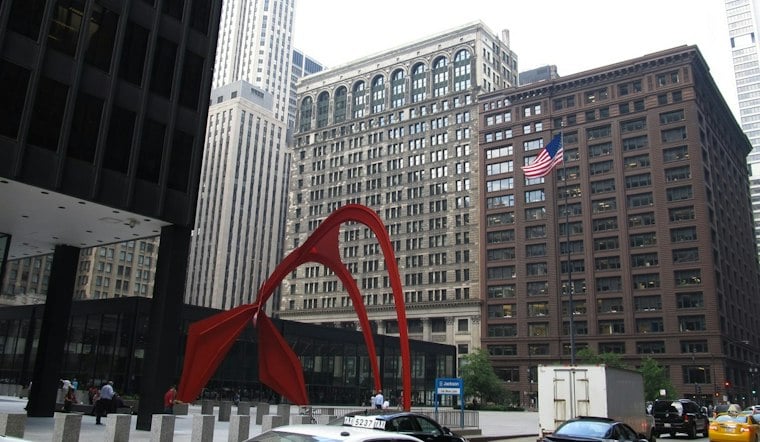
About 20 musicians stood in the rain outside the Chicago Federal Center in the Loop on October 1, chanting “Pause AI!” and singing “Don’t Give Up the Fight” as they launched a campaign against AI-generated music, technology companies and the streaming platforms that host both. Dressed in black T-shirts reading “Human Music Only. Press Pause on AI,” the group demanded legal safeguards against AI-generated copies of their work and announced plans for a streaming-platform blackout later this month.
The roughly half-hour gathering, as reported by the Chicago Tribune, came amid a mounting national dispute over generative AI, with AI-powered data centers drawing pushback nationwide even as the Trump administration has signaled a laissez-faire approach to regulating the technology and moved to rename AI “super intelligence.” The Tribune reported that some leading AI firms have warned their own models’ coding abilities could foment humanity’s demise, even as AI-generated videos, text and other content continue to inundate the internet.
Organizers described the rally as an opening step toward a prolonged, global campaign to regulate AI in music and support human artists, the Tribune reported. Singer Melody Angel said, “We want policy that says: ‘This is fake music, and this is real music.’ We should have the choice.” Vocalist Tammy McCann argued that AI lacks human lived experience, including the experience of having a baby.
Composer Reads Suno Leader’s Own Words Back to the Crowd
Composer and arts manager Tim Corpus, whose work spans concert music, film and interactive media according to his professional biography, used the rally to read remarks attributed to the leader of AI music company Suno. The leader reportedly said in 2025 that most people don’t enjoy the time they spend making music. Corpus disputed that view, telling the crowd, “It is hard. It does take a lot of time and practice,” according to the Tribune. Musician Ugochi Nwaogwugwu described being a musician as an earned position.
Jeannie Tanner urged listeners to keep AI-generated content out of their feeds, warning that it was polluting creative careers, the Tribune reported. The musicians’ concern, the paper said, is that AI-generated music draws on existing recordings scraped from across the web, exploiting decades of human recording work. Streaming platforms, meanwhile, have been slow to address AI fakes of real artists, even as some have welcomed AI-generated music.
A Broader Campaign Already Underway
The rally followed an open letter from Chicago musicians criticizing Spotify’s compensation model, its ties to AI and its handling of unlabeled AI-generated music and data collection. Reports on how many artists signed differ: CBS News Chicago reported that at least 80 musicians signed the letter, published September 22, while WBEZ reported the letter had nearly 70 signees. The campaign was organized by Sam Cantor of Minor Moon and Austin Koenigstein of Smushie, according to CBS News Chicago.
Rapper and poet Mykele Deville told the station that independent-artist payouts on Spotify can be vanishingly small, saying, “You get fractions of a percentage of a penny if you get it.” Deville said he withheld his new album from the platform entirely, explaining, “I made the decision to try and reeducate my audience to find my music where I can be equitably compensated for it.” Spotify has pushed back on that characterization, telling the station it does not pay royalties according to a fixed per-play rate and that independent artists and labels collectively generated more than $5 billion on the platform in 2024, roughly half of its total royalty payouts. The company also said it paid $10 billion to the music industry in the prior year and $60 billion all-time, and that the number of artists earning at least $1,000 to $10 million annually on the platform has at least tripled since 2017.
The Chicago campaign isn’t isolated. WBEZ reported that Massive Attack, Hotline TNT and King Gizzard & the Lizard Wizard have also announced Spotify departures in recent months, part of a wider reckoning playing out across the streaming industry.
Blackout Planned for Late October
Chicago artists plan to carry their protest into a concrete action: a music-platform blackout on October 26 and 27 asking listeners to avoid Spotify and Apple Music. The timing lands amid rapid shifts in how streaming services handle AI content. Spotify announced in August that it would begin labeling AI-generated artist profiles with “AI Persona” tags and exclude their music from editorial and algorithmic recommendations, according to TechCrunch, which noted the badge concerns an artist’s public identity rather than how the underlying music was actually made. That builds on a policy Spotify first announced in September 2025 that identifies and labels AI music and bans unauthorized AI voice clones and deepfakes.
Spotify also added a feature in April allowing creators to disclose exactly how AI was used in their music credits, according to Billboard. The same month, Apple Music told the outlet that more than a third of its monthly uploads were 100% AI-generated, while Qobuz had reported in January that 34% of its daily new uploads were AI-made. Deezer has reported an even starker figure: 50,000 AI-generated tracks uploaded to its platform daily, representing 34% of all new music, according to Time.
Industry Observers Warn of a Flooded Market
NPR reported that tools like Suno and Udio let anyone generate complete songs, including vocals, lyrics and instrumentation, from a simple text prompt, and some industry observers argue the resulting flood of songs could overwhelm streaming systems and dilute the share of revenue going to human-made music. Other platforms have drawn firmer lines: Tidal announced in June that it would not knowingly pay royalties for music it identifies as wholly AI-generated, and said it would begin blocking or removing violating content on July 15, according to Vice. Bandcamp went further still, announcing in January a total ban on songs involving AI in all or a substantial part of the creative process, per Billboard.
Legal fights are also mounting. Universal Music Group sued distributor DistroKid in federal court in Delaware, accusing it of deceptive trade practices and copyright infringement tied to AI-generated music and seeking statutory damages and injunctive relief, according to the Los Angeles Times. DistroKid disputed the allegations, telling the paper it takes copyright protection, fraud prevention and the integrity of the music ecosystem seriously. Universal, Sony and Warner separately sued AI music generators Udio and Suno in 2024 over alleged unauthorized training on their recordings. Impersonation remains a parallel concern: the Guardian has reported that AI fakes have targeted at least a dozen well-known musicians across jazz, indie rock and rap, including Drake, and that Spotify removed more than 75 million spammy tracks over a recent 12-month period.
What Copyright Law Has—and Hasn’t—Resolved
A 2023 U.S. Copyright Office notice raised unresolved questions about the scope and level of human authorship in works made partly or wholly with generative AI. It was a request for comments, not a final ruling, so it did not settle what human contribution is sufficient for AI-assisted music to qualify for copyright or determine whether existing copyright law covers AI training on copyrighted music. On the music-industry lawsuits, Reuters, republished by ETLegalWorld, reported that Universal Music settled its copyright dispute with Udio. That report does not establish the disposition of the separate litigation involving Suno.


