

























































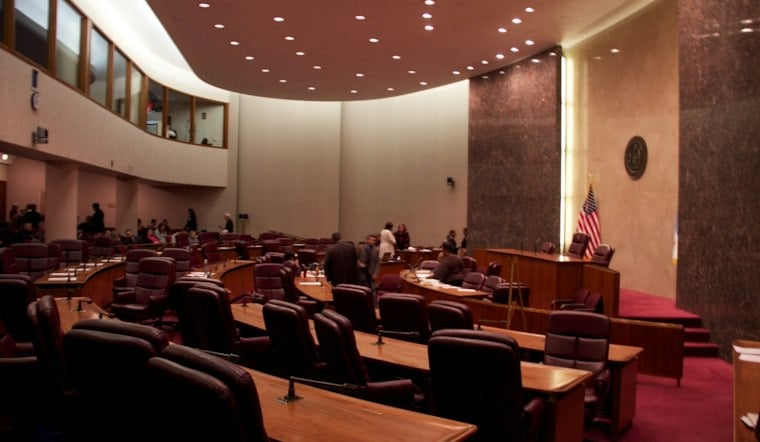
Chicago's housing shortage has a culprit that goes well beyond vacant lots and construction costs, according to a new report from the Metropolitan Planning Council: the decades-old custom of aldermanic prerogative, which lets individual ward alderpersons approve or kill development projects largely unchecked by their City Council colleagues. The 80-page report, developed over three years, argues that this hyperlocal veto power produces political infighting rather than common-sense policymaking, and it lands as Chicago heads toward a municipal election next spring where housing is shaping up to be a flashpoint issue.
A Zoning Code Showing Its Age
As reported by the Chicago Tribune, the Metropolitan Planning Council recommends more than a dozen changes to the city's zoning code, including allowing four-flats by default on residential lots that currently permit mostly single-family homes, and letting apartment buildings rise up to six stories by-right near rail stations and high-volume bus corridors. Metropolitan Planning Council President and CEO Dan Lurie told the Tribune the report initially carried the working title “This Isn't Working,” capturing what he described as the frustration behind the research. The group also produced a 50-page zine meant to walk ordinary residents through a zoning process that can otherwise require expensive attorneys or permit expediters to navigate, per the same account.
The scale of the bureaucracy is part of the problem, according to the report: Chicago's zoning code contains at least 67 zoning districts, 28 geographic overlays, and 180 specific land-use types, and getting a project approved can mean navigating at least five separate government decision-making bodies. The city's current code dates to a comprehensive rewrite adopted in May 2004 under Mayor Richard M. Daley, which itself replaced a framework that had been in place since 1957, according to the Metropolitan Planning Council. That 2004 overhaul introduced pedestrian design streets and transit-oriented parking reductions but preserved widespread single-family zoning designations, and the code has not received a comprehensive rewrite since.
How Aldermanic Prerogative Shapes What Gets Built
Aldermanic prerogative itself is not written into city law. It is an unofficial system in which colleagues on the City Council generally defer to whichever alderperson represents the ward where a project is proposed, letting that single member approve or reject it. The practice has drawn federal scrutiny before: in November 2023, the U.S. Department of Housing and Urban Development issued a formal finding that the custom violated federal civil rights laws by enabling ward alderpersons to block and downsize affordable housing proposals in predominantly white neighborhoods, following a 2018 complaint filed by the Chicago Area Fair Housing Alliance and nine other advocacy groups, according to Sun-Times Media Wire.
That federal investigation did not result in binding changes. In July 2025, HUD prepared to dismiss its long-running civil rights probe into aldermanic prerogative under the Trump administration, prompting local housing advocacy organizations that had previously sought a binding federal consent decree to abandon the federal process and instead pursue direct policy negotiations with City Hall, according to The Real Deal. That shift effectively placed the burden of reform back on the City Council itself.
Discretionary Approvals Dominate New Construction
Chicago's reliance on case-by-case approvals has become the norm rather than the exception for multi-family housing. Between 2006 and 2024, nearly 60% of all new housing units citywide — and more than two-thirds of units in buildings with five or more homes — were built through the discretionary Planned Development process, because standard zoning prohibits multi-family housing on most residential land, per the Metropolitan Planning Council's April 2025 research. Planned Developments require heightened public review and full City Council approval, adding time and uncertainty to projects that might otherwise move through as a matter of right.
That bottleneck shows up in the numbers. Chicago issued just 1.36 residential building permits per 1,000 residents in 2023, far below the average of 4.71 permits per 1,000 residents across the nine other largest U.S. cities, according to an Illinois Policy Institute analysis that cited low overall permit volume as a major driver of the region's affordability pressure. The Chicago metro area lacks roughly 230,000 affordable rental homes for very low-income households, according to figures attributed to the National Low Income Housing Coalition in the Tribune's reporting.
Recent Reforms, and Where They Fall Short
City leaders have not ignored the problem entirely. Mayor Brandon Johnson launched the Cut the Tape initiative to address development bottlenecks, and by May 2025 — one year after the effort began under Executive Order 2023-21 — the city reported that over 90% of its 107 recommendations were completed or in progress. Independent analyses noted, however, that many completed items established committees and digital portals rather than enacting broad zoning overhauls, per the Tribune's reporting on the Metropolitan Planning Council findings.
Under former Mayor Lori Lightfoot, who prioritized tackling aldermanic prerogative and spurring housing and business projects on the South and West sides, the city enacted the Connected Communities Ordinance in July 2022. The ordinance allows a full City Council up-or-down vote on large affordable-housing proposals in high-cost, transit-rich areas, including an inclusionary application mechanism that can force a vote in the Committee on Zoning if the committee sits on a qualifying project for 300 days, according to DLA Piper. More recently, Chicago's permanent Accessory Dwelling Unit ordinance took effect in April 2026 after a 46-0 City Council vote, expanding eligible parcels for coach houses and basement conversions from 116,000 under a pilot program to more than 320,000 parcels citywide, ending a prohibition on new coach houses that had stood since 1957. Even so, several aldermen opted out of the citywide coach-house and ADU program when it took effect, and single-family residential zones outside the original pilot areas still require local alderpersons to opt in, leaving aldermanic prerogative intact over single-family blocks in 16 of the city's 50 wards.
Political Will and the Road Ahead
Metropolitan Planning Council Director of Housing and Community Development Emily Bloom-Carlin told the Tribune that investors, developers and housing providers have long reported that building in Illinois is difficult and unpredictable, but that political will for large-scale change is shifting amid the national affordability crisis and successful programs addressing the housing shortage. She noted that some newer alderpersons prefer focusing on large, meaningful work rather than approving individual permits and zoning requests one at a time.
Beyond housing density, the report also recommends allowing beauty and nail salons, barber shops, tattoo parlors and outdoor patios by-right instead of requiring approval from the Chicago Zoning Board of Appeals, which currently decides whether such businesses and patios can be built — the report argues for by-right approval for uses that typically clear the board easily anyway. The politics extend beyond city limits, too: some Illinois municipalities have opposed Governor JB Pritzker's housing plan as an intrusion into local decision-making. Lurie said he hopes the report provides a foundation for candidates on next spring's municipal ballot to make their housing positions known, adding that real reform will require City Council participation and a broader shift in Chicago politics. Chicago, he and the report's authors argue, is approaching a looming affordable-housing inflection point.





