

























































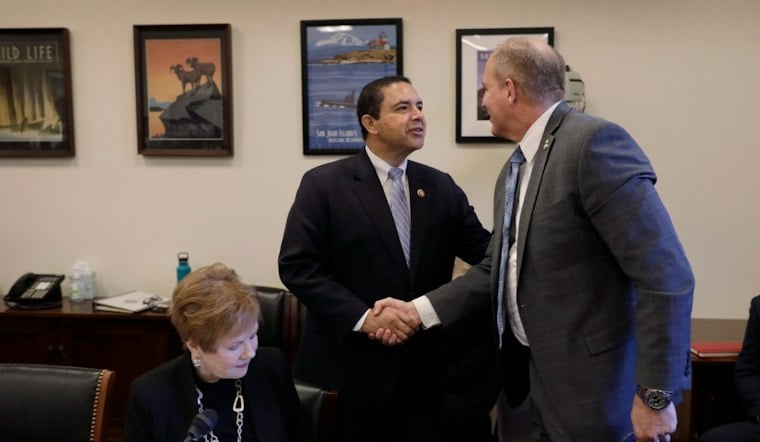
Henry Cuellar stood before regional business leaders and local elected officials this week holding a ceremonial check for $1,649,327,476 — secured federal transportation funding earmarked for Hidalgo County infrastructure projects. The moment came during the Rio Grande Valley Partnership's infrastructure summit, held Tuesday at the Mission Event Center, where officials laid out a pipeline of road, bridge and corridor work stretching across the region.
According to Texas Border Business, Cuellar announced about $1.65 billion in federal transportation funding for Hidalgo County, framing it as roughly 70% of the transportation investment currently under discussion, with state and local governments expected to cover the rest. As reported by the Rio Grande Guardian, Cuellar is a Democrat representing Laredo who addressed the summit directly, telling attendees that federal dollars account for roughly 70 percent, or more than $1.6 billion, of a broader regional infrastructure project portfolio.
Hidalgo County Judge Richard Cortez, who introduced Cuellar before his remarks, told the crowd that reliable water supplies, electricity, workforce availability, quality of life and efficient transportation all factor into the region's economic competitiveness, per the same Texas Border Business account. Cortez also recalled that his professional relationship with Cuellar dates back to 2005, when he was first elected mayor of McAllen — the same year Cuellar entered the U.S. House of Representatives, according to the Rio Grande Guardian.
Seniority and Timing on Capitol Hill
Cuellar emphasized that federal reauthorizations and upcoming annual appropriations need to be secured before end-of-year deadlines in order to keep South Texas transportation corridors moving forward, the Rio Grande Guardian reports. He told the summit that the Texas delegation in the House and Senate must first pass transportation funding before the state can distribute it — underscoring how much of the region's infrastructure timeline hinges on decisions made far from the Rio Grande Valley.
During his remarks, Cuellar thanked Texas Transportation Commissioner Alex Meade and TxDOT Pharr District Engineer Pete Alvarez, along with local officials, for advancing regional transportation projects, the same account notes. Alvarez, for his part, identified a slate of priority corridors at the summit — U.S. highways 77 and 281, Interstate 2, the 365 Tollway, the International Bridge Trade Corridor and State Highway 68 — as the connective tissue tying the region's growth together.
Why Project Readiness Matters for Funding
Texas Border Business also reports that projects with completed engineering, environmental reviews, right-of-way acquisition and utility relocation have a greater chance of landing construction dollars, since TxDOT evaluates proposals using four criteria: safety, connectivity, congestion relief and economic development. One project checking several of those boxes is the International Bridge Trade Corridor/SH 68, a proposed 13.15-mile non-tolled highway through Pharr, Alamo and Donna for which the Hidalgo County Regional Mobility Authority has already completed preliminary engineering, with an estimated ultimate construction cost of $248 million.
The push for readiness tracks with how the region's funding fortunes have shifted over the past decade. Transportation funding for the TxDOT Pharr District climbed from roughly $596 million in 2015 to $1.9 billion in 2019, according to Meade, a jump that Texas Border Business ties to the 2019 consolidation of three metropolitan planning organizations into the single Rio Grande Valley Metropolitan Planning Organization.
Planning Documents Behind the Numbers
That consolidated body, the RGVMPO, maintains both a four-year Transportation Improvement Program and a 25-year Metropolitan Transportation Plan, according to its own project pages. The Transportation Improvement Program identifies construction projects across roadway, transit and active transportation categories and is revised quarterly, per RGVMPO records, which show the FY 2027-2030 version was adopted on May 20, 2026, with Amendment #1 approved September 16, 2026. The companion 25-year Metropolitan Transportation Plan, the RGVMPO's planning page notes, saw its own Amendment #3 approved the same day.
Truck traffic adds another layer of urgency to the funding conversation. Ninety-five percent of Texas's overweight or oversized truck corridors are located in the Rio Grande Valley, according to a separate account from the Rio Grande Guardian — a statistic regional officials have pointed to in making the case for continued investment in corridors like the International Bridge Trade Corridor and State Highway 68.
Not every figure lines up neatly. The Texas Department of Transportation notes that most of its projects are funded with an 80% federal, 20% state split nationwide, while the summit's framing described the transportation investment under discussion as about 70% federally funded — a discrepancy the dossier of reporting leaves unresolved. For now, the ceremonial check Cuellar presented stands as the most concrete marker of where Hidalgo County's infrastructure money is headed, even as the broader funding math among federal, state and local partners continues to take shape.





