

























































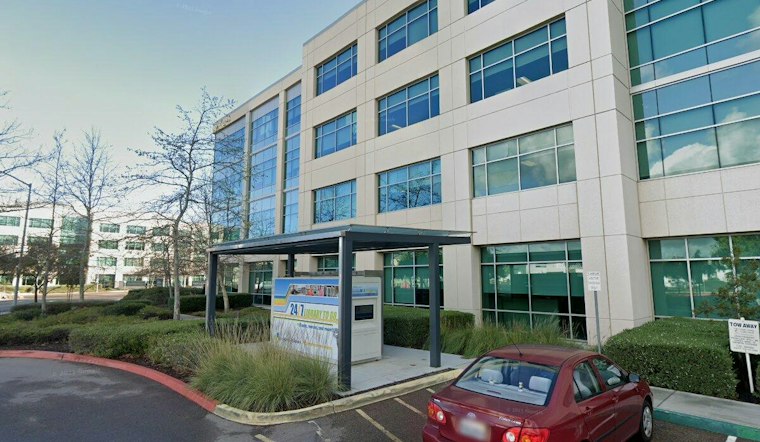
A person in immigration custody died inside a housing unit at the Otay Mesa Detention Center in San Diego on Saturday, according to private prison company CoreCivic, which operates the facility. The death, confirmed via email, adds to the number of people who have died while held by U.S. Immigration and Customs Enforcement this year.
CoreCivic told Daylight San Diego that a staff member found the detainee unresponsive in a housing unit a little after 11:30 a.m. on Oct. 24. Staff attempted life-saving measures and called emergency medical services, the company said, and emergency medical professionals ultimately pronounced the person dead at the facility. CoreCivic has not released the person's identity, gender or nationality, and directed further questions to ICE.
As of Monday evening, ICE had not published information about the death in its news releases, and the agency did not respond to a request for comment, per the same account. ICE typically reports information about people who have died in its custody, though no timeline for that disclosure was given.
A Facility Already Under Scrutiny
CoreCivic operates Otay Mesa under a contract with the Department of Homeland Security, according to inewsource.org, and the facility holds more than 1,000 immigrants a day. The federal government bought the facility from CoreCivic for $739.2 million in July, though CoreCivic expected to continue operating it through December 2029 under its existing ICE contract, inewsource reported.
A San Diego County inspection released in August found that conditions at Otay Mesa generally met state standards, but faulted the facility for failing to disclose two suspected tuberculosis cases for several weeks, the same inewsource report noted. A California Department of Justice state inspection report found that of 27 detainees who said they had requested medical or mental health care, 21 reported they did not receive the help they needed. KPBS has reported that the county's August findings specifically blamed the facility for its lack of transparency about detainee health, and separately, a California Department of Justice report found 1,433 people held at Otay Mesa during an October 2025 site visit, according to NBC 7 San Diego.
Part Of A Broader Pattern Of Deaths In ICE Custody
The Otay Mesa death would bring the number of known ICE-custody deaths in 2026 to at least 30, according to the National Immigration Project of the National Lawyers Guild, which tracks the tally as of Oct. 26. That follows 33 detainee deaths reported by ICE in 2025, the highest total in more than two decades, the group said.
The most recent ICE-listed death before Otay Mesa happened at a facility in Georgia on Oct. 23, when an immigrant detained at the D. Ray James facility in Folkston died, as reported by The Guardian. ICE identified that detainee as 48-year-old Luis Sandoval of El Salvador and said facility staff found him with a ligature around his neck; a local sheriff's office requested that the Georgia Bureau of Investigation open an in-custody death investigation. Researcher Austin Kocher told The Guardian that ICE custody deaths in 2026 have averaged one every 10 days.
What Happens Next
Under its published protocol, ICE requires the field office director overseeing the relevant facility to report any detainee death within 12 hours to the agency's Assistant Director for Field Operations, Custody Management, the Joint Information Center and the Office of the Principal Legal Advisor, according to U.S. Immigration and Customs Enforcement. The agency's guidance also describes conducting medical reviews under those protocols, though no further details about this case have been made public.
This remains a developing story that may be updated as more information becomes available, and no additional confirmation of the detainee's identity or cause of death has surfaced since CoreCivic's initial statement.





