

























































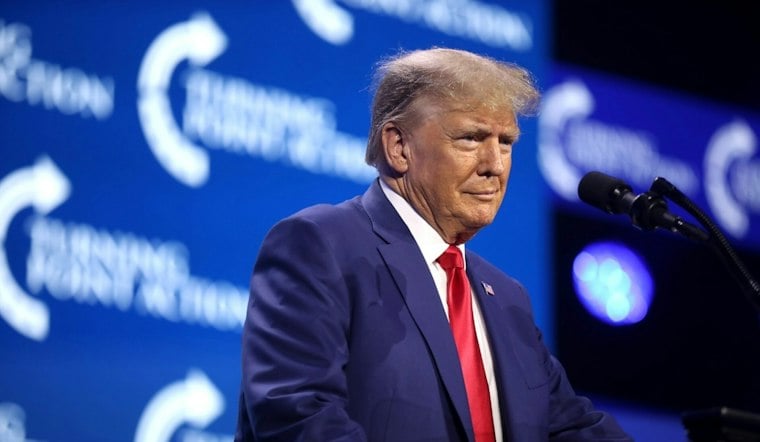
Byron Donalds stood alongside President Donald Trump in front of thousands of supporters in Daytona Beach and declared that his vision for Florida, not his race, is what should earn him the governorship. The Naples congressman, who is of Jamaican and Panamanian descent, is trying to become the state's first Black governor, and he's doing it while fending off a pointed accusation from his Democratic opponent, David Jolly, that his policies are anti-Black.
Donalds Draws a Line Between Identity and Platform
Speaking at the Friday rally, Donalds told the crowd that it is his plan for a free Florida that matters, not where voters come from or what they look like. As reported by MyNews13, Donalds said, “That is what qualifies me to be your next governor.” The rally drew thousands of attendees, according to the same report, which also noted that more than half of Florida's GOP primary voters had picked a candidate other than Donalds earlier in the race.
A day earlier, at a campaign stop in Hialeah, Donalds offered a more pointed defense, saying his potential historic election would reflect Floridians' desire to entrust him with the state's future. He reiterated his belief in a meritocratic system, telling supporters that Republicans believe in the merit, talent and ability of all people, and that Democrats should not lecture people on race, according to the Miami Herald's reporting by Churchill Ndonwie.
Jolly's Anti-Black Accusation, Repeated and Specific
Jolly has not let up. “I do think his policies are anti-Black,” he said, as quoted by Florida Politics. Jolly ties that charge to specifics: he says Donalds voted against the Voting Rights Act and would continue to limit access to capital and credit for minority-owned businesses, arguing, “When he votes against the Voting Rights Act. When he votes to end access to capital.”
Jolly also went after Donalds over Florida A&M University's claim that it is owed $2 billion, saying Donalds brushed off questions about it by responding, “Well, I don't know. I'll have to look into it,” per Florida Politics. The two campaigns had discussed holding a debate at FAMU but ultimately couldn't agree on a schedule or format, the outlet reported. Donalds separately faced criticism at a FAMU town hall over his support for changes to how race is taught in Florida's public schools, his backing of efforts to dismantle diversity initiatives, and Trump's immigration crackdown, according to a report from ms.now.news.now.news.
A Civil Rights-Era Clash and a Half-True Rating
Donalds has countered by invoking the GOP's own civil rights history, saying the Republican Party was formed to free enslaved people and that Republicans fought for civil rights in the United States. He has argued that Republicans ensured the Civil Rights Act and Voting Rights Act passed Congress while Democratic senators filibustered the Civil Rights Act. The House did pass the John R. Lewis Voting Rights Advancement Act in 2021, according to House Clerk records, which include an individual roll-call record for the 2021 vote.
Jolly has also compared Donalds to Supreme Court Justice Clarence Thomas, suggesting that making history as a first does not automatically mean the history is good. “He's reaching for history. Well, Clarence Thomas made history as well,” Jolly said, per Florida Politics. Separately, PolitiFact rated Jolly's claim that Donalds suggested there were good parts of Jim Crow as “Half True,” according to WLRN. The fact-checkers found that Donalds' 2024 remarks centered on Black family unity and conservative voting patterns during the Jim Crow era rather than praise for its racist policies, writing, “He wasn't praising the racist policies of the era, as Jolly's statement implies.”
Polls Diverge Sharply on Black Voter Support
The numbers tell a complicated story. A Stetson University poll found Jolly with 68% support and Donalds with 29% among Black voters, even as that same survey showed Donalds leading Jolly overall, 52% to 41%, among modeled likely voters statewide, according to Stetson University. About 5% of respondents remained undecided in the governor's race overall, with another 3% backing a different candidate, and cost of living and inflation ranked as the top concern for 40% of likely voters.
Other surveys cited by Florida Politics show even wider gaps among Black voters specifically. A St. Pete Polls survey found Jolly leading Donalds among Black voters 76% to 18%, with a small number undecided, while an earlier St. Pete Polls survey in the race had Jolly at 65% and Donalds at 14%, with 16% undecided. A Mason-Dixon poll put the gap at 76% to 10%. Jolly has cited the 76% figure himself, telling ms.now.news.now.news that about 10% of Black voters remain undecided.
A Divided Community and a Slim Electorate
Black Floridians make up only about 13% of the state's active voters, a slim but potentially decisive bloc, according to ms.now.news.now.news. The outlet also discussed unemployment and reported that Donalds' candidacy has divided the Black community, with some critics citing his close ties to Trump and his opposition to diversity, equity and inclusion initiatives while his own Black supporters have reportedly faced questioning of their blackness and racial slurs.
Jolly, for his part, has argued that Black voters should consider Donalds' positions on voting rights and capital access for minority-owned businesses when assessing his potential historic candidacy.
History offers a mixed signal for both camps. In 2018, Democrat Andrew Gillum lost to Ron DeSantis by less than a percentage point, per ms.now.news.now.news reporting.





