

























































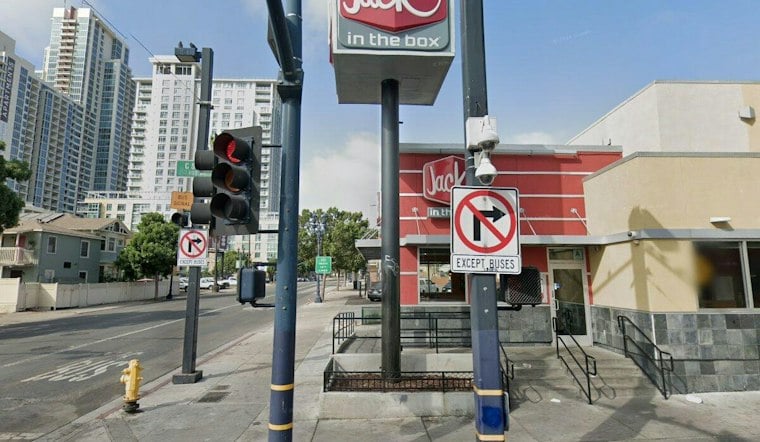
Customers outside a downtown San Diego Jack in the Box say they have been getting soaked without warning by building-mounted sprinklers that kick on alongside a recorded voice telling people to buy something or leave. The spray has reportedly hit paying customers and passersby alike, catching them off guard as they walked near the restaurant.
The sprinklers began running sometime during the week before the report, cycling through three areas around the building with several minutes between each spray, according to 10News. The water activates alongside a 25-second recorded announcement that opens and closes with warnings directed at loiterers, per the station's reporting.
That recording does not mince words. It tells people near the building: “You are blocking the drive-thru … Buy something or bounce. The clown is watching … Move. Now. Jack says so,” according to the outlet's account — a reference to the chain's longtime clown mascot.
Customers Say They Were Caught Off Guard
Brandi James said she was drenched just after leaving the restaurant with a meal, with her electric bike parked on the steps nearby. “There was water coming down, sprinkling all over me and my bike,” James said, per the same report. She said the soaking damaged the bike and left it squeaking when she tried to ride it afterward, and she called the sprinkler system harassment, adding that she is a paying customer who spends money at the restaurant every day.
Donica McArthur, who is not homeless, said she was also drenched and that the system gave no warning or countdown before it activated. She said it showed no consideration for people in the area and left her feeling disrespected and in shock, calling the whole setup inhumane, the station's report notes.
Jack in the Box Disavows the Recording
In a statement to the outlet, Jack in the Box said the voice recording does not reflect the company's brand standards or values and was never approved by the company, adding that it was disabled immediately once flagged. The location uses an audio-based device intended to help maintain a safe, clean and comfortable environment for guests and employees, the company said, though it distanced itself from the specific wording used in this case.
Jack in the Box described the water system itself as a ground-surface cleaning mechanism that automatically cleans the area between routine pressure washing, and said it is not positioned to interfere with guests or passersby. The company said it recognizes the importance of treating people in its communities with dignity and respect, while also saying it supports measures that keep the neighborhood peaceful and the restaurant clean, safe and comfortable for guests and employees.
A Familiar Tactic in Public Spaces
Sprinklers aimed at discouraging loitering are not new. A Skid Row store owner named Jack Simone installed electrically powered roof sprinklers decades ago to disperse people gathered outside his business, using them when fights broke out or when alcohol and drug use spilled onto the sidewalk, according to a 1992 account from the Los Angeles Times. Similar pavement sprinklers have since appeared outside the Strand bookstore in New York, a fashion retailer in Hamburg and government offices in Guangzhou, spraying intermittently and soaking people along with their belongings, according to The Guardian, which describes the broader use of such features as “defensive” or “disciplinary” architecture.
The pattern has shown up closer to home, too. A hotel on San Francisco's Eddy Street reportedly installed sprinklers to douse homeless people sleeping nearby before later announcing plans to remove them, while a Chevron station on Van Ness Avenue installed a sonic device aimed at deterring loiterers who might harass or threaten employees, according to the San Francisco Standard. A city homelessness official cited in that report described such devices as examples of “hostile architecture” meant to push people out of a given space.
Whether the downtown San Diego installation runs afoul of any local rule remains unclear. A city code excerpt addressing the washing of sidewalks, driveways and other paved surfaces states that such washing is generally allowed only to address immediate safety or sanitation hazards, according to San Diego Municipal Code documents, though how that provision might apply to this particular system has not been established.




