

























































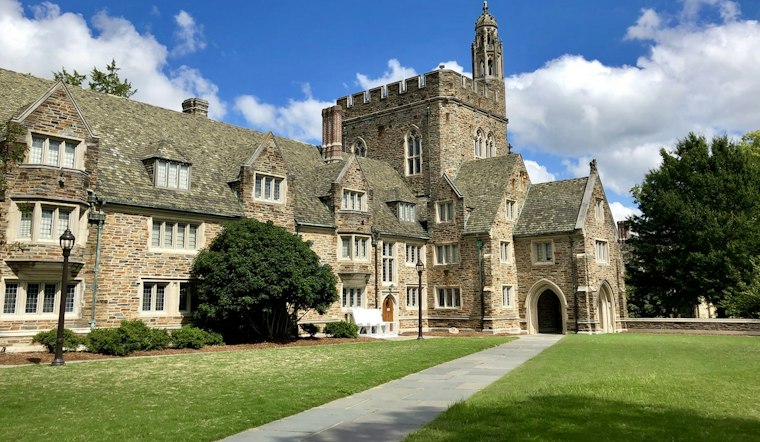
Duke University students organized a protest on campus Thursday in solidarity with a Cornell student known as Jane Doe, who says she was raped by at least seven fraternity brothers over one night in October 2024 — but the private university barred outside media from attending.
Duke spokesperson Gregory Phillips told the Raleigh News & Observer by email that the event was for the Duke community and outside media would not be admitted. The paper reported that it planned to follow social media livestreams and interview students by phone after the rally. Duke had not provided the paper with an explanation of how the media-access decision was made by publication time.
The News & Observer reported that Sunrise Duke and Duke Planned Parenthood Generation Action organized the rally, which was publicized through a press release and social media posts. Organizers called on Duke to address rape culture, strengthen prevention of gender-based violence and support survivors. In a statement quoted by the paper, they wrote: “so many of us on this campus are Jane Does and love Jane Does.”
Student Organizer Pushes Back on Media Blackout
Karlin, a senior and Sunrise Duke leader, told the News & Observer that organizers wanted media coverage and that the community had a right to know what was happening on campus. Karlin also criticized Duke policies as obstacles to student organizing, press access and change. The paper reported that Karlin said students were not being silenced in response to sexual violence.
The News & Observer reported that the rally included speeches, a march, an open mic and questions from the Duke Chronicle. The student newspaper was the only outlet with in-person coverage, the paper said; outside media had been excluded.
Duke's Registration Rules Loom Over Student Activism
The News & Observer reported that Duke required organizers to register the rally at least two weeks in advance and that students who do not follow the protest policy may face disciplinary action. The paper said the application asks organizers for the anticipated crowd size, expected noise levels, a protest plan, a site map and a designated point of contact.
Duke's event policy, published by Duke Student Affairs, says all events must be registered and approved in advance, with outdoor event requests submitted at least 15 days ahead of time. Separately, the Duke Community Standard states that every student is required, as a condition of enrollment, to comply with its rules — which do permit banners, signs and flags at protests, though chalking is banned on any campus surface, including sidewalks, archways and benches.
According to the News & Observer, a faculty committee that compared Duke’s rules with those at 10 peer schools found the registration requirement unusual among comparable universities. The paper also reported that Duke said no students had been found responsible for violating the protest policy in the previous two years.
Rules and campus data require context
The comparison reported by the News & Observer focused on Duke and 10 peer schools. Separately, UNC-Chapel Hill’s demonstration guidance—not Duke’s policy—says violations of its Use of University Property Standard can lead to removal, a trespass notice, internal discipline, citation or arrest, according to UNC-Chapel Hill Free Speech. Campus crime reports and surveys also measure different things. Cornell says its Annual Security Report covers reported Clery Act crimes from the previous three calendar years across specified campus, noncampus and adjacent public-property locations, according to Cornell University Division of Public Safety. Those figures are not campuswide prevalence estimates or findings about Jane Doe’s allegation. The Association of American Universities’ 2019 report found no relationship in its analysis between official crime statistics and survey prevalence rates, underscoring that the measures are not interchangeable.
Cornell Case Has Sparked Protests Nationwide
The Duke rally responded directly to the case at Cornell University, where the student known as Jane Doe has alleged she was raped by at least seven fraternity brothers in October 2024. Cornell hosted a protest with thousands of participants in Ithaca this month, and CNN reported that demonstrators rallied Monday under the banner “Justice for Survivors.” Time reported that hundreds of students, faculty members and other supporters gathered that day in front of the school's student center.
More than 100 Cornell students also staged a seven-hour sit-in at a dining hall as part of “Zero Day,” an economic blackout urging students not to attend class or spend money on campus, according to CBS News. A 2025 Cornell survey cited in that report found that more than one in three undergraduate women reported nonconsensual sexual contact involving force or incapacitation since enrolling. In a follow-up report, CNN said Cornell students described their trust in the administration as “really low” and said the protests were meant to pressure administrators into changing their response.
The protests have extended beyond Ithaca and Durham. CBS News reported that Columbia University students and professors held a rally in Manhattan calling for a stronger response to sexual-violence cases. Thursday’s demonstrations also coincided with a nationwide day of action called #StopSexualViolence: From the Frat House to the White House. Free Speech For People said the action brought survivors of sexual assault and their allies together on college campuses across the country.



