

























































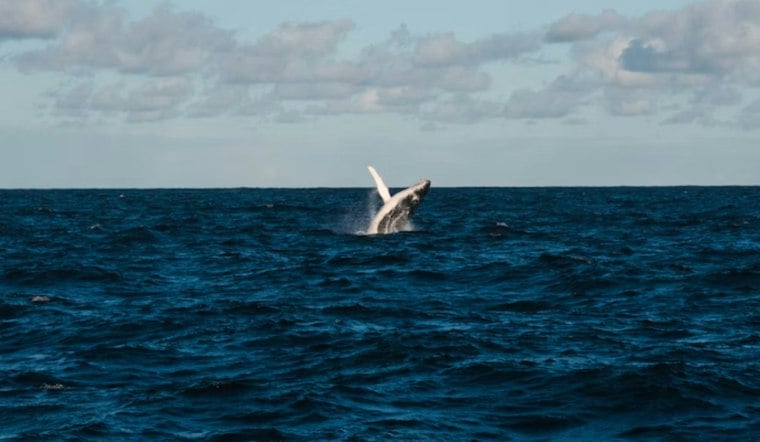
A humpback whale dragging a commercial fishing net across its body, pectoral fins and tail was spotted struggling off the Los Angeles coast this week, prompting a wildlife rescue attempt that ultimately had to be called off as weather conditions deteriorated. The whale was last seen heading south through the San Pedro area, and officials are now asking boaters and beachgoers to help relocate it.
The entanglement was first reported by Harbor Breeze Whale Watching Tours, whose crew spotted the whale off Palos Verdes before it later turned up near Point Fermin in San Pedro, according to KTLA. A spokesperson for the tour company said the whale “was definitely struggling and was restricted in its movements,” the outlet reported. The net had wrapped around the animal's midsection, pectoral fins and part of its tail, limiting its ability to swim, surface for air, or feed.
Rescue Attempt Hampered by Weather and a Moving Target
Wildlife experts attempted to free the adult humpback from the gillnet but were unable to remove the gear, per Sarah Mesnick, a NOAA Fisheries ecologist, as quoted by the same outlet. The rescue team made multiple attempts to reach the trailing lines and also tried to attach a satellite tracking tag so responders could relocate the whale later, but the animal's behavior combined with rough water and weather conditions hampered both efforts. The team called off the rescue late Thursday afternoon as conditions worsened further, and the whale was last seen moving south through the San Pedro area.
This is not the first time this particular whale has been tracked moving down the coast. It was previously spotted off Humboldt County on August 22 and again near San Luis Obispo on September 20, before the entanglement was confirmed off Los Angeles around October 1. Wildlife officials hope the whale will resurface somewhere along the coast so a trained team can attempt another rescue. NOAA Fisheries is asking the public to report sightings to its entanglement hotline at (877) 767-9425.
Why Civilians Can't Step In
Federal law strictly prohibits untrained members of the public from attempting to disentangle a marine mammal themselves. Official rescue operations in California are legally restricted to trained teams working under a specific federal authorization, in this case NOAA Permit #24359, according to NOAA Fisheries. Unauthorized attempts carry federal civil and criminal penalties, and the restriction exists because disentanglement work is physically dangerous for both the responders and the whale, requiring specialized cutting tools and careful timing around an animal that can thrash or dive unpredictably.
That danger was on full display in August, when a NOAA-permitted team off Westport, Washington, successfully freed an adult female humpback that had been found hog-tied in heavy commercial gear with lines running through her mouth and tail, a case Hoodline covered in detail after a local angler's tip led responders to deploy specialized cutting tools and satellite tracking buoys. That operation succeeded; the San Pedro case remains unresolved, with the whale still trailing gear somewhere along the Southern California coast.
A Pattern Along the Southern California Coast
The San Pedro sighting follows a dead juvenile humpback that washed ashore on the Balboa Peninsula in Newport Beach in February, where teams from the Pacific Marine Mammal Center and NOAA performed necropsy sampling as part of a broader investigation into the cause of death, Hoodline reported at the time in its coverage of the stranding on the Balboa Peninsula. Humpbacks foraging off Southern California belong to two protected groups under the Endangered Species Act: the endangered Central America population, which relies heavily on these waters, and the threatened Mexico population, according to NOAA Fisheries.
Research published in PLOS Climate in February found that marine heatwaves suppress coastal upwelling and cause “habitat compression,” squeezing krill and anchovy into narrow nearshore corridors and pushing whales directly into active commercial fishing zones. That dynamic has reshaped feeding patterns off California since 2014, and it helps explain why entangled whales keep turning up close to shore rather than farther offshore where fixed gear is less common.
The Numbers Behind the Trend
NOAA Fisheries confirmed 76 large whale entanglements nationwide in 2025, down from 95 in 2024 but still above the 18-year historical average of 72.7 cases annually, with gear entanglement identified as a leading human-caused threat to large whales in U.S. waters. On the West Coast specifically, federal data compiled by the Center for Biological Diversity showed 33 confirmed entanglements in 2025 following 34 in 2024, with humpback whales accounting for the vast majority of those cases. Entanglement remains a threat to marine mammals.
State regulators have been tightening rules in response. The California Department of Fish and Wildlife updated its Risk Assessment Mitigation Program for the 2025–2026 season. On September 27, Governor Gavin Newsom signed Senate Bill 1393, extending that mitigation program through 2040 and updating transit rules for commercial vessels near closed zones, according to SeafoodSource. For now, the San Pedro whale remains untagged and unaccounted for, and wildlife officials are counting on another sighting to give a trained team a second chance.



