

























































Flagstaff’s 25th anniversary as the world’s first International Dark Sky City puts a decades-long effort to protect its night sky in focus as the Flagstaff Science Festival closes this weekend. Telescopes, scientists and a free star party at Buffalo Park are part of the festival’s finale, which runs through Sunday.
The festival, billed as the nation’s longest-running free science festival, has built much of this year’s programming around Flagstaff’s dark-sky status, according to Arizona's Family. The anniversary marks the city’s 2001 designation as the world’s first International Dark Sky City, following a proposal from the Flagstaff Dark Skies Coalition, as summarized in Wikipedia’s account of Flagstaff.
A Quarter-Century of Protecting the Night
Flagstaff’s dark-sky protections began well before its 2001 designation. The city limits outdoor lighting, and its street lights have a distinctive orange glow. The City of Flagstaff’s lighting history traces the effort to Ordinance 400, passed in April 1958 to address high-intensity commercial searchlights and protect observations at Lowell Observatory. The city and Coconino County later approved zoning codes restricting outdoor light per acre in 1989.
What Flagstaff’s lighting rules cover
The city’s history distinguishes the 1958 ordinance addressing searchlights from the 1989 zoning codes restricting outdoor light per acre. Today, the municipal code requires an outdoor lighting permit before installing, modifying or replacing covered outdoor fixtures, according to the City of Flagstaff Municipal Code. The National Park Service reports that satellite data showed continuously lit areas brightening globally at 2.2% per year from 2012 to 2016, and identifies Flagstaff among places where lighting regulations have been created and enforced. The global rate is not a measurement of Flagstaff specifically.
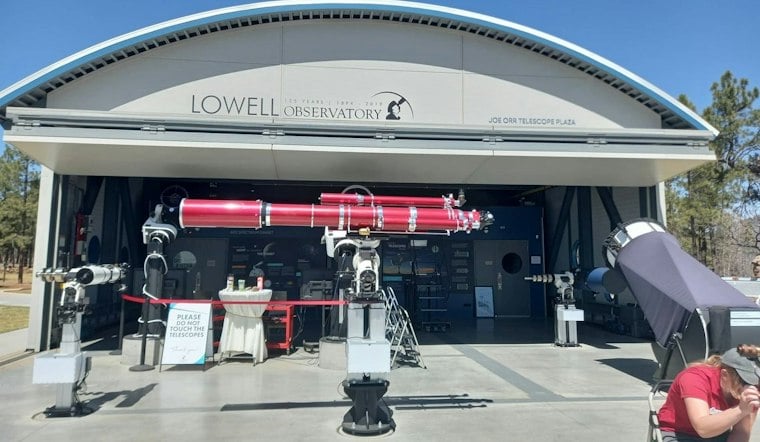
Lowell Observatory has studied the stars above Flagstaff since 1894, with scientists there credited with discovering Pluto and finding evidence that the universe is expanding, per the same account. The observatory also helped establish Flagstaff as the first International Dark Sky City. Kevin Schindler, Lowell Observatory's historian, said the science festival gives the public a rare look at what researchers usually do behind closed doors, and he described dark skies as what makes astronomy special in Flagstaff.
Why the Dark Still Matters
Flagstaff’s policies stand against a wider pattern of growing light pollution. The National Park Service reports that satellite data showed continuously lit areas brightening globally by 2.2% per year from 2012 to 2016, while identifying Flagstaff among places where lighting regulations have been created and enforced. Separately, DarkSky International traces its certification program to Flagstaff’s 2001 designation; the program now includes more than 200 cities worldwide and covers more than 160,000 square kilometers across 22 countries.
Lowell Observatory was founded by Percival Lowell, who believed science should be shared with everybody — a philosophy that still threads through the observatory's public programming today. Sam Lockhart, who studies planetary science at Northern Arizona University, said Flagstaff's protected dark sky was part of what drew him to the city in the first place. Lockhart pointed to the community's collective awareness and willingness to protect its night skies and stay connected to the cosmos as something that sets Flagstaff apart.
STEM Roots Run Deep
Flagstaff's astronomy identity is tied to a broader STEM push: the city was designated the nation's first STEM Community, a status formally declared in 2012 by civic and educational leaders aiming to weave science, technology, engineering, and math programming across K-12 schools and university curricula, according to the City of Flagstaff's STEM designation records. Flagstaff hosts 15 public schools alongside Northern Arizona University and federal scientific agencies, giving the city an unusually dense concentration of science infrastructure for its size.
That infrastructure keeps expanding. Lowell Observatory opened the 40,000-square-foot, $53 million Marley Foundation Astronomy Discovery Center on Mars Hill in November 2024, featuring an open-air rooftop planetarium and a multi-story LED theater, as reported by the Sedona Red Rock News. The investment reflects just how much weight Flagstaff's astronomy sector carries statewide — Arizona's astronomy facilities represent more than $1.2 billion in total investment and support over 3,300 jobs, according to figures from the Arizona State Legislature.
The Festival's Final Stretch
The festival’s final weekend includes a free star party at Buffalo Park, where attendees can look through more than a dozen telescopes. The Flagstaff Science Festival wraps up Sunday. Schindler, speaking to Arizona’s Family, described Flagstaff’s scientific work as ongoing rather than a historic footnote.
Hoodline previously covered how the world's first Dark Sky City status continues to ripple outward into other communities' own astronomy events, a reminder that Flagstaff's 1958 and 1989 lighting ordinances didn't just earn a single designation — they set the template that more than 200 cities worldwide have since followed.



