

























































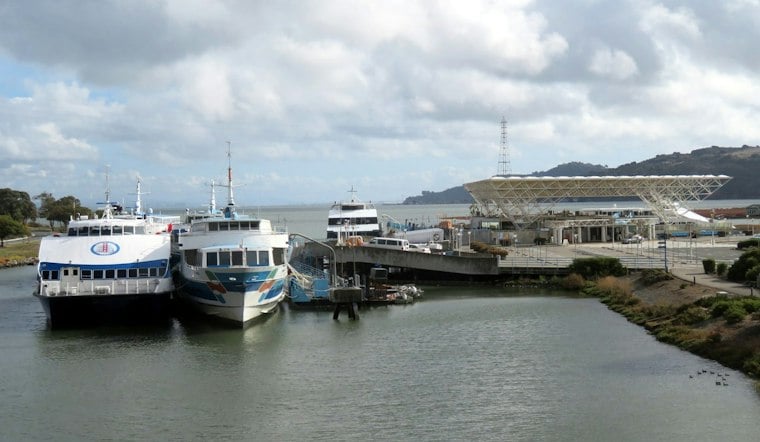
An engine breakdown on the M.V. Napa has knocked four Golden Gate Ferry vessels out of commission at once, forcing commuters between Marin County and San Francisco onto slower replacement buses with far less room for bikes. The Napa was pulled from service on October 18 after its engine failed, and the ripple effects are still being felt across the Larkspur, Tiburon, Angel Island and Sausalito routes more than a week later.
The breakdown could not have come at a worse moment, since three other vessels were already drydocked for routine inspections and maintenance when the Napa went down, according to Marin Independent Journal. That left Golden Gate Ferry with four of its seven vessels sidelined simultaneously, disrupting schedules throughout Marin County and San Francisco starting October 19. The district responded by releasing a temporary weekday schedule covering Larkspur, Angel Island, Tiburon and Sausalito that remains in effect until further notice, though Saturday and Sunday service is unchanged.
Which Trips Are Canceled or Bused
The cuts are concentrated on weekday commuter runs. Canceled trips include two evening departures serving Larkspur, one morning trip serving Tiburon, and four trips serving Angel Island, the outlet reports. Eleven more Larkspur trips — five departing and six arriving — have been reassigned to buses, while nine Tiburon trips are also being substituted with bus service.
The swap comes with real costs for riders. Bus trips take roughly 55 minutes compared with about 35 minutes by ferry, and buses carry far less capacity for bikes than the boats do. Sausalito has fared better: no trips there were canceled or replaced with buses this week, though departure and arrival times have been adjusted. Golden Gate Transit is providing the replacement bus service for most trips where a ferry isn't available, and some passengers have already begun adjusting their routines to catch an earlier or later run instead.
Why the Napa Is Out Until Spring
The Napa, a high-speed catamaran that can carry 450 passengers, was already scheduled for replacement of its four engines next year. Rather than patch the broken engine and revisit the work later, the district decided to carry out a full $3.5 million overhaul while the boat is already out of the water, spokesperson Paolo Cosulich-Schwartz told the Marin Independent Journal. That cost covers shipyard work, inspections and testing, and any additional repairs tied directly to the failure are expected to be covered under warranty, per Cosulich-Schwartz. The vessel is expected to return to service in spring 2027.
Two of the other sidelined boats should be back much sooner. The M.V. Golden Gate is expected back in service next week, with the M.V. Del Norte following the week after, according to the same report. Cosulich-Schwartz said regular schedules should resume once the Golden Gate is running again, though the district acknowledged that disruptions like these can frustrate riders. The other drydocked vessels, besides the Napa, are the Del Norte, the Golden Gate and the M.S. San Francisco, a Spaulding-class boat; the district said ferries are required to go through drydocking every 24 months and tries to avoid pulling more than one vessel of a given class at a time, while also prioritizing that work outside the baseball season when extra capacity is needed. Many drydocking projects take several months, and the district said it isn't always able to keep spare vessels on hand for breakdowns.
An Aging Fleet Awaiting Replacement
Golden Gate Ferry's current fleet includes three Spaulding-class boats built in the 1970s, which are used for Larkspur service and are larger and slower than the four high-speed catamarans built in the late 1990s and early 2000s, including the Napa. The district relies on Spaulding vessels for Larkspur runs in part because of design limits among the catamarans; separately, only two of the four catamarans can currently dock at both Tiburon and Sausalito because of design differences among the boats, according to The Ark.
That patchwork is part of why the district approved a plan in November 2025 to spend more than $118 million to begin replacing its vessels. The district is building two new 500-passenger, high-speed, low-emission ferries, and Cosulich-Schwartz has said the district has contracts in place to replace its entire fleet and will keep building new boats as funding allows. A board document from the Golden Gate Bridge, Highway and Transportation District states the replacement push is driven by California Air Resources Board commercial harbor craft regulations combined with the advancing age of the fleet, and the program covers construction of two sister ships with options for up to six more, according to Golden Gate Bridge, Highway and Transportation District records, which also show the district awarded Mavrik Marine Inc. a contract worth $92,429,639.02 for the two new sister ships, pending a satisfactory Buy America audit.
The new hull design is projected to burn about a third less fuel than the current boats while cutting nitrogen oxide emissions by 85% and particulate matter by 95%, per SFGate. Delivery timelines differ slightly depending on the source: Marin Independent Journal reports the two replacement ferries are scheduled for delivery in 2028 and 2029, while a separate Marin Independent Journal report on the district's fleet plans states the first new Liwa-class ferry is expected in 2027 with a Del Norte replacement targeted for 2028, and SFGate likewise reports the Del Norte replacement should be ready in 2028 with new vessels arriving annually after that. The district has also said it is limited to 42 daily trips at the Larkspur terminal but expects to eventually need about 54 trips to keep pace with demand, per a separate Marin Independent Journal report. Once the standardized fleet is in place, the goal is for any vessel to serve any route, eliminating the dock-compatibility issues that currently constrain scheduling, The Ark reports.





