

























































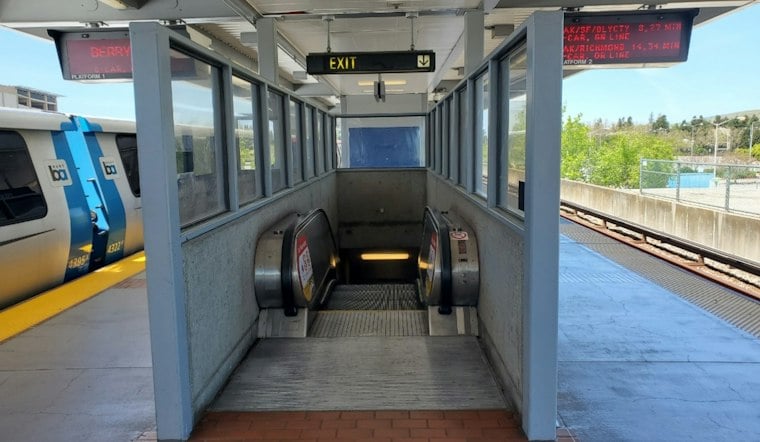
Fremont has a Tesla plant, roughly 900 manufacturers and some of the busiest advanced-manufacturing payrolls on the West Coast, but it has never had a real downtown. That could start to change under a plan taking shape at the city's BART station, where a developer team wants to build 643 homes on parking lots just north of the tracks.
BART's board of directors has selected Pacific Development and Affirmed Housing to build the project on about 12 acres of station parking in Fremont, according to the San Francisco Chronicle, which reported that the complex would include 176 affordable residential units. The Chronicle's J.K. Dineen reports the project is envisioned as a triangular complex of three buildings that would sit a 10-minute walk from Capital Avenue, the corridor the city has designated as its main mixed-use retail and residential spine.
The scale of what's being discussed lines up with action BART's board already took. Directors voted 9-0 on Oct. 22 to open exclusive negotiations with Pacific Development and Affirmed Housing for a mixed-income project and public plaza at the Fremont station, according to Coastside News, which reported BART owns nearly 8 acres for the first phase of the larger Fremont site. That outlet described the proposal as a market-rate building paired with a family-affordable building and about 5,200 square feet of nonresidential space, with the exclusive negotiating agreement running 30 months and carrying an option for an additional 18.
Why Fremont Never Got a Center of Gravity
Fremont was formed in 1956 through the merger of Centerville, Niles, Irvington, Mission San Jose and Warm Springs, and its population grew 125% over the following 50 years, per the Chronicle's reporting. The city now spans about 90 square miles and is home to roughly 225,000 residents, but that sprawling, merger-born geography is part of why it never developed a traditional downtown core.
Donavan Lazaro, who heads economic development for the city of Fremont, told the Chronicle that the city is essentially building a downtown from scratch. He said the BART station site works because it's central, walkable and offers larger parcels that sit away from single-family neighborhoods, meaning the housing push can proceed without disrupting the city's tree-lined residential streets or its office parks.
A Job Base Without a Place to Live Near It
Fremont's employment numbers are the backdrop for why BART land matters so much. Manufacturing jobs in the city rose from about 30,000 in 2018 to 65,000, the Chronicle reported, with the city estimating that roughly 35% of all Fremont jobs are now in manufacturing. The Tesla factory there is described as the most productive of 83 automotive plants in the country, part of what makes Fremont the West Coast's biggest employment center for advanced manufacturing.
That job growth has collided with a median single-family home price around $1.4 million, according to Zillow figures cited by the Chronicle. Five housing complexes with about 1,000 homes have already opened along or near Capitol Avenue, and another 3,500 homes are in the pipeline downtown, including the BART project itself.
Tule Pond and the Developer's Timeline
Sean Murphy, a Pacific Development partner, said the project will focus on Tule Pond, a 17-acre wetland and stormwater treatment system behind the station, with the plan including ground-floor cafes and a large plaza. Murphy told the Chronicle he hopes to get the project approved in 2027 and start construction in 2028.
Lazaro said he expects the BART property to accommodate upwards of 1,500 new residents once built out, and he argued that redeveloping the parking lots for workforce and affordable housing will support both retail and transit ridership downtown. BART's own board materials describe similar goals for the station area: a BART planning document calls for prioritizing primarily residential uses east of the station while reserving the west side for a later phase, and for creating an urban, walkable area consistent with Fremont's adopted downtown plans. The same document sets a goal of reducing residents' reliance on driving and requires that at least 20% of homes be affordable to low-, very low- or extremely low-income households.
Parking Spaces and the Fiscal Case for BART
The Fremont station currently has about 1,900 parking spaces, but a BART ridership study found only 26% of them were being used on an average weekday so far in 2025, according to the Tri-City Voice, which also reported that BART gathered resident feedback on the housing idea at an open house on Sept. 25. That reporting described potential residential buildings ranging from five to 12 stories, with retail and community facilities also under consideration. BART's planning document separately notes the first phase is expected to retain about 700 on-site surface parking spaces, with another 250 to 300 spaces remaining in areas east of the station that can't be developed.
The financial stakes for BART are real. Residential development on agency land currently generates about $2.2 million a year in land leases and fees, and BART's board materials state that housing on the Fremont site should generate long-term lease revenue to support BART operations as well as property-tax income for city services.
How Fremont Fits Into BART's Bigger Housing Push
Fremont is one piece of a much larger program. BART's surface-lot development effort has already produced 4,232 housing units, with another 3,800 in the pipeline systemwide, and roughly 4,300 units have been built on BART land over the past two decades with another 3,920 units in the pipeline, per the Chronicle's broader reporting. BART has said it hopes to see 20,000 homes built at its 50 stations, an echo of the agency's adopted 2016 target of 20,000 housing units and 4.5 million square feet of office space on BART property by 2040, with 35% of that housing affordable.
Other Bay Area stations show how that strategy plays out. BART's El Cerrito Plaza project aims to turn 6.5 acres of surface parking into 743 units, including about 351 affordable homes, with a first phase of 70 affordable homes. A 97-unit senior housing project at Lake Merritt BART is already under construction, and a 762-unit complex including 240 affordable units is rising on the West Oakland BART parking lot, according to KTVU. That West Oakland project will cut parking from 440 spaces to 200 in its first phase before eventually eliminating station parking entirely, with the affordable units scheduled to be built first.
Whether Fremont's downtown experiment plays out on that same timeline remains to be seen, but the city's pitch is straightforward: pair a job base built on factories and advanced manufacturing with a walkable residential core next to a train station, something Fremont's sprawling, merger-built geography never produced on its own.





