

























































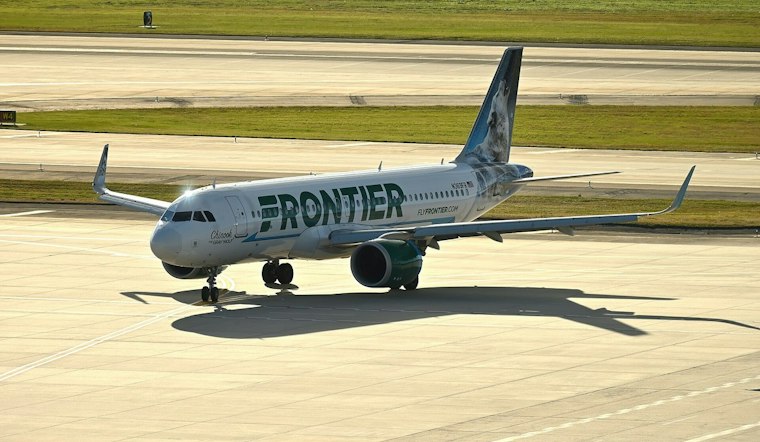
A video from Frontier Airlines Flight 2052 shows a flight attendant physically restraining a woman beside an aircraft exit after the plane landed in Atlanta. The confrontation happened while passengers were still aboard because a jet bridge could not properly connect to the aircraft, according to TMZ.
The flight, which traveled from New Orleans to Hartsfield-Jackson Atlanta International Airport on October 6, could not fully deplane until the bridge was repaired and reconnected. The video poster said passengers had been landed for “35/50 mins.”
What the video and passenger account establish
In the 13-second clip, the woman yells “OPEN THE DOOR” as a flight attendant pulls her away; TMZ characterized the event as a physical altercation. The video shows a brief confrontation.
The person who posted the clip said there was “no air or water or light.” Paddle Your Own Kanoo reported that the air conditioning was on and only the emergency lights were switched on. The poster also claimed the woman moved toward the exit after her mother hyperventilated, passed out and remained unresponsive for several minutes. Those details were relayed by Paddle Your Own Kanoo. Frontier said it was seeking more information about the incident and apologized for the inconvenience and discomfort during deplaning.
The legal standard is narrower than the video’s safety question
A crew member’s need to control access to an aircraft exit is a safety issue, but the video alone does not determine whether anyone committed a crime. The Justice Department’s explanation of the law says 49 U.S.C. § 46504 applies when someone assaults or intimidates a crew member in a way that interferes with the member’s duties; the statute carries a possible sentence of up to 20 years. That standard does not establish that its elements were met in this case, or make reaching for an exit by itself a violation of that provision.
The FAA says it can impose civil fines for unruly conduct but does not have criminal prosecutorial authority; criminal charges, if warranted, are separate. The agency says the rate of unruly-passenger incidents fell by more than 80 percent from record highs in early 2021, while noting recent increases. That broad rate trend provides context, not evidence about the cause or classification of the Atlanta incident. FAA guidance and data distinguish that rate measure from reports and enforcement actions.
A past case illustrates why exit-door incidents should be compared carefully rather than treated as identical. WBUR reported that Francisco Severo Torres pleaded guilty after trying to open an emergency door and attack a flight attendant aboard United Airlines Flight 2609 from Los Angeles to Boston in March 2023; he was sentenced to 26 months in prison. That was an in-flight incident with a guilty plea, unlike the reported post-landing confrontation in Atlanta. WBUR’s report describes the separate case.
Federal tarmac-delay rules are also relevant to questions about conditions aboard a grounded aircraft. The Department of Transportation’s DOT guidance describes a three-hour deplaning requirement for covered domestic tarmac delays, with exceptions; that rule should not be read as a finding that Frontier violated it in this incident.



