

























































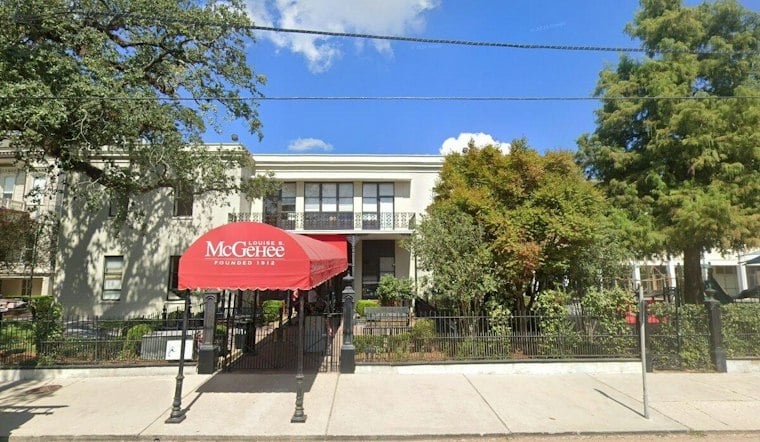
Four mature oak trees along First Street in New Orleans' Garden District are set to come down to make way for a new three-story gymnasium at Louise S. McGehee School, a project the school says has been years in the making but that has left some neighbors mourning the loss of century-old canopy in one of the city's most storied residential enclaves.
According to WDSU, McGehee has received city approval to build the new gymnasium, and the project will require removing the four oaks that currently line the First Street side of campus. Public filings with the New Orleans Historic District Landmarks Commission describe the proposed structure as a 23,535-square-foot multi-story gymnasium fronting First Street, along with a separate 1,370-square-foot addition fronting Prytania Street, according to city of New Orleans public notices tied to the school's plans submitted by EDR Architects.
Neighbors Weigh Charm Against Change
Garden District resident Fran Swan told the station the oaks add charm, comfort, and habitat for birds and cats, and said she wants to preserve every tree possible because of the value trees add to the city. Swan also acknowledged, per the same report, that the project requires making room for the next generation and that it involves a tradeoff — a sentiment that captures the uneasy middle ground many longtime residents occupy as the school moves forward with construction.
The First Street corridor sits within a Garden District landscape where oaks are considered a defining feature of the neighborhood, the outlet reported. The district was designated a National Historic Landmark in 1971.
Why McGehee Says the Old Gym No Longer Works
McGehee says its current gymnasium, built in the 1960s, fails to meet state standards and no longer serves the school's physical education and athletics needs, the station reported. The school specifically says the facility falls short of contemporary Louisiana High School Athletics Association standards, and that the new gymnasium will provide modernized space for physical education, health and wellness, and athletic opportunities for girls. School officials have framed the upgrade as necessary to remain competitive and attract students.
Per the same report, McGehee's board of trustees approved a broader campus master plan in 2022 designed to meet student needs and ensure the school's long-term competitiveness, and the gymnasium itself has been in development for several years. Before settling on the First Street site, the school searched for an off-campus location for the gym but found no feasible options, ultimately deciding to build on its existing campus after exhausting other alternatives. The school submitted its master plan to the City Planning Commission and the Historic District Landmarks Commission in April 2025, and the gym project secured approval in November 2025 following agency revisions and community meetings, according to the outlet.
A Historic Campus Already Under the Microscope
McGehee's main administration building, the 1872 Bradish Johnson House at 2343 Prytania Street, is a French Second Empire mansion designed by architect James Freret that originally cost about $100,000 to build — roughly $2.2 million in today's dollars, according to the Preservation Resource Center of New Orleans. Founded in 1912, the institution moved to its Prytania Street campus in 1929. The campus includes former residences and a mid-20th-century addition.
Beyond the gymnasium, McGehee is also renovating its auditorium and constructing a new front entryway, work the station reports has already begun and that was designed to protect a large adjacent oak. School leadership has described a commitment to a green city and a green campus, and says it is working with a local reforestation nonprofit to plant new trees that will offset the loss of the four removed oaks. The school has said it plans to more than replace what is lost and will seek additional ways to offset the tree loss through planting, funding, and participation in an extensive tree-planting project, with the gym construction expected to be finalized in 2028.
A City Already Short on Canopy
The dispute over four private oaks unfolds amid broader concerns about New Orleans' tree canopy.
That canopy concern comes as the city continues to recover from catastrophic canopy loss. The nonprofit Sustaining Our Urban Landscape reports that Hurricane Katrina destroyed an estimated 200,000 trees in 2005, leaving New Orleans with roughly 18% tree canopy coverage, compared with 63% in Charleston and 44% in Savannah. Separately, a $75 million grant to the Arbor Day Foundation was canceled.



