

























































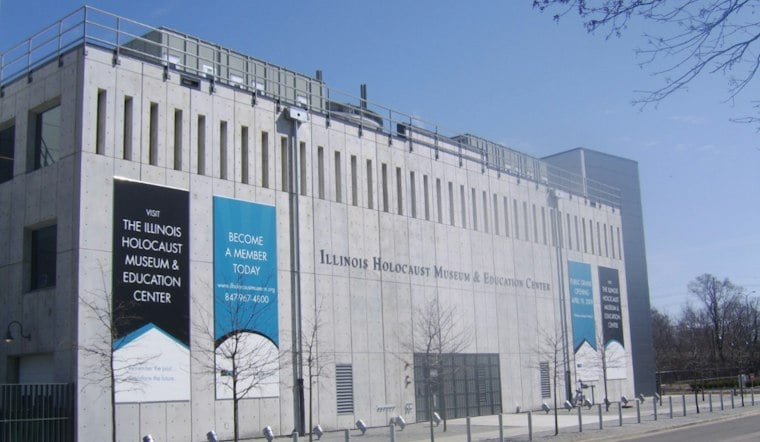
The Illinois Holocaust Museum & Education Center will swing its doors back open on November 11, capping a 16-month renovation of its Skokie campus that began in July 2025. The $8 million project has reworked the museum's core exhibition, redesigned its auditorium and gallery spaces, and built a new welcome center with a bigger lobby for visitors arriving off Woods Drive near Golf Road and the Edens Expressway.
According to CBS Chicago, the renovation also adds a reflection gallery where guests can gather after moving through the museum's exhibits. The expanded Zev & Shifra Karkomi Holocaust Exhibition now folds in new material on the historical roots of antisemitism, the story of Chicago resident Leo Edelman, and the experiences of non-Jewish victim groups targeted by the Nazis, according to a release distributed via GlobeNewswire.
Bernard Cherkasov, who is affiliated with the museum, framed the rebuilt galleries as a handoff of memory to people who never met a survivor in person. “We're building this museum for a new generation of witnesses, a new generation of upstanders, people who are seeing what is troubling them around the world and ready to take on the mantle of leading change,” Cherkasov said, per the CBS Chicago report. He added that Holocaust survivors cannot be asked to carry their memories and the lessons of the Holocaust forever.
Technology Fills the Gap as Survivors Age
That generational shift is already visible inside the museum's walls. Visitors can learn from witnesses through both a virtual reality theater and a holographic theater, tools CBS Chicago describes as central to how the museum now delivers firsthand testimony. In September, CBS News Chicago documented how survivor Aaron Elster's story continued to be told through his hologram eight years after his death, a technology Hoodline previously explored in its own look at the museum's hologram theater.
The museum is also pushing testimony beyond its Skokie building entirely. This month, it released three of its virtual-reality survivor films — Walk to Westerbork, Letters from Drancy, and Escape to Shanghai — for free download on consumer headsets including the Meta Quest 3, according to a report by UTV Lifestyle. The move extends access to survivor accounts to anyone with a home headset, not just museum visitors.
A Downtown Stand-In Winds Down
While the Skokie campus was shuttered, the museum kept a public foothold in the city through Experience360, a satellite location at State and Kinzie streets in Chicago that served as the museum's temporary home during renovations, per CBS Chicago. Located at 360 N. State Street in River North, Experience360 opened in August 2025 and will remain open through December 31, 2026, according to information reported by WTTW.
Once the Skokie building reopens, the museum won't wait long to add fresh programming. Beginning November 15, it will launch a temporary exhibition called Blacklist: The Hollywood Red Scare, on loan from Jewish Museum Milwaukee and running through March 2027, per the GlobeNewswire release. The show examines free speech, political censorship, and civil liberties during the Cold War-era Red Scare.
Roots in a Neo-Nazi March Threat
The museum's existence traces back to the late 1970s, when neo-Nazis threatened to march through Skokie, prompting local Holocaust survivors to later form the Holocaust Memorial Foundation of Illinois and open a small storefront center in 1984, according to the museum's own history and corroborating background compiled by Wikipedia. That storefront eventually gave way to the 65,000-square-foot complex that opened in 2009, designed by architect Stanley Tigerman, whose contrasting dark and light wings were meant to symbolize tragedy and renewal, as reported by Engineering News-Record.
Skokie's connection to survivor history runs deep: the village's Jewish population peaked at roughly 58% to 60% in the mid-1960s and still comprises an estimated 28% to 30% of its roughly 65,000 residents today, a demographic arc Hoodline detailed in its earlier coverage of Skokie's kosher fridge tribute. That concentration of survivors helped push Illinois to become, in 1990, the first U.S. state to mandate Holocaust education in public elementary and high schools, a law expanded in 2005 to cover instruction on other global genocides, according to the Illinois Holocaust & Genocide Commission.
The renovation also lands against a mixed backdrop of hate-crime data. FBI figures cited in state analyses show annual hate crimes in Illinois climbing from 98 in 2021 to 347 in 2023.





