

























































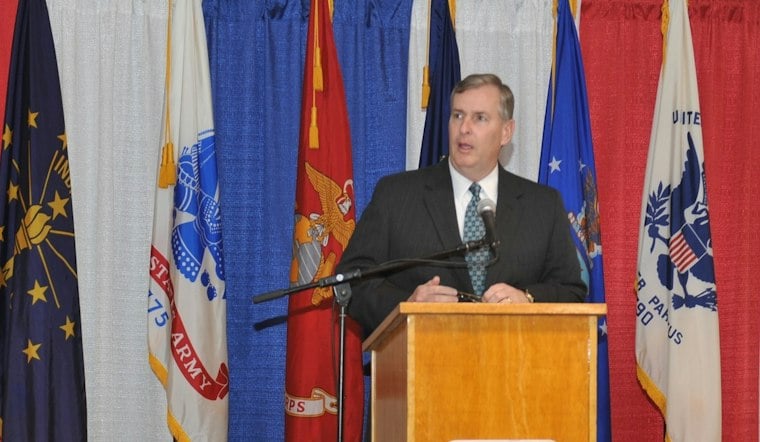
Indiana secretary of state candidate Greg Ballard planned to deliver notice of a lawsuit Thursday morning and intended to file documents in Marion Superior Court, demanding that the state's Election Commission finally take up a stack of campaign finance complaints before voters finish casting their ballots. The independent and Lincoln Party candidate argues the four-member commission has simply refused to do its job while early voting is already underway ahead of the Nov. 3 general election.
Ballard is suing the Indiana Election Commission to try to compel its members to hear the campaign finance complaints, according to IndyStar. He alleges the commission is derelict in its duty to administer election laws by declining to act on complaints involving his two chief rivals, Republican Max Engling and Democrat Beau Bayh, even as ballots are already being cast.
A $60,000 Donation and a Refund
At the center of the dispute is a complaint alleging Engling's campaign accepted an excessive $60,000 contribution on June 30 from a group called Hoosier Leadership for America, even though Indiana law limits corporate donations to $5,000 annually for statewide candidates, per IndyStar's reporting. The Engling campaign refunded the money before the complaint was ever filed, but Ballard argues the alleged acceptance and reporting violations still deserve to be litigated rather than quietly erased by a refund.
A second complaint, filed in September, asked the commission to investigate whether an event featuring Engling as a special guest should have been reported as an in-kind campaign contribution, the same IndyStar report notes. Separately, the Indiana Election Division sent the Engling campaign letters regarding both complaints but had not received a formal response to the July allegation, according to Yahoo News. The outlet also reported that state law does not actually compel the commission to hear campaign finance complaints at all.
Why the Commission Hasn't Met
The Indiana Election Commission is a bipartisan body with four members, two Republicans and two Democrats, and it has announced no plans to meet on the pending complaints. Commission members are appointed by the governor on the recommendation of the state chairs of Indiana's two major political parties, and under Indiana law, the chair must belong to the same party as the sitting secretary of state, who is a Republican. That makes Republican chair Beth Boyce the person with the power to call a meeting.
Ballard says he is not seeking any particular outcome from the commission on the merits of the complaints — only that it actually convene and act before Election Day. He has told reporters he would drop the lawsuit entirely if Boyce called a meeting by Oct. 26. Julia Vaughn of Common Cause Indiana said she doubts the complaints will be heard before the commission, a sentiment that underscores Ballard's frustration, according to the Yahoo News report.
Ballard's Bigger Complaint About Structure
Beyond the immediate dispute, Ballard has argued that the commission's current structure allows partisan disagreements to interfere with its ability to function, and has called for a nonpartisan commission. The commission handles campaign-finance complaints.
Money Pouring Into a Four-Way Race
The lawsuit lands amid a secretary of state race that has already drawn unusually heavy spending. The contest features four candidates: Ballard, Bayh, Engling and Libertarian candidate Lauri Shillings, as IndyStar reported. Since July 1, the start of the third-quarter reporting period, the Engling, Bayh and Ballard campaigns have each pulled in significant cash from multiple large donors, according to The Republic.
Engling's campaign led the pack with large donors, bringing in about $1.5 million, while Bayh collected roughly $680,000, Ballard about $285,000 and Shillings $10,000, the newspaper reported. University of Indianapolis political science professor Laura Merrifield Wilson said the heavy spending indicates that donors are anticipating a competitive race. For comparison, Republican and Democratic candidates raised about $310,000 and $328,000, respectively, during the same period in 2022, and about $200,000 and $175,000 in 2018 — figures that make this cycle's fundraising look like a different ballgame entirely.
Ballard's own campaign was fined earlier this year for filing campaign reports late, the same Yahoo News article noted, a detail that adds some irony to his push for stricter enforcement against his rivals. Statewide campaigns are required to file disclosures whenever they receive $1,000 or more in contributions, with third-quarter reports covering July through September due by the middle of October. Whether Boyce calls a meeting before Ballard's Oct. 26 deadline — or whether the lawsuit proceeds through Marion Superior Court instead — remains to be seen as ballots continue to be cast across the state.





