

























































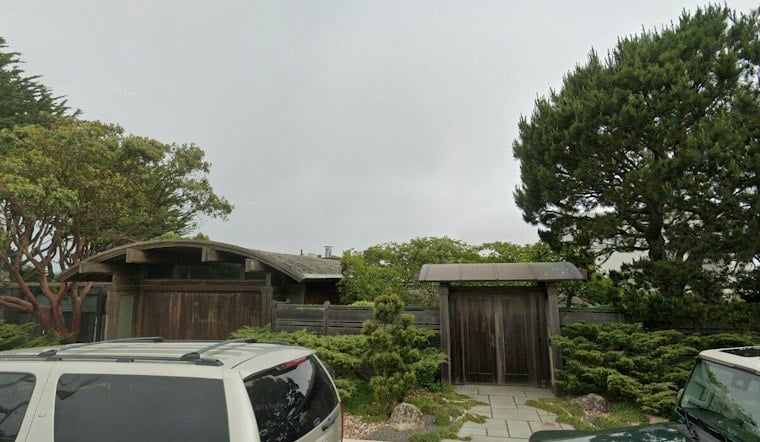
The redwood-clad midcentury home that designer Ken Fulk has called his own for 16 years just hit the San Francisco market for $7.9 million. Fulk and his husband, classical pianist Kurt Wootton, bought the Clarendon Heights house, which Fulk nicknamed the Tree House, for $1.925 million in 2010, and now they're ready to let it go.
According to The San Francisco Standard, the Duncan House went on the market last week, with Fulk and Wootton bought the property in 2010 for $1.925 million. A separate listing on Compass shows the Sotheby's International Realty listing went live on October 16, 2026, at an asking price of $7,900,000. Notably, Architectural Digest has offered a different account of the purchase timeline, reporting that Gwendolyn Evans sold the house to Fulk in late 2011 — a discrepancy that remains unresolved between the two accounts.
The 3,200-square-foot, two-story house has three bedrooms and four bathrooms, built entirely of redwood with 26-foot-tall windows framing sweeping views of the Golden Gate Bridge and the Pacific Ocean. From the street, the home appears to be just one story, but it actually cascades down the slope in levels, a design detail tied to its Arts and Crafts-influenced use of redwood and handmade finishes.
A Midcentury Commission Treated Like a Sculpture
The Duncan House takes its name from psychiatrist Dr. Cloyce Duncan, described as a trailblazing figure in his field, who commissioned the home from architect Charles Warren Callister in 1959. The house was completed in 1963. Duncan reportedly treated the house as a commissioned sculpture, preserving its original fixtures and finishes.
Alameda-based architect Pierluigi Serraino included the Duncan House in his book NorCalMod and called it one of Callister's finest projects, the same report notes. Callister's other notable work includes a Christian Science church in Belvedere — which that town approved for conversion into a home in 2024 — and the Flower House in Berkeley. Whoever buys the Duncan House will become just its third resident.
Fulk said he and his household tried to do as little as possible to the house. “We tried to do as little as possible to the house,” he said, according to the same report. City records back that up: they show just one major renovation, completed during Fulk's first year of ownership.
What the $62,000 Renovation Actually Touched
Building permits from that renovation covered a kitchen remodel, several redone bathrooms, and the addition of a breakfast room and laundry room on the first floor. The permits also covered a full electrical overhaul, new plumbing, and a new furnace. Two building permits put the combined cost at $62,000, and the city signed off on most of the work by October 2011.
The listing lands in the middle of an unusually hot stretch for San Francisco real estate. More than 90% of houses sold above asking, with the typical sale closing 31% higher than the listing price, according to a Business Journals analysis of Compass data. Fulk's own zip code, 94114, ranked sixth on the Business Journals' Wealthy 1000 list as of October 19, a ranking that draws on 2024 American Community Survey data from the U.S. Census Bureau and weighs income, home equity, estimated savings, poverty rates and population density.
A Cable Car Hill and a Pattern of Sales
Fulk said he and Wootton, who live with five dogs, decided to leave the Tree House and move into the heart of the city, to a new hill accessible by cable car. “We can’t wait to be more ingrained in the day to day life of this magical town,” he said, per the Standard's report. Clarendon Heights, the neighborhood they're leaving, is also home to designer Stanlee Gatti and gallerist Jessica Silverman.
The Duncan House is the third Fulk property to hit the market in 2026. In August, he sold his former offices, the Magic Factory, for $6 million after buying the building for $3 million in 2007. In March, he and Wootton listed a Napa Valley ranch for $4.5 million; that property was purchased in 2005 for $750,000.
The sales come after Fulk faced legal, financial and zoning issues in July over efforts to renovate a cluster of hotels in Marin County. A spokesperson for Fulk told the Standard that the sales of his properties were unrelated to the struggling Marin hotel project. Fulk did not respond to a request for comment from the Standard for its report.


