

























































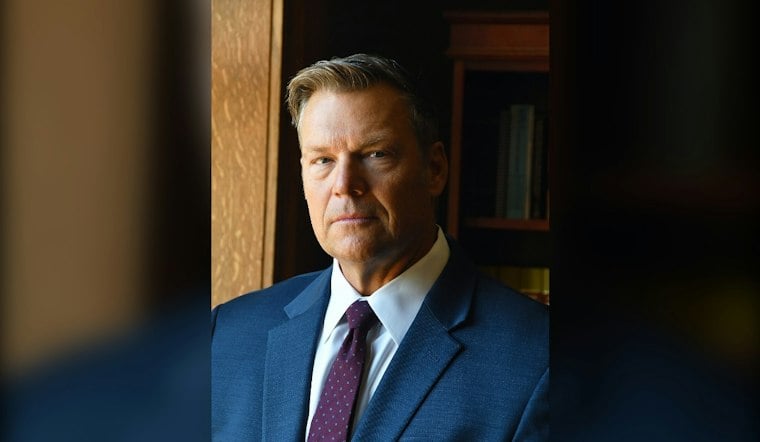
Kansas Attorney General Kris Kobach and Democratic challenger Chris Mann squared off again this week in a campaign rematch of their razor-thin 2022 race, clashing over the death penalty, medical marijuana, and penalties for officers who misuse license-plate-reader data. Kobach, the Republican incumbent, pushed to keep capital punishment on the books and speed up executions, while Mann argued the Kansas Legislature, not the attorney general, should set policy on both the death penalty and marijuana.
A Rematch Four Years In The Making
The debate marked a repeat of the 2022 race narrowly won by Kobach, according to Kansas Reflector. Kobach received 50.8% of the vote to Mann's 49.2% in that contest, per KMBC. The debate was hosted by the Johnson County Bar Association and moderated by Nick Haines, according to KCUR.
Mann, a former police officer and prosecutor, told the crowd his law enforcement career ended when a drunk driver struck him during a traffic stop, the Kansas Reflector reported. He said he was endorsed by the 4,800 law enforcement officers of the Kansas State Lodge of the Fraternal Order of Police, while Kobach countered that his reelection was endorsed by 50 sheriffs in Kansas, the outlet noted.
Fentanyl Crackdown And Crime Statistics
Kobach said his priority for a second term would be continuation of an “extremely effective” crackdown on fentanyl trafficking and abuse, as reported by the Lawrence Journal-World. He also said Kansas now has the lowest crime rate in 57 years, a figure KMBC reported he described as 22.5 index crimes per 1,000 people annually.
Death Penalty Divides The Candidates
The sharpest divide came over capital punishment. Kobach argued Kansas should still be in the execution business, pushing to retain the death penalty, speed up appeals, and consider using gas rather than relying solely on lethal injection, according to the Kansas Reflector. Mann countered that was the domain of the Kansas Legislature, arguing the death penalty had not been shown to deter violent crime.
Kansas hasn’t executed anyone since 1965, per Kansas.com, and the outlet reports that all of the nine men still on death row in Kansas are in various stages of their appeals. Kansas reinstated capital punishment in 1994 and is one of 27 states with an active death penalty, according to KAKE.
Marijuana Debate Returns To The Legislature
Both candidates agreed that legalizing marijuana was ultimately a question for lawmakers rather than the attorney general's office. Marijuana has remained illegal in Kansas even as legislators debated medical-cannabis proposals in 2021, 2022, 2023 and 2024, according to KCUR. The Kansas House approved a medical-marijuana plan in 2021 by a vote of 79-42, the station reported, but it's the Senate where the roadblock has remained in the years since, with the debate becoming a recurring annual fight at the statehouse.
License-Plate Cameras And Privacy Penalties
Kobach and Mann also found common ground on penalties for abuse of automated license-plate-reader systems, commonly known as Flock cameras. Kobach said officers who misuse that access to stalk people should lose their jobs and could face financial fines, loss of employment and potential jail time, the Lawrence Journal-World reported. Both candidates agreed that private companies operating the systems need to be held accountable as well, per the Kansas Reflector.
The issue carries broader stakes beyond Kansas: most Midwestern states have little to no regulation of Flock Safety cameras or similar systems, though that is likely to change as surveillance companies face bipartisan backlash, according to a separate KCUR report. Separately, The Hill reported that an Oklahoma federal judge ruled warrantless searches of AI-powered surveillance-camera data, including Flock Safety data, may violate the Fourth Amendment without adequate probable cause.
With the general election approaching, the rematch between the two candidates leaves Kansas voters to weigh starkly different visions for the attorney general's office, from how aggressively the state pursues executions to how it polices the companies and officers who have access to drivers' location data.



