

























































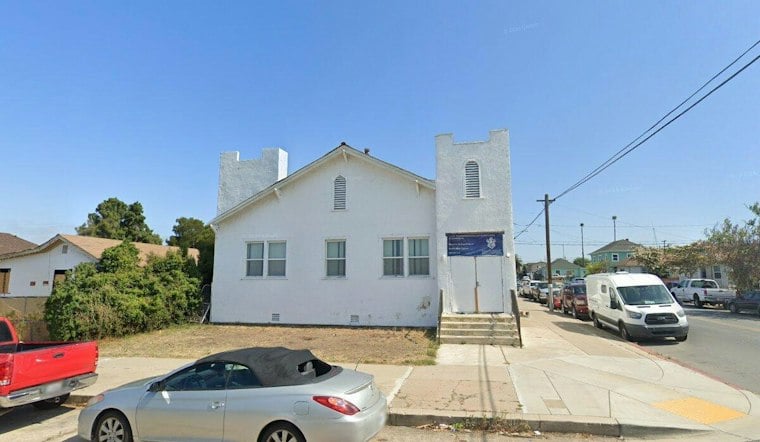
A longtime Logan Heights church just turned its own property into the foundation for 43 affordable homes. Logan Temple AME Zion Church has partnered with developer LogosFaith Development on a project called Logos Logan Legacy Place, breaking ground at 3186 and 3190 Franklin Avenue on land the church already owns.
The partnership marks LogosFaith Development's first project in San Diego, according to Connect CRE, which reported that the 43-home community will rise on church-owned land and incorporate adaptive reuse of the church's existing fellowship hall. The outlet reported that the development preserves a longstanding neighborhood presence for the congregation while adding new housing to the block.
Pastor Martin Porter, founder and CEO of LogosFaith Development, called the collaboration a milestone for the city. “Partnering with Logan AME Zion Church to bring this affordable housing project to San Diego is a meaningful milestone,” Porter said, according to the same report. The groundbreaking drew Porter alongside Rev. Dr. Virgil M. Ward, public officials and members of the development team, the outlet reported.
Church Land, City-First Expansion
Delivery for Logos Logan Legacy Place is set for 2028, per Connect CRE's reporting. Behind the scenes, state filing records reviewed by bizprofile.net show that Logos Logan Legacy Place Franklin, LP was established as a California limited partnership on October 15, 2024, with Porter listed as the entity's registered agent.
The project fits into a wider pattern of San Diego churches opening their land to housing developers, a shift accelerated by zoning changes at both the state and city level. San Diego adopted reforms in 2019 that streamlined permitting for affordable housing projects built on church parking lots, according to KPBS. Those local reforms paved the way for the city's first project of this kind, Bethel One in Logan Heights, which KPBS described as the first development to emerge from San Diego's Yes in God's Backyard movement.
How Bethel One Set the Template
Bethel One will offer 25 one-bedroom apartments set aside for low-income seniors and veterans, with one additional unit reserved for an on-site property manager, the outlet reported. Building on already-owned church land kept Bethel One's cost per unit around $260,000, far below the $750,000 or more per unit that publicly funded affordable housing projects in San Diego can run, according to KPBS's reporting.
State-level policy has since widened the playing field. California's Senate Bill 4, approved by the governor and filed with the secretary of state on October 11, 2023 according to the California Legislature's own record, addresses planning and zoning for housing development on land owned by higher-education and religious institutions. The City of San Diego has described SB4 as allowing qualifying affordable housing to be built by right on land owned by religious institutions or independent higher-education institutions, subject to certain criteria, according to the City of San Diego.
A Region Sitting on Developable Land
The scale of available church land in San Diego County is substantial. Roughly 3,600 acres of land in the county are eligible for housing approval under SB4, and faith-based organizations own 96% of that eligible land, while nonprofit higher-education institutions hold just 4%, according to a report from the UC San Diego Center for Housing Policy and Design. An earlier 2020 estimate from UC Berkeley's Terner Center, cited by KPBS, put faith communities' potentially developable land across the county at 4,675 acres.
Statewide, advocates believe the opportunity is even larger. Leasing church land to affordable housing developers could convert more than 170,000 acres of land across California into housing, according to the Orange County Register. That same reporting found LogosFaith Development already at work on a separate Southeast Los Angeles project at Harvest Tabernacle Bible Church, where the first phase features a 56-unit complex for formerly incarcerated people.
Similar Projects Taking Shape Elsewhere
Other Southern California churches have already seen what finished projects can look like. In Santa Ana, an abandoned church site is now home to the 93-unit Legacy Square, with 33 units set aside for people at high risk of returning to homelessness and the rest aimed at low-income families, the Orange County Register reported. That congregation now earns $8,000 a month in rent from the development, money the report said helps fund its community programming and events.
Up north, Oakland approved plans last October to convert the historic Brooklyn Presbyterian Church and Parish Hall into a 32-unit affordable housing project, according to ConstructConnect. That plan calls for 30 new units in a four-story building adjacent to the church, plus interior remodeling to create two more residential apartments inside the existing structure. Taken together, these projects point to a growing playbook for congregations sitting on underused land across California, with Logan Temple AME Zion Church now set to add its own chapter in Logan Heights.





