

























































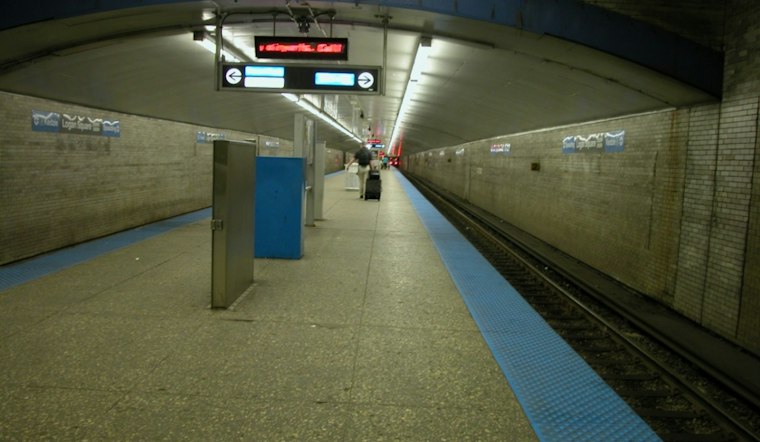
The Chicago Transit Authority board has approved construction contracts for a $40 million overhaul of the California Blue Line station, clearing the way for the 131-year-old Logan Square stop to finally get elevators. The project is set to begin construction in late fall 2027, according to CTA.
The California station, built in 1895, is the oldest surviving station along the former Metropolitan “L” Northwest Branch, according to JLK Architects, the firm providing transportation and historic-preservation design services for the project. As reported by the Chicago Sun-Times, the renovation will add two elevators, expand platforms and canopies, and install new stairs and accessible doors. The work is funded through a combination of state transportation funds and local tax increment financing dollars.
Beyond the elevators, the project calls for new lighting, sidewalks, ramps, drainage improvements and landscaping work around the station, per the Sun-Times report. During construction, riders will use a temporary stationhouse and entrance at St. George’s Court while crews work on the permanent structure. CTA says the station served 1.1 million commuters in 2025.
Engineering the Fix for a Century-Old Structure
Retrofitting a station this old for modern accessibility comes with structural complications. The design calls for additional structure to support a wider elevator platform, along with modifications to the historic steel platform canopies and a new electrical room, according to the same JLK Architects project page. The plan also includes modifications to the existing egress stairs and additional egress routes alongside the two new elevators.
This isn’t the first time California station has been reworked. It last underwent renovation in 2014 under CTA’s Your New Blue program, which delivered new platforms, improved lighting, new bicycle racks and other refurbishments, the station’s history page notes. Chicago-L.org records that the California station house reopened on October 16, 2014, after that rehabilitation.
Part of a Larger, Slow-Moving Accessibility Push
The California project is one piece of CTA’s All Stations Accessibility Program, which aims to make every CTA rail station fully accessible by 2038, per the Sun-Times. CTA spokesperson Nora Leerhsen said an accessible CTA enables independent travel and connects people with regional opportunities, and that the investment at California will create a modern, welcoming station serving riders with disabilities and the wider community.
Not everyone agrees on how quickly that goal is being met. Five years into the broader accessibility plan, CTA had not added a single elevator, according to a 2024 Chicago Sun-Times report. That plan is divided into four phases spanning 20 years, and its second phase, expected to cost $617.5 million, is only about half funded. CTA’s overall cost estimate for making every station accessible has also climbed sharply, from an original $2.1 billion projection in 2018 to $4.98 billion today, the same report found.
Earlier coverage from Block Club Chicago in 2022 described the California upgrade as a $36 million project featuring two elevators serving both platforms, three new stair sets with emergency exits, and wider platforms — figures that have since risen to the $40 million price tag and two-elevator design now approved by the board.
Other Blue Line Stations in the Pipeline
California isn’t the only Blue Line stop in line for upgrades. A separate $118.5 million federal infrastructure allocation is funding modernization at the Belmont, Irving Park and Pulaski stations, which are also slated to receive elevators, ramps and new signage, Block Club reported. Construction at Belmont was expected to begin in 2025, according to a CTA spokesperson cited in that coverage.
The stakes extend beyond any single station. National Transit Database figures cited by the UIC Voorhees Center show that 97 of CTA’s 145 train stations, or 67%, are currently ADA accessible. That leaves Chicago ahead of some peer systems — more than 70% of New York City’s subway stations are inaccessible, compared with roughly 30% of Chicago’s, per the 2024 Sun-Times report — but still short of full compliance. The Voorhees Center also points to the aging Baby Boom generation as a driver of rising demand for accessible transit and senior transportation services in the years ahead.





