

























































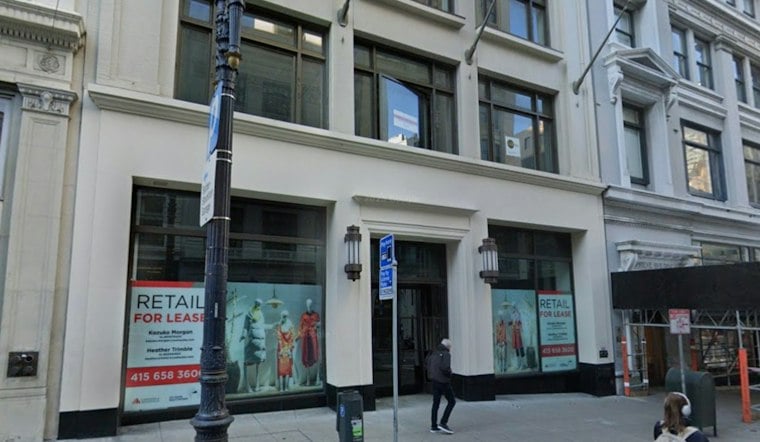
Louis Vuitton USA Inc. has purchased 220 Post Street, a six-story building in the heart of San Francisco's Union Square, paying $48 million according to records. The deal closed during the week of October 16, and it has real estate watchers and retail insiders wondering whether the French luxury house is quietly laying the groundwork for a flagship store in the neighborhood it already calls home.
The purchase was first reported by the San Francisco Chronicle, whose Laura Waxmann detailed the sale of the more than century-old retail building, which sits between Grant and Stockton streets and contains roughly 38,400 square feet. That works out to about $1,250 per square foot, a price tag that reflects both the building's prime location and its troubled recent ownership history. Louis Vuitton USA Inc. is linked to LVMH, the New York-based luxury conglomerate behind Louis Vuitton and Dior.
The building has a storied retail past. For nearly two decades it housed the Saks Fifth Avenue men's store, which closed in 2016, and before that it was home to an Eddie Bauer flagship and the original Abercrombie & Fitch. The Chronicle's reporting also notes that 220 Post Street offers a mix of office and retail space, a detail corroborated by Pacific Retail, which describes the property as a prestigious commercial building in the heart of the Union Square retail district.
A Building That Changed Hands Through Foreclosure
220 Post Street's ownership saga is central to understanding the discount Louis Vuitton appears to have secured. City Center Realty Partners and Angelo, Gordon & Co. purchased the property for $73 million in 2016, according to public records cited in the Chronicle's reporting, with the explicit goal of attracting a luxury tenant to the building — a goal separately confirmed by a 2018 account from bizjournals.com, which put the purchase price at $75 million and quoted the stated aim of landing a high-end occupant. That ownership group ultimately lost the building to lender Aareal Capital, which foreclosed on a $56 million loan tied to the 2016 acquisition in 2023. Before the foreclosure, LVMH reportedly sought to acquire 220 Post Street for $83 million, an offer that was rejected by the previous ownership, according to Charlie McCabe, a San Francisco broker who previously sold the building for a Swiss investor. McCabe told the paper that Louis Vuitton's eventual $48 million acquisition reflects an owner-user locking in low occupancy costs — a markedly better deal than the one LVMH walked away from years earlier. Aareal Capital did not respond to a request for comment on the sale as of October 9, and LVMH representatives did not respond to the Chronicle's questions.
Clues in the Paperwork, But No Confirmed Plans
The purchasing entity lists Louis Vuitton's New York flagship at 1 East 57th Street as its principal address and names several Louis Vuitton Americas executives as officers, according to the Chronicle's review of the filing. Megan Grant is CEO of Louis Vuitton Americas. Still, the purpose of the purchase remains unclear — whether the building will become Louis Vuitton's permanent San Francisco flagship, house another LVMH brand, or serve some other function has not been established.
Louis Vuitton currently operates a leased storefront at 233 Geary Street, a corner location inside a larger building owned and occupied by Macy's, confirmed by the brand's own store locator. The term of that Geary Street lease could not be determined. History offers some precedent for how these situations can play out: Louis Vuitton bought the building next to its Manhattan flagship at 1 East 57th Street for $60 million in 2007, and the seller's broker confirmed Louis Vuitton as the buyer while noting the company did not disclose its plans for the property, according to a contemporaneous account from Observer. More recently, Louis Vuitton has reportedly moved toward demolishing its current Fifth Avenue and 57th Street building to construct a new flagship, combining its 19-story building at 727 Fifth Avenue with the adjacent Hublot store at 743 Fifth Avenue, while temporarily relocating to a 65,000-square-foot space at 6 East 57th Street, according to Bisnow. In Paris, LVMH separately acquired the building housing its flagship Louis Vuitton superstore at 101 Champs-Élysées, reportedly paying about €770 million, with one broker suggesting the price could have reached €900 million, per Fashion Network.
Post Street's Growing Luxury Cluster
The Post Street purchase arrives as Union Square works through a prolonged, uneven recovery. The district endured years of retailer retreat following pandemic-era declines in foot traffic and high-profile property crime, with major names including Nordstrom, Bloomingdale's and Saks Fifth Avenue all departing. Significant vacancy still weighs on the neighborhood.
Yet there are signs of momentum, particularly along Post Street. Zara is replacing its longtime store at 250 Post Street with a larger flagship a block away at 400 Post Street, the Chronicle reports, while Nordstrom Rack is returning to Union Square with a planned 51,000-square-foot store. The RealReal has reopened its former flagship at 253 Post Street. Watchmakers Patek Philippe, Rolex and Breitling have all added or expanded boutiques along the corridor, and Bulgari opened a boutique on Grant Avenue last year. Tiffany & Co. remains an established anchor on the adjoining Geary Street corridor. Taken together, the Post Street investment suggests luxury retailers see value in a concentrated street-level shopping corridor and may expect Union Square's recovery to be led by its most prestigious addresses — and LVMH's purchase could bring another marquee name to the block, even if what that name will be remains unconfirmed.
Broader market data back up the sense of cautious improvement. Union Square's overall retail vacancy rate was 20.3% in the second quarter of 2026, down from 20.9% a year earlier, according to a Cushman & Wakefield market report. The district recorded 42,900 square feet of year-to-date net absorption and saw pedestrian traffic climb 4% year over year to 3.48 million visits in the same quarter. Asking rents for premier ground-floor retail space held at $500 per square foot annually, while Post Street rents specifically rose 7.7% to $350 per square foot, the report notes — a sign that even as the broader district struggles, this particular stretch is commanding a premium. The report also pointed to the return of the former Saks Fifth Avenue space to the market following that retailer's Chapter 11 bankruptcy filing earlier in 2026.
Separately, the Chronicle reported in late 2025 that Union Square's retail vacancy rate had declined to 22.7% in the third quarter from 23.0% the prior quarter — the first such decrease since 2022 — with average monthly visitors rising 3% year over year to 1.16 million. Whatever the precise current vacancy figure, the overall trajectory described across multiple reports points to a neighborhood whose center of gravity is shifting northward, toward a street-level luxury corridor anchored increasingly by Post Street rather than the big department stores that once defined the square.





