

























































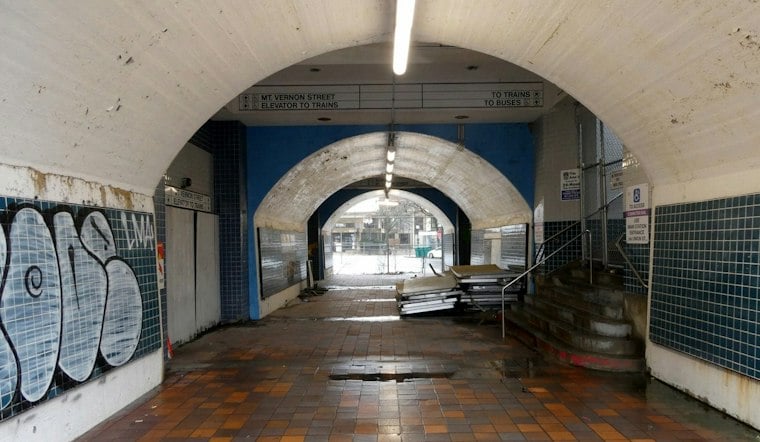
Lynn and MBTA police moved in Monday morning and cleared out a persistent homeless encampment that had sprawled beneath the Central Square train tracks for weeks, following a wave of public health and safety complaints from residents and commuters. The operation involved nine Lynn police officers and six MBTA officers, with Police Chief Christopher Kelly also involved in the clearing.
The walkway beneath the tracks had become home to anywhere from a couple dozen to more than 60 people living in tents, on mattresses, and in chairs, according to Rock 101. The station reports that the buildup led to thousands of municipal complaints, with pedestrians describing having to detour around the train station entirely to avoid overwhelming odors and blocked walkways. iHeart reported that the city cleared the encampment following those complaints.
Outreach Teams Respond as One Person Is Taken for Medical Evaluation
Multiple outreach groups assisted during the removal, including Lynn's CALM Team, Healthy Streets, the Lynn Shelter Association, and the Department of Public Works, according to Itemlive. One man was taken by ambulance for medical evaluation during the operation after appearing intoxicated and suffering facial injuries from an alleged assault, though police noted that transport was the sole medical incident of the Monday morning sweep.
The clearance came less than three weeks after Mayor Jared C. Nicholson signed an emergency executive order on October 2 establishing the Downtown Lynn Health and Safety Task Force, the outlet's reporting notes. The task force, co-chaired by the police chief and the city's public health director, was given a 90-day mandate to deliver actionable solutions for escalating homelessness, substance use, and mental health crises downtown.
Advocate Says Residents Were Threatened With Arrest
Not everyone sees the sweep as a success. Unhoused advocate Daniel Diaz pushed back against the city's operation, telling Rock 101 that residents were threatened with arrest despite having nowhere else to go. Diaz called on municipal leaders to repurpose vacant buildings into tiny homes or affordable condominiums rather than displacing people with nowhere to land.
Overdose Deaths Down Sharply, But Street Crises Persist
City data released alongside the mayor's executive order showed Lynn has cut annual fatal opioid overdoses from 70 in 2017 down to four through this October, even as street-level addiction challenges continue to strain downtown corridors, Itemlive reported. Officials have pointed to that progress as evidence that public health intervention strategies are working, even as encampments like the one at Central Square keep reemerging.
The legal backdrop for this kind of enforcement shifted in June 2024, when the U.S. Supreme Court ruled 6-3 in City of Grants Pass v. Johnson that municipal ordinances penalizing public sleeping and camping do not violate the Eighth Amendment's prohibition on cruel and unusual punishment. The ruling, tracked by the ACLU, eliminated constitutional hurdles that previously complicated municipal anti-camping enforcement even in cities where shelter space is full, giving local governments like Lynn's broader legal authority to clear public encampments.





