

























































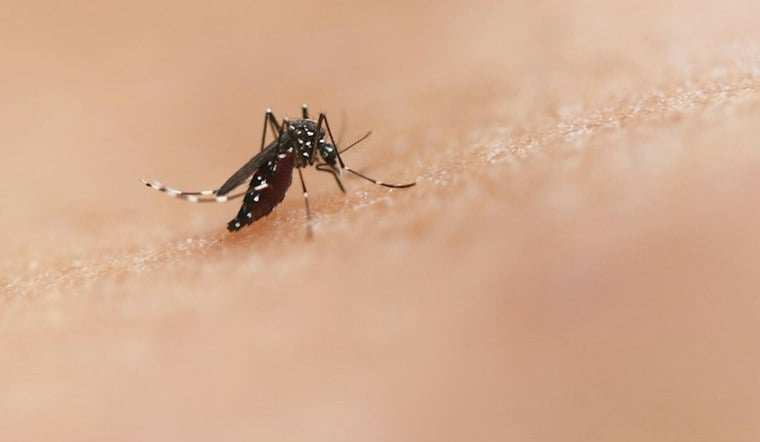
Massachusetts is maybe a week or two from the first hard frost that ends mosquito season, and the mosquitoes are still making the most of it. State health officials confirmed the 12th human West Nile virus case of 2026 on Friday. They also pushed two more South Shore communities into the high-risk category.
The Latest Case, and Who Just Got Upgraded
According to the Massachusetts Department of Public Health, the newest patient is a woman in her 60s who was likely exposed somewhere in Norfolk County. In response, DPH raised the West Nile risk level in Milton and Quincy to high.
They join a list that already covered most of the inner core: Boston, Brookline, Cambridge, Chelsea, Everett, Malden, Newton, Revere, Somerville, Watertown, and Winthrop. That makes 13 high-risk communities in all, a solid ring around the city. Most of the rest of the state sits at moderate risk.
Notably, this is the first case announced this season with likely exposure in Norfolk County. Up to now, most cases had been concentrated in Middlesex and Suffolk.
How We Got to 12
The count has climbed quickly over the past few weeks:
- June 16: DPH announced the season's first West Nile–positive mosquitoes.
- Mid-September: The state's tally stood at eight human cases, per Western Mass News.
- Sept. 25: DPH reported three more cases: a man in his 60s and a man of unknown age, both exposed in Suffolk County, and a man in his 90s exposed in Middlesex. That brought the total to 11, as the Boston Globe reported.
- Oct. 2: The Norfolk County case made it 12, per Boston 25 News.
The patients skew older and male. Of the 11 cases reported through late September, the Globe's rundown showed nearly all were men, ranging from their 50s to their 90s. The one exception was a woman in her 30s exposed in Middlesex County.
The Mosquitoes Are Basically Everywhere
The human cases are only the visible part of the season. DPH says 340 mosquito samples have tested positive for West Nile since June. Those samples came from 13 of the state's 14 counties: Barnstable, Berkshire, Bristol, Dukes, Essex, Franklin, Hampden, Hampshire, Middlesex, Norfolk, Plymouth, Suffolk, and Worcester. Nantucket is the lone holdout.
Eastern equine encephalitis, West Nile's rarer and nastier cousin, is also turning up in surveillance traps. DPH counts 27 EEE-positive mosquito samples this year, up from 26 a week earlier. So far there have been no human or animal EEE cases.
There have also been no animal West Nile cases reported this season.
How This Season Compares
Twelve cases is a busy year by recent Massachusetts standards, though not a record:
- 2023: Six human cases all season, per DPH.
- 2024: 19 West Nile cases plus four human EEE cases, WBUR reported.
- 2025: Eight cases by late September. The risk map looked very different, too: 47 communities were at high risk, stretching from Suffolk and Middlesex out into Essex and Worcester counties.
- 2018: An outlier year, with 49 human cases.
The takeaway: 2026 has produced 12 cases, with high risk in 13 communities.
What West Nile Actually Does
For most people, nothing. According to the CDC, about 80% of people infected never develop symptoms. Most of the rest get a flu-like illness, with fever, headache, and body aches, and recover fully, though fatigue can linger for weeks.
A small share, roughly 1 in 150 infected people, develop severe illness affecting the brain or spinal cord, such as encephalitis or meningitis. That risk is highest for people over 60. There's no vaccine for people and no specific treatment, so severe cases get supportive hospital care.
That's also why the reported case count undercounts actual infections. Most infected people never feel sick enough to get tested.
Waiting on the Frost
DPH says West Nile risk lasts until the first hard frost, which kills off adult mosquitoes. Boston 25's weather team says it could come as early as next week, after this weekend's nor'easter moves through.
Until then, the state's advice is the usual end-of-season drill:
- Use repellent. Pick one with an EPA-registered ingredient, such as DEET, picaridin, permethrin, or oil of lemon eucalyptus.
- Watch the clock. Be extra careful from dusk to dawn, when many mosquitoes bite most.
- Cover up. Long sleeves, long pants, and socks help if you're outside in the evening.
- Dump standing water. Empty flowerpots, kiddie pools, and clogged gutters. The nor'easter will leave plenty of fresh breeding spots behind.
- Check your screens. Fix any gaps in window and door screens.
DPH's Massachusetts Arbovirus Update page is worth a look if you live in one of the 13 high-risk communities, or just want to know how close you are to one.





