

























































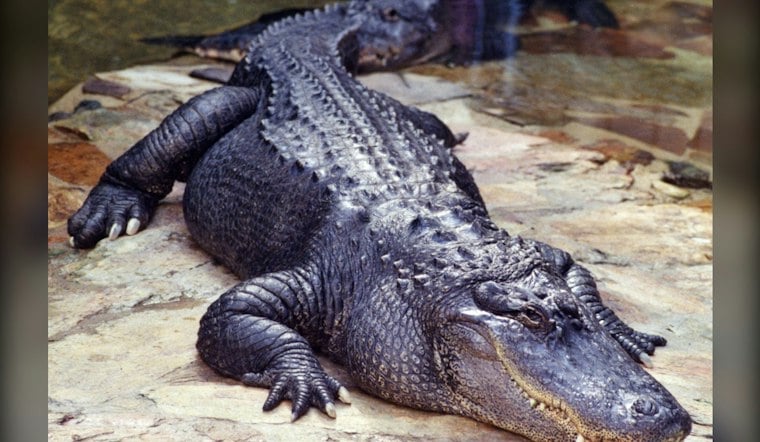
A 7-foot female American crocodile pulled from a private swimming pool in Miami-Dade County died less than two hours after researchers released her back into a nearby canal, and a field necropsy later revealed why: more than 22 grams of lead packed into her stomach. Florida wildlife officials say it is the first documented case of a crocodile dying from lead poisoning in the state.
The animal's death began as a routine nuisance call. A Florida Fish and Wildlife Conservation Commission officer responded to a complaint about a crocodile in a residential pool, and researchers used the opportunity to attach a satellite transmitter as part of ongoing crocodile research, according to WFLA. During the procedure, the crocodile began thrashing violently and developed foul-smelling liquid draining from its nostrils, warning signs that something was seriously wrong before she was ever returned to the water.
Scientists released the crocodile into the canal near where she was found at around 4:20 p.m., and she was found dead less than two hours later. The field necropsy that followed found a grim inventory inside her stomach: 23 air rifle pellets, a fishing weight, and two small unidentifiable lead fragments, adding up to a total lead mass that an IUCN Crocodile Specialist Group report put at 22.42 grams, alongside liver lead concentrations of 78.06 parts per million on a wet weight basis.
Scavenged Iguanas Point to the Source
Researchers also found four undigested green iguana claws in the crocodile's stomach, and per the study, they believe the air rifle pellets came from scavenged iguana corpses rather than direct ingestion of ammunition. Green iguanas are invasive in Florida and can devastate local ecosystems, and the same report notes that green iguana population management often uses lead ammunition loaded into air rifles.
The crocodile showed other signs consistent with lead toxicity, including tooth loss and black stains inside her mouth, the necropsy findings indicate. Elevated lead levels had reduced her overall health to the point that she could not survive the added stress of capture and satellite attachment, a procedure that has been performed thousands of times on other crocodiles without this outcome, per the report presented to the IUCN Crocodile Specialist Group.
A Regulatory Gap Along the Canals
Florida regulations permit year-round humane removal of invasive green iguanas on private property using air rifles, but state rules do not restrict hunters or property owners to non-lead pellets, according to the Florida Fish and Wildlife Conservation Commission. FWC classified green iguanas as a prohibited species in April 2021, which spurred a commercial eradication industry that leans heavily on high-powered pre-charged pneumatic air rifles along South Florida's urban waterways, according to Outdoors Rambler. Unretrieved iguana carcasses left along those canals are easily scavenged by local predators, including, apparently, crocodiles.
The gap is notable given that federal rules banned lead shot for waterfowl hunting nationwide back in 1991 specifically to prevent secondary lead poisoning in birds like bald eagles, but lead fishing sinkers and air-rifle pellets remain broadly unregulated in Florida's aquatic habitats, per the U.S. Fish and Wildlife Service. A 2006 study on captive-reared American alligators had already shown that long-term ingestion of lead-contaminated nutria meat caused severe tissue lead accumulation, lipid peroxidation, and complete reproductive failure, meaning the physiological risk of bioaccumulated lead in crocodilians was documented on paper long before this case put a number on it in the field.
A Population Still Recovering
The American crocodile's presence in a residential pool reflects a broader shift. Verified sightings of the species have expanded northward along Florida's coasts past traditional Everglades estuaries, bringing crocodiles into more frequent contact with residential canal networks, according to National Geographic. FWC manages these encounters under its American Crocodile-Human Interaction Response Plan, maintaining a dedicated hotline at 866-FWC-GATOR to capture and relocate animals found in pools and other human structures.
The species has come a long way to get here. The American crocodile was downlisted from endangered to threatened status by the U.S. Fish and Wildlife Service in 2007, after its adult population grew from an estimated 100 to 300 individuals in 1975 to between 1,400 and 2,000 adults. During 2025, FWC and partner agencies documented 16 American crocodile mortalities statewide, with vehicle strikes accounting for nine deaths, intraspecific combat three, hatching complications two, poaching one, and unknown causes one — lead toxicity had not previously been recorded as a cause of death in that carcass tracking.
The first-of-its-kind case has prompted FWC to conduct more sampling for lead and other contaminants, with plans to sample the state's broader alligator and crocodile population, the study notes. Researchers behind the report are now questioning whether lead-based ammunition causes more ecosystem harm than benefit when used against invasive species like iguanas. It is a question that echoes earlier findings on Florida's reptiles more broadly: a 2016 National Institute of Standards and Technology study found that 100% of tested American alligators across a dozen South Carolina and Florida sites carried persistent perfluorinated alkyl substances in their blood plasma, underscoring how crocodilians are increasingly used as sentinel species for tracking environmental contamination across the state's waterways.





