

























































A wealthy California entrepreneur who is planning to move his company to Florida went shopping for a turnkey Miami home with at least 150 feet of water frontage. The budget started at $60 million. It did not stay there.
Broker Eddy Martinez said the buyer's number had to climb to $100 million, and might still need to reach $150 million before a deal closes, according to The Real Deal. “We had to raise his budget to $100 million,” Martinez said, per the outlet's reporting. It is a small but telling data point in a South Florida market that has become, as the magazine's reporting frames it, a markedly more expensive destination for ultra-high-net-worth buyers.
Miami-Dade County's record single-family home price before the pandemic sat at $50 million. The region has since recorded dozens of sales at or above that mark, the same reporting notes, and the current record belongs to Mark Zuckerberg's $170 million purchase on Indian Creek. That figure still stands as Miami's residential sales ceiling.
Why the Money Keeps Landing in Miami
The buyer surge tracks with a broader concentration of wealth in the city. Miami now holds the highest share of millionaires, centi-millionaires and billionaires of any U.S. city, at 6.7 percent, according to a 2025 report from Henley & Partners. As of 2024, the city counted 180 centi-millionaires — individuals holding more than $100 million in liquid investable assets — and 17 billionaires. Henley & Partners projects that centi-millionaire population will more than double over the next decade.
That capital is reshaping the built environment well beyond waterfront mansions. Developers are building boutique luxury office space in Coconut Grove, Miami Beach, West Palm Beach and Boca Raton, the magazine's reporting notes. In West Palm Beach, Steve Ross has led the transformation of downtown into a mixed-use luxury district, while developer Nadim Ashi has built subsequent phases next to the Surf Club in Surfside and other Four Seasons-branded residential projects across the region.
Demand for exclusivity is showing up in the classroom, too: South Florida is seeing record-high demand for private schools even as public school systems across the region have announced multiple closures.
A Supertall Boom, and One Tower's Troubles
PMG and its partners are building Waldorf Astoria Residences Miami, pitched as the city's first supertall at more than 1,000 feet. As of May, the tower had reached its 75th floor, according to Newsweek, which reports the finished building is expected to rise 1,049 feet across 100 stories and 360 residences when complete in 2028. That completion date has moved before: early marketing in 2021 pointed to summer 2025, development partner Greybrook cited 2026 in January 2022, and by June 2024 the team was targeting the second quarter of 2028, according to the Miami New Times.
Billionaire Ken Griffin is building his own supertall ambitions nearby — a headquarters The Real Deal describes as costing more than $1 billion on a bayfront Brickell site, after Griffin spent nearly $800 million acquiring the property and surrounding buildings. Other reporting puts the project's price tag considerably higher: Bloomberg quoted a figure of roughly $2.5 billion for the tower, and a separate account from The Real Deal's Miami desk likewise cites the $2.5 billion figure for the 2.5-acre site, which Griffin bought for $363 million in 2022. The project has also been redesigned from a mixed-use tower into a nearly all-office building, with its proposed height cut to roughly 954 feet and its floor count reduced from 63 stories to 52, per Floridian Development.
Rig Collapse Halts the Site
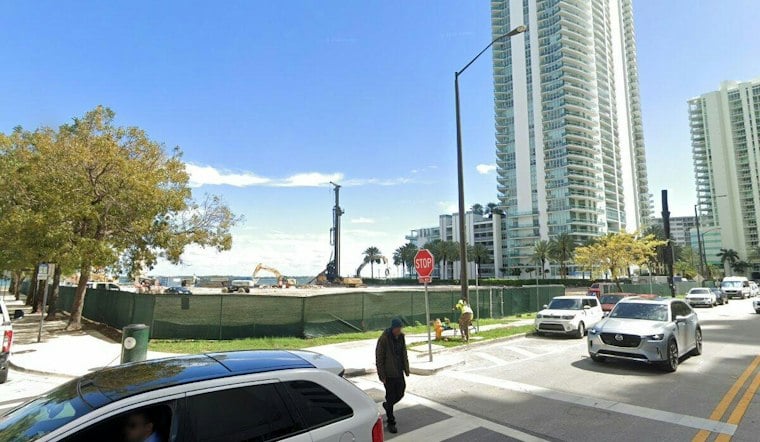
Construction came to a sudden stop on September 14, when an 85-foot drilling rig collapsed at the Brickell site, injuring four people. CBS News Miami reported the rig fell onto Brickell Bay Drive, crushing three vehicles — including one that caught fire — along with a construction container. All construction and operations at the 1201 Brickell Bay Drive site have ceased pending completion and acceptance of an investigation and report, the same Real Deal account of the pause notes.
It is not the first construction-safety episode on a major Brickell project. In 2020, a bundle of rebar fell at the 830 Brickell construction site, injuring six workers, and a scaffolding collapse at Echo Brickell left five people injured and one dead, according to the same reporting on the Citadel pause. Those earlier incidents came years after the 2021 collapse of Champlain Towers South in Surfside, which prompted Florida lawmakers to pass landmark condominium safety legislation and pushed Fannie Mae and Freddie Mac to tighten condominium lending standards — changes that have left some older South Florida condos no longer affordable to maintain, per the trend described in the same Real Deal feature.
Rents Climb While Wages Stall
Beneath the supertall skyline and nine-figure home sales, the affordability gap is widening. Miami was named the least-affordable U.S. city for renters among 182 cities surveyed, according to WalletHub data reported by the Miami Herald. The city's median monthly rent of $1,758, annualized, is nearly 34 percent of its $62,462 median annual income, and the Herald's report notes that New York ranked 161st and San Francisco 43rd on the same list — both more affordable for renters than Miami.
Nearly 60 percent of renters in the Greater Miami area are considered rent-burdened, paying at least 30 percent of their income toward housing, the same Herald report found, and Miami-Dade County needs roughly 90,000 additional units affordable to residents earning 80 percent of the area median income. Miami rents have climbed by more than 50 percent over the past decade by some estimates, while wages have not kept pace, according to The Real Deal's reporting.
The pressure is also showing up in enrollment figures. Miami-Dade County Public Schools reported a 4 percent drop in enrollment, from 326,279 to 313,220 students, between the 2024-25 and 2025-26 school years, according to K-12 Dive. The district has approved a plan to close or consolidate nine schools during the 2026-27 school year, a move it expects will save $10 million.
Meanwhile, the Federal Reserve raised interest rates for the first time in three years, disappointing buyers who had expected borrowing costs to fall, The Real Deal's reporting notes. South Florida's working class has been pushed away from the cities and neighborhoods it serves, the magazine's account adds, and some local real estate agents and small businesses have struggled or closed as new development has replaced them.





