

























































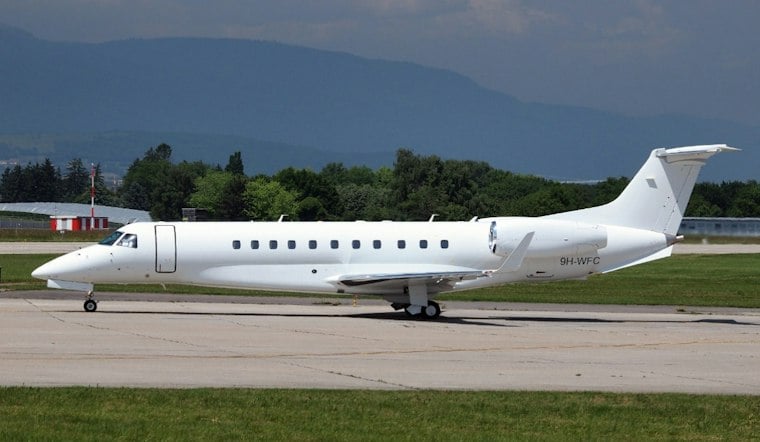
A Miami-area startup called Aegis Air began selling seats this week on a tiny private jet flying between Opa-Locka and Caracas, charging $3,750 each way for travelers willing to pay a steep premium for private-terminal service at Venezuela's recovering main airport. The company launched the service on Tuesday with a 16-seat Embraer E135, offering two round trips a week between Miami Opa-Locka Executive Airport and Caracas's Simón Bolívar International Airport at Maiquetía.
A Private-Terminal Pitch for a Narrow Market
Aegis Air operates the flights as Part 380 public charters, a federal framework that, according to the eCFR, requires charter operators to have an accepted prospectus on file before they can sell individual seats, with built-in consumer protections for passengers. As reported by ch-aviation, the aircraft itself is wet-leased from Aero, a Part 135-certified U.S. private jet airline that supplies both the plane and crew for the route. The jet has 16 leather seats arranged one-by-one down the cabin, according to Private Jet Card Comparisons, which also reported the per-seat fare of $3,750 each way, or $7,500 round trip. Aero separately flies four E135 aircraft in its fleet and is set to begin operating Blade's seasonal New York-to-South Florida service starting November 19, per the same outlet's reporting.
Aegis Air chief executive Ross Thompson told AeroXplorer that passengers get an air-conditioned private terminal, luggage handling and ground transportation, with check-in required about 20 minutes before departure. Southbound flights depart at 9 a.m., and northbound returns leave Caracas at 2 p.m., per the same report. Thompson said his team can also help with entry requirements, including visas where applicable, and described the service as filling a gap for travelers who want a more controlled arrival experience than commercial terminals currently offer.
Who Aegis Air Is Chasing
The carrier is targeting bankers, business executives, diplomats, lawyers and affluent members of the Venezuelan diaspora, according to ch-aviation, with AeroXplorer's reporting adding oil and gas executives and international attorneys among the customers local reporting has identified. Thompson described demand for secure business travel to Venezuela as growing, and he pointed to major oil deals announced by the Trump administration, along with infrastructure rebuilding work following the June earthquakes, as reasons the commercial air links are expanding. He has worked in intelligence, security and crisis management since 2006 and founded Covac Global, a medical repatriation provider, before co-founding Aegis Air with Frank Ornstein, a former Four Seasons executive who leads a Palm Beach-based hospitality investors group, per AeroXplorer.
Thompson said his prior security aviation work generated a flood of requests once Venezuela opened back up, and he and Ornstein are now exploring broader hospitality deals in Latin America, including a potential hotel purchase in Caracas, AeroXplorer reported. Thompson also said the hospitality investors group's projects in Colombia and Turks and Caicos already carry built-in demand that could feed future Aegis Air routes. The launch is currently self-funded, though Private Jet Card Comparisons reported that Thompson says several investors have expressed interest, and ch-aviation noted the company ultimately aims to own its own aircraft rather than lease them.
Caracas Airport Still Running on Temporary Terminals
The timing follows a chaotic stretch for Venezuelan aviation. Earthquakes struck on June 24 and killed more than 6,500 people, according to AeroXplorer, damaging Maiquetía's main runway and terminals in the process. The airport reopened September 1 using temporary modular terminals, and Venezuela's transport minister, Francisco Garcés, estimated that recovery of the original airport facilities would come around the end of the first half of 2027, per the same report. Separately, Latin Times reported that 19 carriers, 11 of them international, were already flying through those provisional structures, with weekly international flights climbing to 178 in September from 157 in May. ALTA chief executive Peter Cerdá warned that the temporary setup could remain in place for another eight or nine months.
Thompson told AeroXplorer that airport customs and immigration facilities continue to experience disruption, a friction point Aegis Air is positioning its private-terminal model to sidestep. The broader U.S.-Venezuela reopening traces back to the lifting of flight restrictions after the January U.S. military operation that removed Nicolás Maduro from power, per AeroXplorer. American Airlines became the first U.S. carrier to return on April 30 after nearly seven years away, flying Embraer 175 jets following a March approval from the U.S. Department of Transportation.
Crowded Skies as Majors Pile Back In
American Airlines scheduled twice-daily Miami-Caracas flights starting September 3, according to AeroXplorer, and restored its second daily frequency on October 15, per Latin Times. NBC6 reported round-trip fares as low as just over $1,000 in May and above $2,700 in late April when the route relaunched. American also plans nonstop Miami-to-Barcelona, Venezuela service starting January 15, 2027, with three weekly flights on Embraer 175 jets featuring a premium cabin, Wi-Fi and in-seat power, per the Miami International Airport announcement, which separately described the carrier's current Caracas service as twice-daily.
Laser Airlines has scheduled daily Miami service operated by GlobalX, and United Airlines has a confirmed January 12, 2027 start date for its Houston-Caracas route, according to Latin Times, after an earlier push-back of that comeback. JetBlue Airways has said it would start flights between Fort Lauderdale-Hollywood International Airport and Caracas by year-end, per the Miami Herald. Against that backdrop, Aegis Air is framing itself as something different: a niche product for travelers who value privacy and handling over cost, AeroXplorer reported, with its founder describing the long-term goal as becoming the JSX of Latin America and the Caribbean. JSX currently seats 30 passengers on its Embraer E135 and E145 jets, nearly double Aegis Air's 16-seat cabin, according to the same report.
What Comes Next for the Route
Each weekly Aegis Air schedule adds 32 seats in each direction, AeroXplorer noted, on a roughly 1,360-mile sector that takes just over three hours to fly. ch-aviation reported that Aegis Air expects to add Houston-Caracas service soon, followed by a Washington, D.C. route, and is in discussions with other operators about additional services that could eventually extend to VIP-configured Boeing 757s. The company also sees opportunities to serve high-end resort destinations beyond Venezuela and beyond the range of its Embraer E135 aircraft, according to the same report. For now, Aegis Air remains what AeroXplorer describes as a virtual carrier founded this year, betting that executives, diplomats and members of the Venezuelan diaspora will keep paying a premium to avoid the crowded, still-recovering terminals at Maiquetía.





