

























































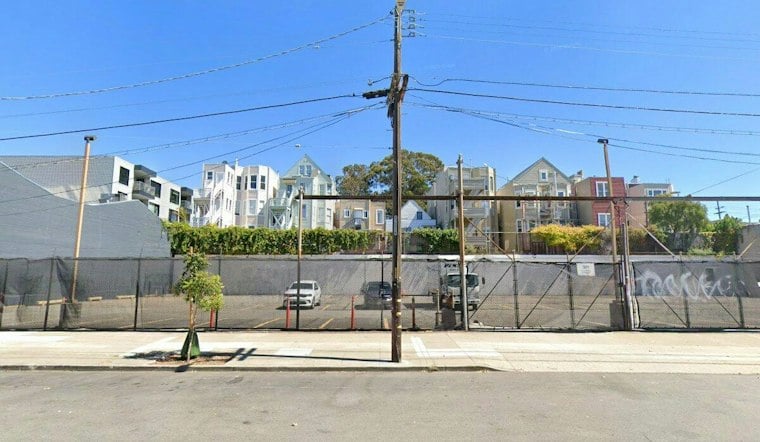
A half-acre surface parking lot along Florida Street between 16th and 17th streets in San Francisco's Mission District is about to become a nine-story apartment building, with groundbreaking planned for next month on one of the only large market-rate residential projects to start construction in the city in years. The 152-unit project at 321 Florida Street is backed by a $61.7 million construction loan from PNC Bank, secured by developer DM Development and investment firm Ascentris in their first joint venture together.
According to San Francisco YIMBY, which has tracked the property since 2020, the project saw permit activity as recently as August and plans to begin groundbreaking in November per a press release. The nine-story, Type I concrete building is scheduled to wrap construction in late 2028, according to a press release from Ascentris, with 39 covered parking spaces and roughly 10,000 square feet of indoor-outdoor rooftop amenity space built into the design.
The scale of the moment is hard to overstate. Per Private Real Estate Daily, citing IREI, 321 Florida Street is expected to become only the second market-rate apartment project with more than 28 units to break ground in San Francisco since 2023, with construction expected to start in November 2026. The outlet describes a lack of comparable starts and an unfinanced pipeline, making this groundbreaking one of just two of its size in three years.
What's Actually Getting Built
Permit filings reviewed by the same outlet show the 107-foot structure totals 154,400 square feet, including 1,340 square feet of ground-floor commercial retail and a nearly 14,000-square-foot garage that uses mechanical stackers to squeeze more parking onto the tight urban lot. The building will hold a mix of studios, one-bedroom, and two-bedroom units, with 15 of the 152 apartments set aside as affordable housing serving very low-income to moderate-income households.
Exterior renderings should remain accurate to the finished project, the YIMBY report notes, even though the total unit count and interior layout have been modified since the original designs were approved in 2021 by Handel Architects. The building's exterior will feature patina metal cladding above board-formed concrete pilasters, paired with floor-to-ceiling windows throughout.
Amenities lean upscale: shared tenant spaces, hot and cold plunges, a coworking space, fitness centers, a rooftop terrace, and even a residential theater. The San Francisco Chronicle's reporting, relayed by the same outlet, states that DM Development modeled those offerings after Strada Investment Partners' 555 Bryant Street complex in SoMa, one of the few large market-rate residential projects completed in San Francisco since the pandemic.
Community Benefits and Sustainability Targets
Beyond the apartments themselves, project endorsement documentation from the Housing Action Coalition shows the all-electric design targets a Silver Greenpoint rating. The project also includes 118 bicycle parking spaces, improvements to nearby Franklin Square, and rent-free community arts space, according to the same filing. The site sits close to both Franklin Square and the grocery-anchored Potrero Center shopping mall, placing it within walking distance of neighborhood amenities.
DM Development's footprint in the surrounding neighborhoods is substantial. Hoodline previously reported on 300 De Haro Street, the developer's 425-unit affordable housing project in nearby Potrero Hill, which broke ground using state-streamlined permitting under Senate Bill 35.
A Housing Deficit the City Is Legally Bound to Fix
The project is scheduled to deliver in late 2028, amid a shortage of competing new supply.
Whether one groundbreaking signals a broader thaw in development lending across the city, or simply reflects one well-capitalized firm pushing a deal forward on its own, remains an open question. What's not in dispute is the gap between the city's housing pipeline and its legal obligations: the San Francisco Planning Department's Regional Housing Needs Allocation framework requires the city to plan for 82,069 new housing units between 2023 and 2031, with more than 46,000 of those designated for low- and moderate-income households.
City officials have also moved to speed up approvals for projects like this one. 321 Florida Street's 152 units represent only a small fraction of what the city still needs to build to meet its state-mandated housing targets by 2031.





