

























































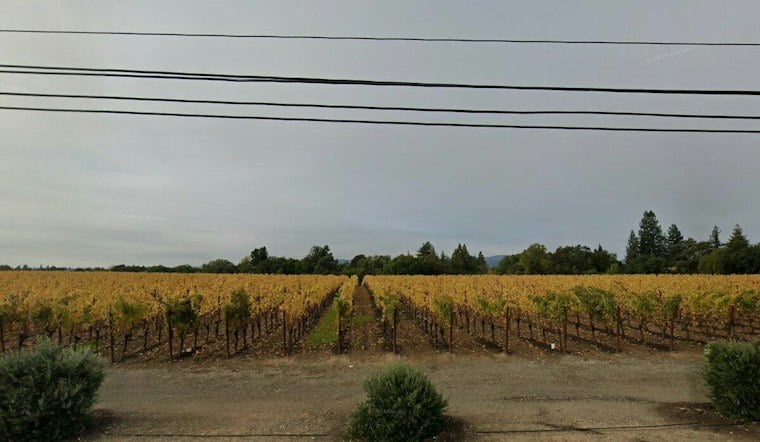
The Napa County Planning Commission approved the ONTRAIL Vineyards micro-winery, proposed off Silverado Trail near Soda Canyon northeast of Napa, on a 4-1 vote Wednesday. The decision followed a review process of nearly two years, with commissioners considering a projected reduction in groundwater use as well as requests for more analysis of possible effects on nearby streams. Applicant Jim Fassio backs the project.
The proposal first came before the Planning Commission in November 2024 and then had three zoning administrator hearings before the commission’s decision, according to The Napa Valley Register. The 13-acre property is at 3252 Silverado Trail. The reported phased plan would convert a 1906 barn into production space for fermenting and aging and turn a farm labor office into a tasting room in the first phase; a second phase would add a winery building. The completed operation could host up to 70 visitors a week.
The Register's report on the vote describes a planned capacity of 450,000 gallons annually for the separate E&P winery, while a separate CEQA project summary filed with the state describes ONTRAIL as a 5,000-gallon-per-year winery with daily tours.
Groundwater Plan Hinges on Irrigation Cuts
The county’s approval rests in part on a projected reduction in annual groundwater use, from 6.87 acre-feet to 5.99 acre-feet, despite the addition of a winery. The county report attributes part of the reduction to improved vineyard irrigation. Commissioner Kara Brunzell described the small winery as a potential benefit for county water use if it proves financially viable, and supported metering the wells, according to the Register. The approval requires meters on the property’s three wells and that the owners share the data with the county.
That projection did not settle questions about the property’s past water use or the stream effects of future pumping. Walter Brooks argued that the estimate of past use was not based on hard measurement and sought a more in-depth Tier 3 well analysis. Brunzell responded that county policy does not require that review and that the commission lacks authority to demand it, the Register reported. The property also has an unmetered well near Hardman Creek.
Opponents Wanted a Full Environmental Review
Opponents Wanted a Full Environmental Review At a separate hearing on the E&P project, Napa-Solano Residents for Responsible Development, a group representing labor interests, told the commission an environmental impact report was needed before that project could move forward. At that hearing, Commissioner Megan Dameron asked that an environmental impact report weigh long-term habitat protection, stormwater impacts and effects on migratory birds, while acknowledging that the E&P project satisfies the county's setback requirement for Sheehy Creek. Brunzell said the commission would look further into Sheehy Creek the following year, the Register reported.
The fight over ONTRAIL's wells is playing out against a broader, long-running dispute between Napa County and the advocacy group Water Audit California over the county's public trust obligations — a disagreement the Register says has simmered across multiple projects for several years, including a separate case involving the Inn at the Abbey project near St. Helena. That fight centers on whether wells located near streams deplete flows during hot months in ways that harm aquatic life. Water Audit California has argued in letters that the groundwater reduction plan for ONTRAIL does not go far enough, while William McKinnon, cited in the same reporting, said a trustee cannot determine feasible protective steps without first establishing the harm caused by pumping.
County Rules Don't Address Timing of Pumping
Under county policy, wells within 1,500 feet of designated streams generally require a Tier 3 analysis, but an applicant may instead assume a well and stream share groundwater and reduce pumping to offset the impact. The Register reported that the county’s analysis for ONTRAIL does not determine whether pumping after that reduction would protect the stream. It also does not propose changing when water is pumped, even though pumping timing affects dry-season stream-flow depletion.
Regional Groundwater Records Offer Context, Not a Site-Specific Answer
Napa County’s 2016 Basin Analysis Report characterized overall groundwater conditions in the Napa Valley Subbasin as stable during its 1988-2015 study period. That broad finding does not establish conditions at the ONTRAIL property. A California Department of Water Resources staff report also noted that groundwater levels in the northeastern area of the Napa subarea declined 10 to 30 feet from 2000 to 2010; it does not identify the ONTRAIL wells or establish current conditions there.
What Groundwater and Stream Monitoring Shows
Napa County’s 2016 basin report described a subbasin-wide network of 113 groundwater-monitoring wells, 100 monitored by the county. It said the Napa Valley Subbasin had operated within its sustainable yield for at least 10 years, according to the Napa County report. For streamflow, the California Department of Water Resources and Napa County are bringing gages online at five Napa River watershed locations to extend monitoring into areas that had been largely unmonitored, according to the department.
The debate arrives as Napa County weighs broader changes to the water-availability-analysis rules that have governed groundwater use for new development since 1990. Those proposed changes, which would require metering for projects that change or intensify water use, went before the Napa County Board of Supervisors on Oct. 13 for feedback rather than a vote. The county has historically approved projects where applicants could show a property would pump less groundwater overall despite adding or expanding a winery — the same logic underpinning the ONTRAIL approval.
Separately, the same Planning Commission meeting included a hearing on the scope of an environmental review for a different, unrelated project — proposed E&P buildings in the airport industrial area next to Sheehy Creek, which would include a winery and warehouse. No members of the public spoke at that portion of the hearing, the Register reported.





