

























































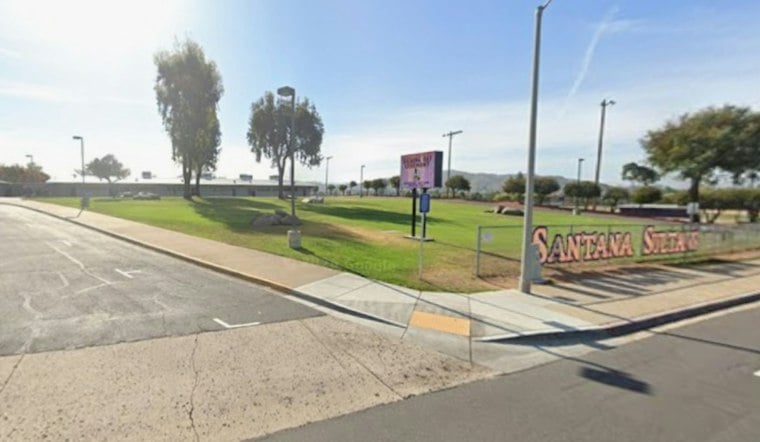
Governor Gavin Newsom signed Assembly Bill 1959 into law on September 27, 2026, closing a legal gap that nearly allowed a convicted teenage mass shooter to walk free with little more than probation. San Diego County District Attorney Summer Stephan and Assemblymember Dr. Darshana Patel marked the signing this week, framing it as a fix for a loophole exposed by the case of 2001 Santana High School shooter Charles “Andy” Williams.
Stephan joined Patel to mark the bill's signing in a post from the SD District Attorney
account, stating that AB 1959 closes a gap in California's juvenile resentencing laws highlighted by the Santana High shooting and strengthens accountability and public safety. The new law, chaptered as Chapter 563 of the Statutes of 2026 after its August 27 enrollment, according to the
Office of Governor Gavin Newsom
, amends Section 707 of the Welfare and Institutions Code to let prosecutors request transfer hearings for now-adult offenders who committed violent crimes at age 14 or 15 and are seeking sentence recalls under Penal Code 1170(d).
The Loophole the Bill Was Built to Close
The prospect that Williams could be released, potentially with juvenile probation, raised concerns about public safety.
That gap became impossible to ignore after San Diego Superior Court Judge Lisa Rodriguez ruled on January 6, 2026 that Williams was eligible for sentence recall, finding his 50-year-to-life sentence functioned as the equivalent of life without parole under evolving state juvenile resentencing standards, per the Times of San Diego. Stephan immediately appealed the ruling, a move Hoodline first reported in January.
The 2001 Shooting That Started It All
Williams was 15 when he opened fire with a .22-caliber revolver at Santana High School in Santee on March 5, 2001, killing 14-year-old Bryan Zuckor and 17-year-old Randy Gordon and injuring 13 other students and staff members, according to CBS 8. He was tried as an adult in 2002 and sentenced to 50 years to life in state prison.
The timing of Rodriguez's recall ruling drew particular scrutiny because the California Board of Parole Hearings had denied Williams parole in September 2024, determining he still posed a public safety threat, per the San Diego DA NewsCenter. That denial preceded his successful petition to a trial court for sentence recall under state juvenile law.
A San Diego juvenile court judge ordered Williams to remain incarcerated while the DA's appeal of his recall proceeds before the California Fourth District Court of Appeal, CBS 8 reported. Defense attorneys had sought his immediate release from prison pending that appellate process. Williams remains in state prison as that appeal continues to work its way through the courts.
Bipartisan Push Through Sacramento
AB 1959 addressed restrictions on sentence recall petitions for juvenile mass shooters and school-zone offenses. A later amendment, on April 9, 2026, authorized prosecutor-requested transfer hearings under Welfare and Institutions Code 707, giving judges case-by-case discretion rather than a blanket prohibition.
The measure, authored by Patel and sponsored by San Diego prosecutors, passed with unanimous bipartisan support: a 69-0 vote in the State Assembly on May 21, 2026, followed by a 34-0 vote in the State Senate on August 20, 2026, per LegiScan. Patel has pushed other public safety measures this year, including AB 237, a measure addressing mass school threats, mentioned in Hoodline's report on a Carlsbad school lockdown. Patel is currently seeking reelection in a race Hoodline has also profiled, North County's 76th Assembly race.
What Changes Going Forward
AB 1959 provides for judicial consideration of transfer factors when deciding whether a person should be transferred from juvenile court to criminal court. The jurisdictional gap had emerged after California appellate and supreme courts expanded juvenile recall options under Penal Code 1170(d) for offenders serving lengthy de facto life terms, inadvertently leaving 14- and 15-year-old offenders without the same risk review applied to older juveniles.
The law establishes a permanent statutory standard for future cases. Williams' case remains the subject of an appeal even as the legislation it inspired is now on the books statewide.




