

























































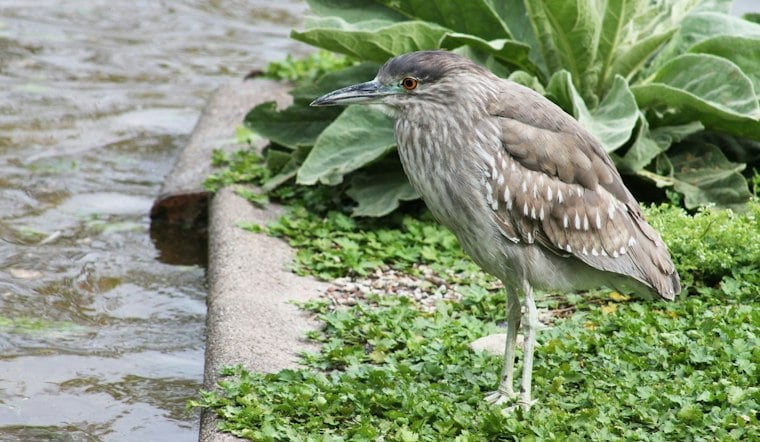
A planned affordable housing development at 285 12th Street would bring apartments for some of Oakland’s lowest-income residents to an empty lot at 12th and Harrison streets. Four Indian laurel ficus trees beside the site hold 81 black-crowned night-heron nests — 66% of all nests counted citywide in 2026 — and may have to be removed when construction begins. The project puts the housing need and the future of Oakland’s official bird’s largest gathering place in direct tension.
A Rookery Larger Than Any Other in Oakland
The four trees at the corner, along with three across the street, host black-crowned night herons and snowy egrets that breed there each spring and summer. The dispute has also drawn coverage from Coyote Media. CBS News reports that the rookery hosts nearly 100 nests in total. The birds contribute to regional biodiversity, but they are also loud and messy, leaving droppings on sidewalks, parked cars and pedestrians below, the station reports.
The danger cuts both ways. In 2019, a mature ficus tree loaded with heron nests split and partially collapsed, sending dozens of newborn chicks crashing to the ground; the surviving chicks were rescued and taken to the International Bird Rescue center, per the same account. Mature ficus trees carry a risk of limbs breaking and falling on property or on the nests themselves, and chicks and fledglings that tumble onto hard concrete can suffer broken legs, broken wings, and damaged internal organs, CBS News reports. Predators may find injured birds that rescuers do not reach in time.
The Housing Project Moving Forward Below the Nests
The development planned for 285 12th Street is being built by the nonprofit East Bay Asian Local Development Corporation, known as EBALDC, according to Coyote Media. Accounts of the project's size differ: Coyote Media and SFYIMBY both describe a 65-unit building, with SFYIMBY breaking it down as 15 studios, 16 one-bedrooms, 17 two-bedrooms and 17 three-bedrooms, while the Oakland Housing Authority states the development will provide 64 units of affordable family housing. CBS News separately reports the project plans 64 units of affordable housing. All units will be restricted to households earning 30% to 60% of Area Median Income, with 13 reserved for people exiting homelessness, according to the Oakland Housing Authority.
Oakland and EBALDC were jointly awarded $35.9 million in state climate-action funding to support the 285 12th Street development and related transportation improvements, the housing authority reports. Initial grading and site-preparation permits for the parcel were submitted on July 2, 2026, according to SFYIMBY. Coyote Media reports that when ground breaks on the lot later this year, it is likely the four ficus trees on the corner will have to come down.
Oakland has a critical and growing need for low-income housing, and affordable projects in the city routinely carry long waitlists, Coyote Media notes. Oakland's Housing and Community Development Department frames its mission around a “3P” approach — protecting residents from displacement, preserving existing affordable stock, and producing new deeply affordable units — per the housing authority. Ryan Nakano has said the herons symbolize Oakland residents who face displacement, tying the fate of the rookery directly to the affordable-housing fight, according to CBS News. Nakano has also said the heron represents Oakland because it is resilient, even while acknowledging the birds are loud and messy.
Past Relocation Attempts Have Fallen Flat
Efforts to relocate Oakland's herons back to Lake Merritt have had limited success, according to the San Francisco Bay Bird Observatory, which notes that tree removal rarely resolves these conflicts because the birds simply nest in other nearby trees. Oakland's own prior attempt lasted two breeding seasons and relied on decoy birds, transplanted empty nests, and recorded mating and breeding sounds, according to CBS News. H.T. Harvey & Associates was hired to encourage birds to leave the construction-site rookery and establish a colony near Lake Merritt as part of that effort, the station reports.
None of it worked. “The birds poo-pooed the efforts, and happily continued making stinky, messy nests downtown. Eventually, Oakland quietly killed the relocation plan,” Coyote Media reported. Trimming the trees will not prevent the birds from returning, CBS News notes, and a 2019 count by the bird observatory found just 55 active nests in Oakland, down sharply from 156 in 2018, according to The Oaklandside.
What the records and nest counts show
The project information cited above says initial grading and site-preparation permits were submitted on July 2, 2026; that submission does not establish that tree removal has been approved or set a construction start date. In broader housing context, the City of Oakland’s 2024 progress report says three affordable housing projects entitled under SB 423 included 112 units deed-restricted to VLI households, 73 LI units and 76 MI units, according to the City of Oakland. The Oaklandside reported that the San Francisco Bay Bird Observatory’s peak count of active nests fell 64% between 2018 and 2019, while noting that temporary disturbances at one rookery can shift counts to others. The change in nest counts alone does not establish a change in the overall bird population. In a separate Oakland effort in November 2017, H.T. Harvey retrieved 130 night-heron and 20 snowy-egret nests downtown as part of a relocation effort paid for by Holland Partners, The Oaklandside reported.
The bird observatory previously partnered with the Oakland Zoo, International Bird Rescue, Golden Gate Audubon, and California Fish & Game on a collaborative plan to plant Chinese banyan and Brazilian peppertree species herons favor in a neglected strip of green space near a slough, several blocks from the colony's current sites, according to the bird observatory. In 2015, the Golden Gate Bird Alliance, Oakland Zoo, and International Bird Rescue formed a separate partnership after tree trimmers knocked down active nests, according to the Golden Gate Bird Alliance.
A Rare Success Story From Long Beach
One comparable effort did succeed. A black-crowned night-heron colony in Long Beach was relocated after its former site was threatened by port development, according to the Conservation Evidence Journal. Workers moved 50 mature trees two kilometers away, placing them near roughly 70 existing trees, and used recordings of the original colony's vocalizations, decoys placed in the trees, and restrictions on public access to lure the birds in. The following year, 423 pairs of black-crowned night herons successfully fledged 1,128 chicks at the new site, the journal reported.
Oakland's Official Bird, Named by Schoolkids
Black-crowned night herons became Oakland's official bird in 2019 after a two-year campaign led by Park Day School third-graders, who launched their initiative in 2017 and described the heron as a cool and funky bird, just like Oakland, according to the Oakland Zoo. The zoo has rescued 87 egrets and night herons since nesting season began in March, a 28% increase over the previous year, per Coyote Media. The zoo runs a dedicated heron rescue team that patrols downtown streets, and injured birds it recovers often end up at International Bird Rescue, which operates an intensive-care unit in Fairfield, CBS News reports.
JD Bergeron has said the center provides critical care like a hospital, and that small snowy egrets and black-crowned night herons are currently receiving treatment there, according to CBS News. An egret chick at the center needs an incubator to survive because it cannot yet regulate its own body temperature, the station reports. Bergeron has also said urban environments can be unsafe for birds and problematic for nearby residents, and suggested removing the trees could ultimately be positive for the birds themselves.
EBALDC, which develops the 12th and Harrison project, declined an interview request and referred questions about the project to the City of Oakland, according to CBS News. The city in turn provided a report prepared by H.T. Harvey & Associates. Those involved in the project say they hope to find safe spaces for both people and birds, CBS News reports, even as the fate of downtown Oakland's largest rookery remains tied to a construction timeline still taking shape.





