

























































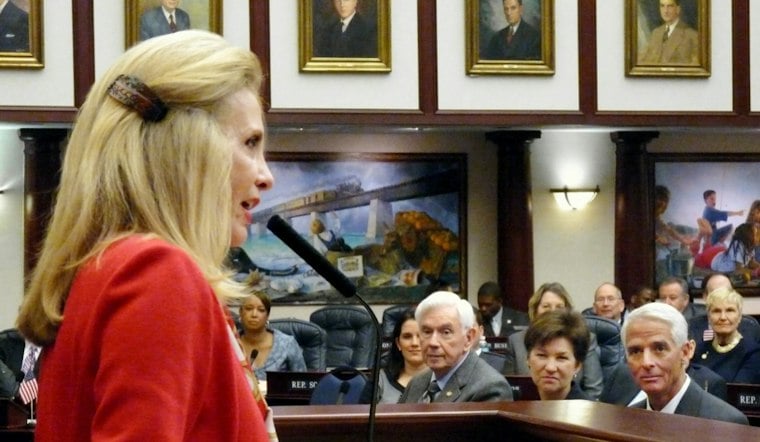
More than 1,000 people tried to RSVP for a town hall on the future of Palm Beach County's Agricultural Reserve this week, but the Andre Fladell South County Civic Center only had room for about 300. County officials closed the doors by 9:30 a.m., leaving a packed house to shout, stand, and chant through nearly two hours of debate over development creeping into the 22,000-acre farming belt.
The Thursday meeting, hosted by Palm Beach County Commissioner Maria Sachs, was billed as a broad planning forum on Ag Reserve growth, infrastructure, and housing rather than a vote on any single project, according to a county statement reported by BocaNewsNow.com. But as WPTV reported, the discussion centered squarely on already-approved projects — including a DMV office, a nursing home, and an Islamic center school — that residents say never got a real public airing before moving forward.
Sachs had only until 11 a.m. to run the discussion, the station's report notes, and she used part of that window to defend the right of attendees to vent. She said residents have the right to voice concerns and hold elected officials accountable, and told the room she has voted against every Agricultural Reserve development project to come before the commission.
A Notification Fight Turns Physical
Tempers flared most visibly around the issue of who gets told when a major project is coming to their backyard. Attorney Pamela Higer-Polani, who lives in the Ag Reserve, argued that residents who never received notice had no way of knowing a commissioner vote was even happening, and said anyone within 1,000 feet of a proposed project should be notified — double the current 500-foot radius. Palm Beach County Sheriff's Office deputies escorted her back to her seat, per the same account from WPTV.
The Boca Raton Tribune similarly reported that Higer-Polani was escorted out by sheriff's deputies after pressing the same 500-to-1,000-foot notice demand, and that the room reached its 300-person capacity by 9:30 a.m. with former Boca Raton Mayor Scott Singer among those in attendance.
Why Some Projects Never Reached a Commission Vote
Much of the frustration traces back to a quirk in the county's approval process. Under Palm Beach County's Unified Land Development Code, certain civic, educational, and house-of-worship conditional uses can proceed through administrative staff reviews and zoning board approvals without ever requiring a public hearing vote by elected commissioners, a pathway confirmed in planning documents cited by BocaNewsNow.com. The Islamic Center School's formal application was submitted and assigned its application number in 2022; the school and daycare conditional uses received final approval from the Board of County Commissioners in September 2023.
The project, filed as Application No. SV/CA-2022-01490, calls for a 57,912-square-foot complex with a 382-student school, a 32-child daycare, and 219 parking spaces that planning documents project will generate more than 1,000 additional vehicle trips per day. Opponents have pointed to traffic congestion and stormwater drainage on the former nursery site as chief concerns, per the same documents reviewed by BocaNewsNow.com.
The Islamic Center project also prompted calls from residents for stricter background checks and more disclosure about applicants and project funding, according to WPTV. Sachs directed those questions to attorney Brian Seymour, who represents the applicant through the Gunster law firm. Separately, the Boca Raton Interfaith Clergy Association urged respect and tolerance, saying faith communities have the right to gather and build houses of worship and community centers, and condemning hatred, bigotry, and intolerant remarks about faith traditions.
Sachs Floats Rule Changes, Promises a Second Meeting
Sachs told the crowd she plans to introduce changes requiring future Ag Reserve development applications to receive explicit approval from elected county commissioners rather than clearing through administrative review alone. She also encouraged residents to contact all seven county commissioners directly, noting that any attempt to revisit already-approved projects like the Islamic Center would likely require legal action, per her comments to WPTV.
Because the room filled before most people who showed up could even get inside, Sachs said she plans to hold a second public meeting to continue the conversation, though no date or location has been finalized. That next gathering, she acknowledged, will likely need a much larger venue.
A Preservation Tier Under Pressure
The anger at Thursday's meeting didn't emerge in a vacuum. The Agricultural Reserve was established under the county's 1980 Comprehensive Plan with agricultural, environmental, and water-resource preservation goals, covering roughly 22,000 acres between Hypoluxo Road and Clint Moore Road, according to the Sierra Club. In March 1999, voters approved a $150 million land acquisition bond that set aside $100 million specifically to buy and permanently preserve roughly 2,400 to 2,500 acres of farmland and environmentally sensitive land in the reserve.
The Ag Reserve's development options were reset by a 1995 Palm Beach County Commission decision. Residential developers seeking one unit per acre must set aside at least 60% of their project as permanent agricultural or environmental preserve — a requirement developers have repeatedly petitioned the county to loosen. County planning data shows that by 2021, about 58%, or more than 12,400 acres, of the reserve remained protected through public ownership and conservation easements, even as more than 9,400 homes and commercial projects had been built there since 2000, the Sierra Club has reported.
Residents' wariness was also fed by a more recent precedent: in May 2023, the Palm Beach County Commission voted 5-2 only to initially transmit the GL Homes land-swap proposal for state review, and the swap was later rejected, according to Stet News. Opponents at the time warned the vote set a precedent for further speculative development inside the protected tier.
Beyond farmland, the reserve also functions as a recharge zone for the region's drinking water aquifer and provides natural stormwater filtration that cuts pollutant runoff into South Florida waterways, according to environmental documentation cited on MariaSachs.com. Converting that permeable agricultural soil into asphalt and concrete, the same documentation notes, increases stormwater runoff and local flood risk — the exact tradeoff residents said they came to Thursday's meeting to fight.





