

























































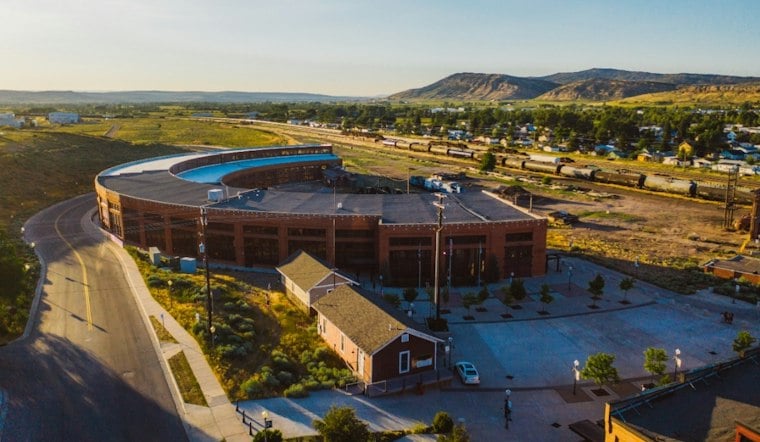
Alpine Distilling has moved its bulk distilling operations into one of Wyoming's most unusual industrial landmarks: a 113-year-old railroad roundhouse in Evanston that had been restored and used for other purposes during the past half-century. The Park City-based craft spirits maker opened the new facility inside the historic Roundhouse this month, marking its first expansion across state lines after a decade of operating solely in Utah.
Founded in 2016 by Sara and Rob Sergent, Alpine Distilling is now using the Evanston site to expand production of its whiskey and botanical spirits portfolio, according to the Park Record. The move involved relocating bulk distilling and manufacturing operations from the company's former Silver Creek property into the Roundhouse's bays. Sara Sergent, who serves as Alpine's CEO and Master Botanical Distiller, said the company intends to settle into the space for at least the next 10 years.
A Union Pacific Landmark Gets a Second Act
The Roundhouse & Railyards complex Alpine has moved into is no ordinary industrial building. Union Pacific Railroad began building the 27-acre complex in 1912, and the structure that still stands today held 28 locomotive bays across 63,000 square feet, with curved walls rising roughly 30 feet, according to Wyoming Architecture Magazine. It's considered the last intact roundhouse remaining on the former Union Pacific mainline between Omaha, Nebraska, and Sacramento, California, per the Park Record's report.
After Union Pacific planned to shutter the facility in the 1920s, Evanston residents persuaded the railroad to repurpose it as a reclamation plant. The plant operated until Union Pacific closed it in 1971 and returned it to the city. The complex was added to the National Register of Historic Places in 1985, and its original 100-foot turntable remains operational today, a detail Atlas Obscura highlights among the site's preserved features. Evanston's own facilities page notes the complex was constructed in 1912-1914, per the City of Evanston.
Why the Sergents Chose a Railroad Relic
While the Roundhouse had other uses during that period, Alpine is now the first operational business inside the space in 50 years, and Rob and Sara Sergent have said the building's history lines up with their own vision for the company. “Distilling comes from that same tradition,” Rob Sergent said, per the Park Record's account. “We have the opportunity to respect this building's history while giving it another working chapter.”
Sara Sergent echoed that sentiment, saying Alpine intends to honor the Roundhouse's past rather than simply occupy it. “We want to become part of its story,” she said. The company plans to eventually open its distilling process to the public through education, experiences and retail, though those offerings have not yet launched at the Evanston site.
Utah Roots Stay Put as Wyoming Production Ramps Up
Despite the cross-border move, Sergent was clear that Alpine isn't leaving Park City behind. “Alpine Distilling remains a Utah-founded business and its Evanston site extends rather than replaces its Utah operations,” she said, framing the Wyoming facility as additive rather than a relocation. She pointed to geography as part of the appeal: “Evanston's proximity to Park City also makes it a natural extension of our existing operations, allowing us to remain closely connected to our Utah team, customers and community.”
The company's Social Aid & Pleasure Club remains Alpine's public-facing home on Park City's Main Street, continuing to host hospitality, custom gin making, botanical education and community gatherings. The Evanston facility, by contrast, is oriented toward production as the company works to grow what began as a Utah brand into a broader regional and national presence.
Expansion Bucks a Rough Stretch for Craft Spirits
Alpine's cross-state push comes at a tough moment for the broader craft distilling industry. U.S. craft spirits sales totaled 12.7 million nine-liter cases and $7.58 billion in 2024, down 6.1% in volume and 3.3% in value from the year before, according to the American Craft Spirits Association. The number of active U.S. craft distillers fell 25.6% between August 2024 and August 2025, dropping from 3,069 to 2,282, and total industry investment declined for the first time on record, reaching $811 million in 2024.
Against that backdrop, selling beyond a home state has become increasingly central to craft producers' survival, with 51.5% of U.S. craft spirits sales in 2024 occurring outside producers' home states, per the same industry report. Alpine has already been building that kind of footprint; the company expanded its Whole Foods Market partnership earlier this year as part of a push toward national growth, according to Utah Business. Alpine's Triple Oak whiskey also earned a 98-point rating and was named Spirit of the Year in 2024, a distinction noted by Utah's Own.
For Evanston, the arrival of a working distillery inside a century-old railroad relic adds a new chapter to the Roundhouse's history — one that began with a fight to save it from closure and now includes stills running under its curved brick walls.


