

























































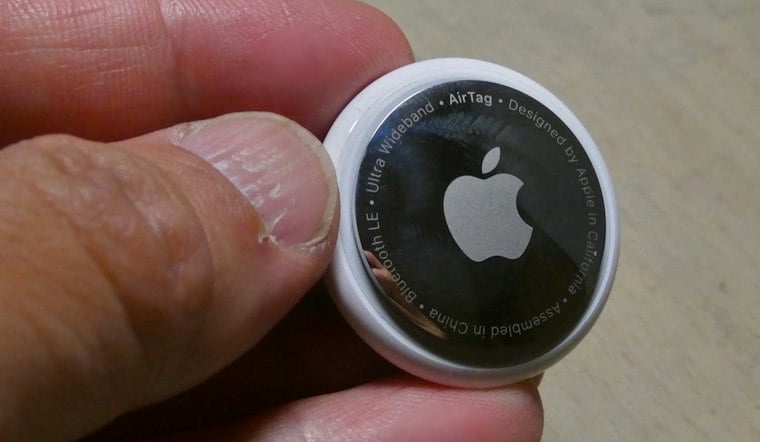
A Portland company that makes accessories for Apple products has stopped selling a tool designed to permanently silence AirTag trackers, after privacy advocates warned it could become a stalker's best friend. Elevation Lab confirmed this week that it discontinued the device, known as the Silencer, and issued a public apology acknowledging the gadget could make it easier for someone with bad intentions to secretly track another person without that person ever receiving a phone alert.
How the Silencer Worked
The Silencer instructed users to remove an AirTag's battery, position a precision steel pin over the location of its tiny speaker, and tap it with a hammer to puncture the casing and permanently destroy the speaker mechanism inside, according to TidBITS. Apple installed speakers in AirTags specifically so the devices periodically chirp and alert people to a nearby tracker they didn't place themselves, a safeguard the company built in when it began selling AirTags five years ago. Elevation Lab's own CEO, Casey Hopkins, said the tool was designed with a narrower purpose in mind: improving the odds of recovering a stolen bicycle, since a silent tracker wouldn't tip off a thief that the item they took was being followed.
That is also the core tension privacy advocates flagged. AirTags are little bigger than a quarter and pair with other Apple products to help people locate luggage, bikes, backpacks and other portable items — but the same discreet size that makes them useful for finding stolen property also makes them easy to hide in a victim's car or handbag to monitor someone's movements without consent, privacy advocates have warned. Once a Silencer-modified AirTag loses its ability to chirp, a thief — or an abuser — would lose the audible warning, and the person being tracked might not receive phone notifications.
Pressure From Privacy Advocates Mounted Fast
The backlash arrived quickly. Tech journalist Glenn Fleishman of Six Colors publicly condemned the Silencer on October 1 and urged its immediate withdrawal, while Electronic Frontier Foundation cybersecurity director Eva Galperin criticized the tool for prioritizing property recovery over human safety, according to the same TidBITS report. Elevation Lab said in its statement that the Silencer could aid someone with bad intentions in tracking a person who would not receive phone notifications warning them of the device, and Hopkins wrote that the company changed course and discontinued the product because of what he called valid privacy concerns.
Elevation Lab issued its apology on Tuesday, according to The Oregonian/OregonLive, which first reported the company's reversal. The Portland firm also said it holds a patent covering the Silencer and plans to use that patent to prevent other manufacturers from selling a similar speaker-disabling product, a notable pivot from selling the gadget itself to policing the market against copycats. U.S. Patent 12,106,167, titled “Housings for tracking devices,” describes a housing with battery compartments and electrical contacts, according to Google Patents.
Not the First Attempt to Mute an AirTag
This isn't the first time modified AirTags with disabled speakers have hit the market. Back in February 2022, so-called “Silent AirTags” with deactivated speakers appeared for sale on Etsy and eBay. PCMag reported that an Etsy listing priced at $77.50 went offline and that there was also an eBay listing, while cybersecurity experts warned the devices could serve as ideal tools for stalkers, per PCMag. Apple and Google have since tried to close that safety gap at the platform level, jointly deploying the Detecting Unwanted Location Trackers specification across iOS 17.5 and Android 6.0 and higher in May 2024, which lets smartphones notify users when an unfamiliar Bluetooth tracker is traveling with them.
Apple also appears to be hardening the hardware itself. Reports on the company's second-generation AirTag this month indicated Apple redesigned the device with a louder speaker and stronger internal adhesives specifically to make manual speaker removal significantly harder, according to MacRumors. Elevation Lab, founded in Portland in 2008 by Hopkins, first gained wide tech recognition in 2012 when its ElevationDock became the first project in Kickstarter history to raise more than $1 million, according to Business Insider.
Real Stakes on Both Sides of the Debate
Federal data from the Bureau of Justice Statistics estimated that 3.4 million U.S. residents aged 16 or older experienced stalking in 2019.
At the same time, AirTags' audible chirps have helped recover stolen property locally. Port of Portland police and the FBI used an AirTag's location data in July to recover a stolen 9mm handgun at Portland International Airport, a case that illustrated the anti-theft rationale accessory makers like Elevation Lab often cite in defending tracking tools. Elevation Lab's about-face suggests that, for now at least, the company has decided the risk of enabling secret surveillance outweighs the benefit of a quieter tool for chasing down stolen bikes.





