

























































The Loomis Street entrance to the Racine Blue Line station reopened Monday with a glowing tribute to its past: a recreated 1950s-style sign lit by LED tubing designed to mimic neon, flashing messages like “4 minutes to loop” and “use rapid transit” above the Near West Side stop near the Eisenhower Expressway.
A Near-Exact Replica of a 1958 Original
The sign recreates the signage of the original Congress Line, which opened in 1958, according to Block Club Chicago. CTA General Manager Graham Garfield said it is the first replicated backlit, more elaborate CTA sign, and the agency intended it as a near-exact replica of what once hung there, right down to its colors and materials. CTA worked with the firm HNTB on the project, providing construction plans from the station's initial 1950s build so designers could match the original specifications.
Garfield, who has served as a transit manager since 1999 and runs the historical archive site Chicago-L.org in addition to overseeing CTA's Heritage Fleet program, used extensive photo references to copy the sign's playful, hand-painted-looking font. The LED tubing chosen for the new sign is more energy-efficient and longer-lasting than the neon it replaces, per Block Club Chicago's report. CTA had removed the original 1950s neon marquees at Blue Line stations by the 1980s.
Accessibility Work Finishes After About a Year
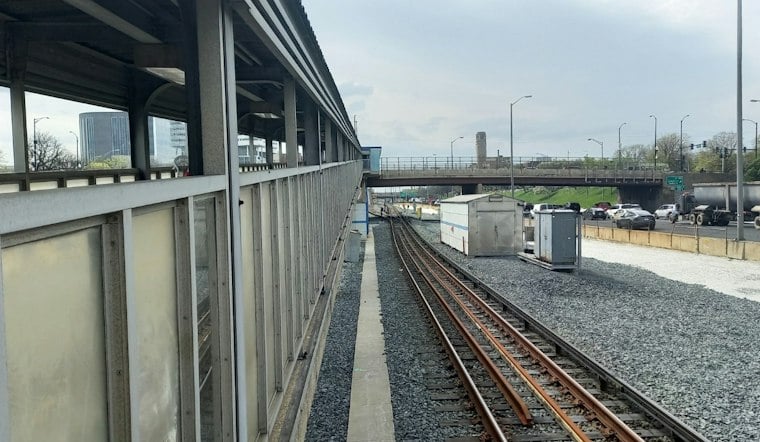
Beyond the sign, CTA completed about a year of construction to modernize accessibility at the Loomis entrance, rebuilding the Racine Avenue entrance from mid-2023 to October 2025 with a new elevator, ramp and stairs. The work is part of the broader Forest Park branch rebuild project, which includes replacing miles of track and rebuilding seven stations to comply with the Americans with Disabilities Act, as Block Club Chicago reported. Phase 1 of the broader branch rebuild cost $268 million and covered nearly three miles of track reconstruction between LaSalle and the Illinois Medical District, along with the Racine station rebuild and an upgrade to the Morgan substation, according to Railway Track and Structures.
Before that track replacement began in 2023, roughly 80 percent of the Forest Park branch was restricted by slow zones tied to six-decade-old infrastructure, per Chicago YIMBY. The Chicago Transit Board had awarded a $75.4 million contract in February 2023 to contractor F.H. Paschen, S.N. Nielsen & Associates specifically to reconstruct the Racine station and bring it into ADA compliance, according to the Chicago Transit Authority, with that contract financed through state Rebuild Illinois funding.
Preserving a Piece of Postwar Transit History
The push to preserve the Loomis entrance's look wasn't optional — CTA worked with the Illinois State Historic Preservation Office and complied with Section 106 of the National Historic Preservation Act, which requires federally assisted infrastructure projects to identify historic properties and consult with preservation officers to limit harm, per Block Club Chicago. The state preservation office specifically asked CTA to retain the Loomis Street entrance as an example of 1950s architectural and transit design. Garfield said the Racine project combines accessibility improvements with historic preservation, rather than treating the two as competing priorities.
That mid-century design matters because the Congress Line was Chicago's first major post-World War II transit station design, opening after CTA assumed control of the city's elevated rail network and streetcar system in 1947. It replaced the Garfield Park elevated line, which was demolished to make way for the Congress Expressway, with tracks placed directly in the expressway median — making it, per WTTW, the first rapid transit line in the world built in the median strip of an expressway. Congress Line stations featured glazed-brick walls, aluminum storefront-style framing and expansive windows, with bright red signs and neon lettering marking their entrances. The line was renamed the Blue Line in 1993.
At the Racine entrance, CTA restored the station house's glass-and-aluminum front while maintaining its original brick exterior, and added recreated CTA-logo door handles to match the vintage look. The entryway now also includes interpretive panels detailing the Congress Line's history and the design features the agency chose to preserve. The sign itself was installed on September 9 in the West Loop, ahead of Monday's full reopening.
Neighbors Welcome the Blend of Old and New
Hannah Thompson, a 24-year-old Near West Side resident, said she enjoys CTA projects that preserve station history. Samarth Limgarga, a 30-year-old Medical District resident who lives a two-minute walk from the Loomis entrance, said the reopened entrance looks lovely.
The citywide appetite for preserving vintage signage extends beyond transit infrastructure. In 2023, the Chicago City Council passed an ordinance, backed by Mayor Brandon Johnson, allowing new building owners to keep designated vintage signs after permits expire — separate legislation sponsored by 35th Ward Alderman Carlos Ramirez-Rosa created a legal pathway for preserving architecturally significant vintage storefront signs more broadly across the city.
A Pattern Across CTA's Legacy Stations
The Racine project fits into a broader pattern of CTA pairing accessibility upgrades with historic preservation across the system. In August, CTA completed a similar $25 million accessibility overhaul at the historic 1899 Austin Green Line station, installing a new elevator, escalator and ADA ramp — Hoodline previously reported on that reopening. As of August, 110 of CTA's 146 rail stations, or 75 percent, are vertically accessible, aligning with the agency's All Stations Accessibility Program goal of reaching full accessibility by 2038.
The broader Forest Park branch rebuild is estimated to cost $3 billion, a figure that dwarfs the $268 million spent so far on Phase 1. Future phases of the branch's overhaul remain unbudgeted pending federal and state capital grants, leaving the timeline for the rest of the corridor's transformation an open question even as the Racine station's refurbished entrance welcomes riders once again.



