

























































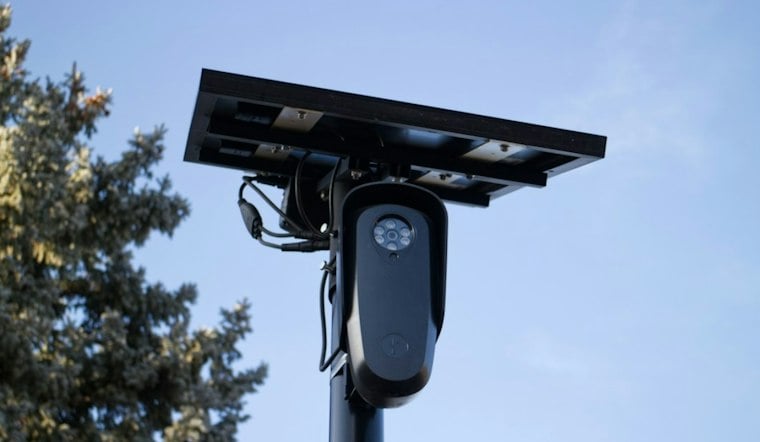
Redwood City will not pick a new company to run its license plate reader cameras until 2027, city officials announced, pushing back a decision that was originally expected this fall. City Manager Patrick Heisinger broke the news at a community forum at the Fair Oaks Community Center, telling residents that a vendor recommendation will not come until the new year.
The delay means Redwood City has effectively decided not to renew its current contract with Flock Safety, the Atlanta-based company whose cameras have scanned license plates across the city. According to the City of Redwood City, the agreement for its fixed-location camera system expires on November 30, 2026 — though the city's own response to a grand jury report, as reported by Redwood City Pulse, put the expiration date at October 31, 2026. The discrepancy between the two dates has not been resolved publicly.
City staff had hoped to bring a vendor recommendation to the City Council this fall, but that timeline slipped as scrutiny of the technology intensified. Per the San Mateo Daily Journal, Thursday's forum was the second of two sessions scheduled to gather community input on law enforcement technology, part of a broader response to nationwide scrutiny of automated license plate readers. Heisinger said additional time to listen and carefully evaluate options would help produce a more informed recommendation responsive to community feedback.
An Audit Flagged Dozens of Unauthorized Searches
The delay follows months of public unease over how Redwood City's camera data has been accessed and shared. An audit examining more than 10 million records going back to April 2023 identified 99 unauthorized queries, according to The Almanac. Ninety-six of those searches stemmed from Flock miscategorizing outside agencies as California law enforcement, while three were run by Flock itself for demonstrations without the police department's permission, the outlet reported.
Redwood City Police Chief Dan Mulholland has said there is no evidence that out-of-state or federal agencies identified in the audit actually received images collected by the city's cameras, according to NBC Bay Area. That same station reported that a separate audit found several out-of-state and federal agencies had the ability to search the city's license plate reader network because of permission errors, which the chief attributed to Flock granting access without city approval. The City of Redwood City, for its part, maintains that its police department has never authorized sharing ALPR data with federal or out-of-state agencies — a claim that sits alongside, rather than resolves, the audit findings described by NBC Bay Area.
The city says it has since taken steps to tighten control over its data. Redwood City opted out of Flock Safety's statewide lookup tool in February 2026, and its sharing configuration has since been limited to law-enforcement agencies within the nine Bay Area counties, according to the city. The city also says its ALPR data is automatically purged after 30 days unless retained as evidence or for another legitimate law-enforcement purpose, and that its system does not use facial-recognition technology.
Seven Proposals, No Recommendation Yet
Redwood City ran a competitive request-for-proposals process to find its next vendor, and the station's report notes the city is now weighing seven proposals for a new provider. Staff have not recommended a vendor to the City Council at this time, the city confirmed. The city's RFP covered three years of equipment and support services for the department's 25 plate readers, with an option to extend the contract for two years, according to Redwood City Pulse.
The city plans to host another community meeting in early 2027 before bringing a final recommendation to the City Council, per the city's own announcement. Officials have also been clear that approving the city's response to a San Mateo County civil grand jury report did not decide whether Redwood City will continue using license plate readers at all, or what terms might appear in any future contract, according to Patch.
Redwood City Joins a Regional Reckoning With Flock
Redwood City's pause fits into a much larger wave of cities reconsidering their relationships with Flock Safety. Secure Justice has recorded 214 cities and counties that have dropped Flock since 2021, and the group counted 93 jurisdictions ending Flock contracts in August 2026 alone — a fourfold jump from the previous month, according to Ars Technica.
The shift has played out across the Bay Area in different ways. Richmond, Santa Cruz, El Cerrito, Los Altos Hills and several Santa Clara County cities have pulled back from or canceled their Flock contracts, while Mountain View ended its use of license plate reader technology entirely, according to KQED. Berkeley took a middle path, voting to keep its relationship with Flock while rejecting a proposed expansion of the technology, KQED reported. San Francisco is preparing to reconsider its own Flock contract in February 2027 amid continued public debate, the outlet added.
Not every neighbor has moved away from Flock. Palo Alto has continued using the company's cameras but now requires outside agencies to sign memorandums of understanding before accessing its data, according to Redwood City Pulse. Santa Clara County, meanwhile, voted to stop using Flock Safety as the primary license plate reader vendor in Cupertino, Saratoga and Los Altos Hills, according to ABC7 News. Redwood City's own path now runs through another winter of public forums before any new cameras — or any new vendor — get the green light.




