

























































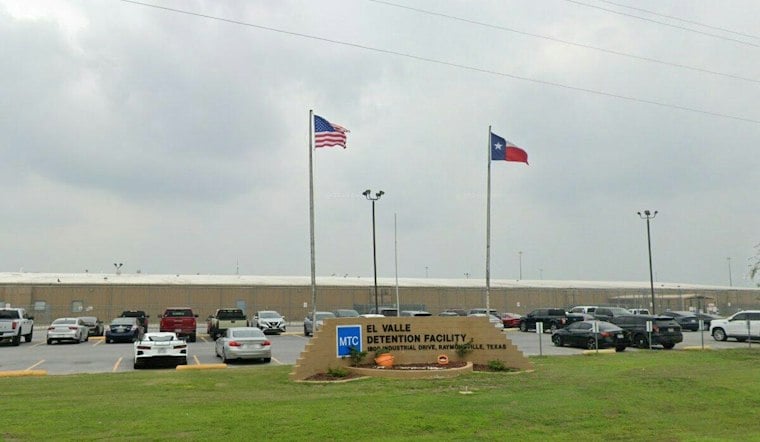
Shokhrukh Abdullaev has not eaten in more than two weeks inside the El Valle Detention Facility in Raymondville, Texas, and back in Rogers Park, his wife is fighting to keep their apartment. Amaliia Gilmutdinova fell behind on months of rent while trying to support her detained husband, and their landlord issued a five-day eviction notice when their lease expired. She has remained in the apartment while scrambling to raise the money she owes.
Abdullaev, a Russian asylum-seeker and Chicago resident, began his hunger strike on Oct. 11, according to Sarah Quinn, who has been helping the family and started a GoFundMe for their rent and legal expenses, as Block Club Chicago reports. As of Tuesday, the fundraiser had collected about $12,000 toward a $25,000 goal. Quinn says roughly 30 immigrants are participating in the strike, including at least one other man from Chicago and several women, and that 10 to 13 of them were on a dry strike — refusing both food and water — as of the prior week.
An Arrest at a Texas Checkpoint
Abdullaev worked as a truck driver, hauling goods across the country, when immigration agents arrested him at a Texas checkpoint in November 2025 while he was driving toward Ohio. His employer sent Gilmutdinova a video of the encounter, but she says she did not learn of her husband's arrest until three days later, per Quinn. Abdullaev was transferred to El Valle, where he has been detained since December 2025.
Block Club Chicago found that Abdullaev has no criminal record, and the family says it has a pending asylum application and work permit — yet his immigration record erroneously lists him as unmarried with no children, an error the family says it has been unable to correct despite repeated attempts. Immigration authorities assigned each family member a separate case after his arrest. Gilmutdinova, who was an outspoken critic of Vladimir Putin and says some of her friends had been persecuted, feared Russian authorities would seize her devices and detain her if she stayed. She and her family arrived in the United States in 2021, when the couple's daughter, Avrova, was 4 years old; Avrova is now enrolled in a local Chicago school, and the family moved into their Rogers Park apartment in October 2025.
Abdullaev was his family's breadwinner, and Gilmutdinova has been spending about $160 a week sending him money for food and bottled water. He attended a mosque in Chicago before his arrest. She told Block Club Chicago she believed the United States would offer freedom and a life they could build — a hope now colliding with her husband's deteriorating condition and the family's housing crisis.
Deteriorating Conditions, Disputed Claims
Gilmutdinova says Abdullaev has reported blood in his urine, itchiness, red eyes and other signs of illness, and that he has not received proper medical attention despite repeated requests, according to Quinn. In a phone call this month, he reported more blood in his urine and sounded weak, though Block Club Chicago was unable to reach him directly inside the facility. Guards have threatened to force-feed hunger strikers, Gilmutdinova says, and detainees have reported isolation, lights and televisions left on continuously, and very cold air conditioning. Abdullaev was moved to isolation after the strike began and lost access to commissary funds that had let him contact family, buy supplemental food and water, and obtain hygiene items.
Separately, Border Report cited at least 30 detainees on hunger strike at El Valle, including at least 15 women, with 13 on a dry strike. That outlet also reported that strikers, including Abdullaev, were seeking transfer to a facility outside the Fifth Circuit so they could present their cases to a judge, according to Sarah Quinn. ICE told Border Report that any allegations of substandard conditions at El Valle are false, saying it continues to provide three meals a day along with drinking water, blankets, medical treatment and communication with family and lawyers. The Department of Homeland Security did not respond to Block Club Chicago's questions about the strike and facility conditions.
Court records reviewed by Block Club Chicago and reporting from other outlets point to conflicting timelines for when the unrest at El Valle began. Border Report described the hunger strike it documented as starting Oct. 11, while the Marshall Project reported that five men had gone without food since Sept. 29. The Marshall Project also reported that three immigrants went without eating for days in September to seek transfer outside Texas, and noted that El Valle is run as a for-profit facility by Management & Training Corporation.
Lawmakers Demand Answers
U.S. Rep. Delia Ramirez, who sits on a Department of Homeland Security oversight committee, and six other members of Congress sent a letter to DHS condemning conditions at El Valle, raising concerns about the hunger strikers and what they described as inadequate detention-center conditions. The letter said detention centers unable to meet medical, safety and basic-needs standards should not continue operating, and the House members said they had identified hunger strikes at 10 other ICE detention centers across the country. They called on federal authorities to release the hunger strikers and refrain from force-feeding detainees. Gilmutdinova's family has also sought help from Illinois state officials to push for Abdullaev's transfer and an inspection of detention conditions, and the family is seeking an immigration attorney.
Quinn says detainees are striking because they feel they are being denied due process, and that the strikers are desperate, with nothing else left to lose. That desperation has only deepened since a Texas appellate court ruled on Oct. 23 that immigration authorities may indefinitely detain immigrants during ongoing immigration cases, according to Politico and The Texas Tribune. The ruling means immigrants without criminal records who complied with authorities, like Abdullaev, lack a right to a bond hearing. After learning of the decision, Gilmutdinova said she planned to ask her husband to end his hunger strike — but he told her he was ready to see it through to the end.
Part of a Wider Pattern
El Valle houses adult administrative detainees held for immigration hearings and possible deportation, not criminal charges, according to its contract reviewed by KRGV. That contract requires initial medical screenings within 12 hours of arrival and a full physical exam within two weeks, and mandates that staffing not fall below 95 percent of the approved plan. KRGV separately reported that more than 450 people were being held at the facility.
Hunger strikes have spread across the ICE detention system this year. Detention Watch Network advocacy director Setareh Ghandehari told the Marshall Project there have been at least a dozen hunger strikes in ICE detention camps in 2026 alone. Dozens of detainees at Delaney Hall in New Jersey went on hunger strike in May, and the Detention Watch Network says more than 200 people remained on a labor and hunger strike there over denied fresh food, medical care and broken air conditioning. The group also reported at least 20 people striking at the Adelanto ICE Processing Center in California over mold, unsafe water and inadequate medical care.
In Georgia, at least 12 hunger strikers were reportedly still participating in a detention complex despite threats of force-feeding, according to The Guardian, which reported that ICE sought court permission to force-feed at least 19 detained hunger strikers between January 2025 and August 2026. A judge must approve force-feeding before guards can restrain a detainee and medical staff insert a feeding tube, the paper reported, and the Georgia Bureau of Investigation opened an in-custody death investigation there after a local sheriff's office requested it. For Gilmutdinova, those national headlines are a backdrop to a far more immediate fear: that her husband's health, and her family's home, may not survive the wait.





