

























































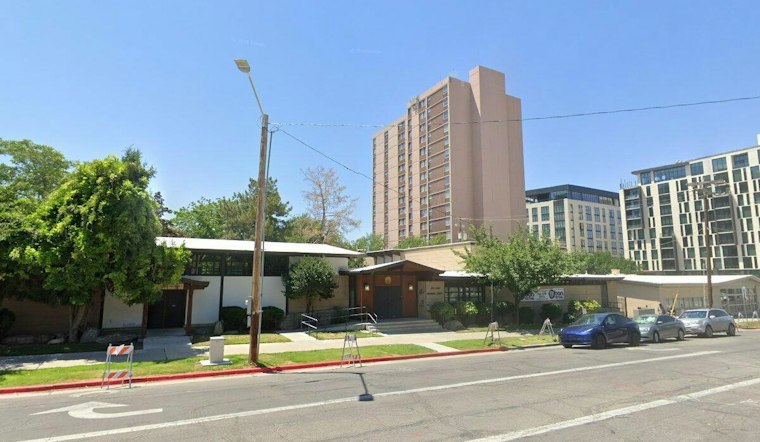
The smell of grilled takoyaki and simmering udon will fill Salt Lake City's 100 South this Saturday afternoon as the Salt Lake Buddhist Temple hosts its annual Japanese Fall Food Festival, a fundraiser that traces its roots back nearly a century to the days when Japanese American farmers shared their harvests with the temple's earliest congregants. The festival runs from 1 p.m. to 7 p.m. and offers okonomiyaki, gyoza, curry, yakitori, sushi, tonkatsu and more to anyone willing to make the trip downtown.
According to KSL.com, the event is the temple's second-largest fundraiser after its summer Obon Festival, and parking near the temple costs $20, which includes a $20 food voucher. Temple president Troy Watanabe told the outlet the food has always been the main draw: “The food is the highlight and has always been that way.” He also recalled his own childhood ties to the event, saying, “I remember helping unload some of the produce as a child and my mom always looking forward to purchasing some of the fresh harvest.”
From Farmers' Market to Fall Festival
The festival dates back to the temple's beginnings in Japantown, when it began as a celebration of harvests gathered by Japanese American farmers who shared portions of their crops with the temple. What is now the Fall Food Festival was once known as the Salt Lake Buddhist Temple Bazaar, which included a farmers' market that let growers sell produce directly to the greater Salt Lake City community, per the same KSL.com account.
That lineage sits on a block with a much larger story behind it. Salt Lake City's historic Japantown once spanned nearly 10 city blocks and was home to more than 8,000 residents at its mid-20th-century peak, with Japanese American families running fish markets, laundries and restaurants across downtown, according to AIA Utah. Urban renewal in the late 1960s demolished most of the district to make way for the Salt Palace Convention Center, leaving only the stretch of 100 South between 200 West and 300 West as a remnant of what once was.
Two Buildings, One Remaining Block
Only two historic religious institutions survive from the original enclave: the Salt Lake Buddhist Temple, founded in 1912, and the Japanese Church of Christ, established in 1918, which sit directly across from each other on that same stretch of 100 South, as reported by KSL-TV. The Japanese Church of Christ, a Gothic Revival building funded by donations from local Japanese American business owners, opened a 100-year-old time capsule in 2025 that had been sealed inside its cornerstone during construction in 1924, according to the University of Utah Marriott Library Blog.
The Salt Lake Buddhist Temple itself carries international ties. It is affiliated with the Buddhist Churches of America, a federation of 63 member temples headquartered in San Francisco under the Jodo Shinshu Honganji-ha sect based in Kyoto, Japan, per the Salt Lake Buddhist Temple's own history. Jodo Shinshu Buddhism was first introduced to the United States in 1899 by Japanese immigrants, the temple notes.
A Community Rebuilt After Wartime Incarceration
The block's resilience is tied to a darker chapter of Utah history. Between September 1942 and October 1945, 11,212 people of Japanese descent were incarcerated at the Topaz War Relocation Center in Delta, Utah, which at the time temporarily became the state's fifth-largest city, according to the Friends of Topaz Museum. After Topaz closed in late 1945, many formerly incarcerated Japanese Americans relocated to Salt Lake City, temporarily tripling Japantown's population, AIA Utah reports. While some internees eventually returned to the West Coast, others built permanent roots in Salt Lake City, strengthening the congregations and food festivals that continue today.
This past July, the temple marked another milestone when it celebrated the 90th anniversary of its summer Obon Festival, which has been hosted continuously on Japantown Street since 1936 and honors ancestors through Bon Odori folk dancing, taiko drumming and street food stalls, according to KSL.com. That festival remains the temple's largest fundraiser, with the Fall Food Festival running as its second.
Millions in Investment Aim to Protect the Block
City and private money are now flowing into the same stretch of street that hosts these festivals. Salt Lake City's Redevelopment Agency is advancing an estimated $11 million Japantown Streetscape design for 100 South that would add cherry blossom trees, widened sidewalks and festival infrastructure meant to buffer the historic structures from surrounding commercial high-rise development, according to KSL.com's earlier reporting from November 2025. Separately, Smith Entertainment Group has committed approximately $5 million toward Japantown Street revitalization, funded through ticket surcharges from events at the nearby Delta Center arena, according to Nichi Bei News. Community leaders reportedly advocated during arena planning to keep 100 South from becoming little more than a loading dock for the entertainment district.
The block is also getting a visual update. Salt Lake City selected artist Cole Eisenhour in April to paint a public mural on the 15-story Multi-Ethnic Senior Highrise on 100 South using themes from kintsugi, the traditional Japanese art of mending broken pottery with gold lacquer to celebrate resilience, KSL-TV reported. For a community that has spent decades rebuilding from a fraction of its former footprint, the symbolism tracks closely with what organizers hope Saturday's festival will represent: a block still standing, still feeding its neighbors, and still fighting to hold its ground.




