

























































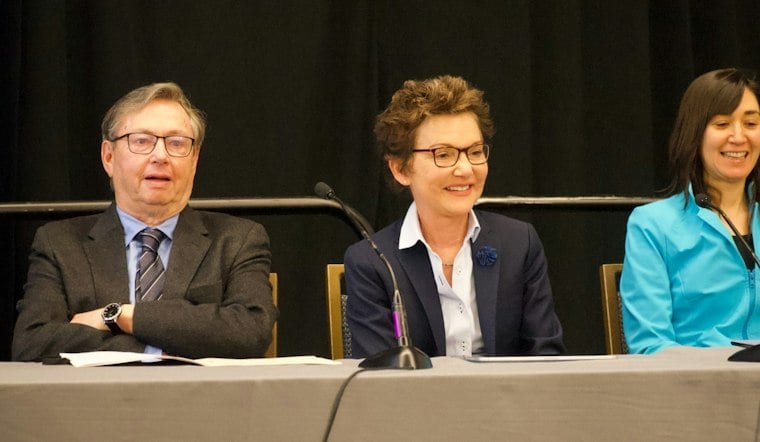
San Francisco Federal Reserve President Mary Daly says the central bank will probably need to raise short-term interest rates further to tame stubborn inflation, but she sees no reason to make that move at the Fed's upcoming October 27-28 meeting. Her comments land just as fresh government data showed consumer prices climbing faster than expected, putting renewed pressure on policymakers heading into the final stretch of 2026.
Daly, who does not hold a vote on the Fed's rate-setting committee this year but still takes part in its regular policy discussions, told Reuters that “the Federal Reserve will probably need to increase short-term interest rates further,” according to a report from investing.com. Still, she made clear the timing is far from settled, saying “there's no need to do so” at this month's meeting. The Fed's benchmark policy rate currently sits in the 3.75%-4.00% range.
“I don't feel urgent that we have to decide with a limited set of information,” Daly said, according to the same report, adding that officials should be thoughtful and deliberate rather than rushed. She argued that continued stability in the labor market gives the Fed breathing room to keep its focus on price stability rather than reacting to every data point.
September Inflation Numbers Complicate the Picture
The debate comes on the heels of a government inflation report showing consumer prices rose 3.7% over the 12 months through September, faster than many economists had anticipated. The seed report, published by Reuters, noted that higher gasoline prices drove most of the overall increase, while underlying inflation stayed sticky without taking a sharp turn upward.
Forbes reported more granular detail on that release, noting the Consumer Price Index rose 0.6% in September and 3.7% over the trailing year, fueled in large part by a 9.1% jump in the gasoline index that month, according to Forbes. Core inflation, which strips out volatile food and energy costs, rose 2.6% over the same 12-month period — elevated, but not the kind of acceleration that would force the Fed's hand immediately.
Daly has also pointed to higher borrowing costs already squeezing parts of the economy, noting that some mortgage rates sitting around 7.5% are putting what she described as an increasingly obvious damper on demand. The Fed targets 2% inflation, though it measures that goal using a different but related index than the monthly CPI figures that grab headlines.
Tariffs, Oil and AI Chip Demand Named as Pressure Points
Earlier this month, Daly laid out why she still backed the Fed's September rate hike and why further moves may be needed. She told Reuters that whether additional hikes are necessary “depends largely on whether the shocks” hitting the economy fade or keep compounding, according to a separate Reuters report. She identified tariffs, oil prices tied to the Middle East conflict, and artificial intelligence as the main forces pushing inflation higher.
On the AI front specifically, Daly flagged rising chip demand as a factor that could make inflationary pressure more persistent rather than fleeting. She said she supported September's rate increase because of rising inflation risks at the time, even though she stressed this week that elevated risk is not the same as realized harm — and that reacting prematurely to a risk that hasn't materialized would be imprudent.
Wall Street Still Debating What Comes Next
Markets reacted quickly to the inflation report, with traders initially boosting bets on an October rate hike before settling down once they had fully parsed the data, Daly's remarks indicate. Financial market pricing now puts roughly a 40% chance on a second straight rate hike at the Fed's next meeting, with a hike no longer seen as the most likely outcome following the inflation data, per the investing.com account of her comments.
Other outlets tracked slightly different numbers. CME FedWatch data cited by Forbes showed about a 66% chance the Fed holds its target range steady at the October meeting, alongside roughly 63% odds of a quarter-point hike in December. Newsquawk, meanwhile, reported that after markets' initial “robust” reaction to the CPI data they had calmed down, while noting that Citi had shifted its own forecast to expect a 25-basis-point hike in December — a reversal from its earlier call for no change — and that traders were said to be fully pricing in two rate hikes by the end of January, according to Newsquawk.
Daly is not alone among Fed officials signaling that more tightening could be ahead. New York Fed President John C. Williams has said it's “reasonable” to think the central bank will need to raise rates again before year-end, while Philadelphia Fed official Anna L. Paulson has said some modest further tightening may be warranted, according to the New York Times.
Fed's Own Projections Show Inflation Running Hotter
The Fed's own September projections reflect some of that uncertainty. The median forecast for headline PCE inflation in 2026 rose to 3.7% from 3.6% in the June projection, while the median forecast for core PCE inflation climbed to 3.4% from 3.3%, according to an analysis from the Richmond Fed. That research also cautions that realized inflation rarely tracks the path traced by the median projection, in part because those projections generally assume no further economic shocks hit the economy during the forecast period.
With the Fed's October meeting now two weeks away, Daly's message suggests policymakers are inclined to wait for more evidence before acting again, even as the inflation data gives hawkish-leaning officials ammunition to push for another hike before year-end. The Fed has several more meetings ahead to make that call.





