

























































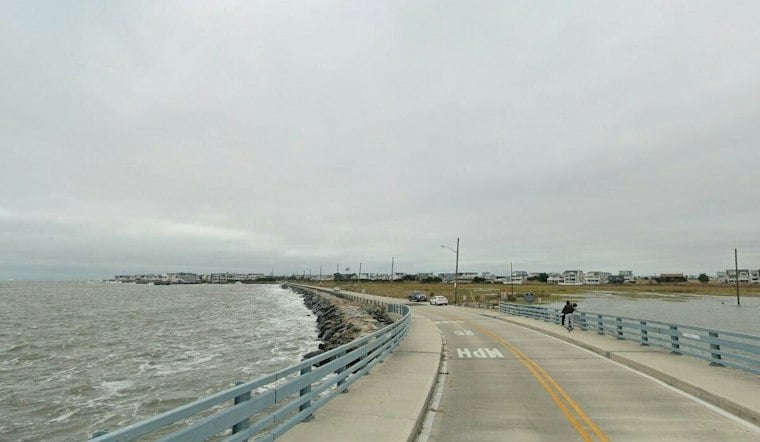
A fast-growing sandbar near the Townsends Inlet Bridge has narrowed the channel boats rely on to pass safely between Avalon and Sea Isle City, and officials have now lined up an emergency dredging project estimated to cost $1.5 million. Shifting sand has squeezed the navigable passage beneath the span, creating hazards for both recreational boaters and commercial vessels trying to get through the inlet.
The narrowing channel has been documented in a social media video showing the sandbar sitting within just several feet of the narrow passage boats use to pass under the open drawbridge, according to NJ.com. Townsends Inlet links Townsend Sound to the Atlantic Ocean, and the sandbar there has made navigation hazardous for sailboats and other larger vessels trying to squeeze through, per the same report. As of October 7, an agreement was already in place to carry out the dredging work at the bridge, NJ.com reported.
A Deal to Dredge, Fast and Cheap
U.S. Rep. Jeff Van Drew said his office helped broker an agreement to dredge at the bridge in order to make the inlet safer for recreational and commercial boats. According to Dredgewire, Van Drew said, “we have an agreement in place to dredge at the bridge and make the inlet safer for recreational and commercial boats.” The plan leans on dredging equipment already mobilized nearby for the Avalon beach replenishment project, with Van Drew saying, “We are using dredging equipment already in the area for the Avalon beach replenishment project,” while adding that the approach is expected to save “millions of dollars for taxpayers.”
The funding picture includes Cape May County putting up $250,000 toward the emergency dredge, with the Cape May County Bridge Commission contributing another $50,000 toward the roughly $1.5 million estimated construction cost, Dredgewire reported. Van Drew said his office is working with local, state, and federal governments to fund, permit, and execute the project. Officials from Avalon and Sea Isle City framed the goal as improving navigational safety while preserving commercial and recreational boating opportunities on the inlet, per the outlet.
How the Sandbar Got So Bad
The problem traces back to a growing sandbar at the south end of Sea Isle City that has created serious navigation problems for boats passing through Townsends Inlet and under the bridge connecting the two towns, according to the Cape May County Herald, which first reported on Avalon's initial push to get the channel dredged using nearby construction equipment. Sea Isle City's southern beach advanced roughly 40 feet into the inlet in about a month, according to a separate report from Dredgewire, squeezing larger boats toward the bridge and making an already difficult passage more dangerous.
Cape May County built the Townsends Inlet Bridge in 1939 as part of the original Ocean Drive linking the barrier islands, and when closed it provides about 23 feet of vertical clearance, Dredgewire reported. The inlet has a long history of needing intervention: it was repeatedly dredged from around 1950 through just after the bicentennial to keep a usable channel open, and major projects in 1978 and 1984 removed roughly 1.4 million cubic yards of sand for beach nourishment. Avalon removed another 740,000 cubic yards from the inlet in 2015 and placed it on beaches between Ninth and 23rd streets, per the outlet's reporting.
Protecting the Bridge From Boat Strikes
The dredging push comes alongside a separate effort to armor the bridge itself. Cape May County officials approved a $4,884,493 contract with South State, Inc. in November 2025 to replace the bridge's protective fender system, according to NJ.com. The improvements are meant to safeguard the bridge from marine vessel collisions and help guide boats safely through the channel, the outlet reported.
The emergency dredge is also piggybacking on equipment already at work nearby. As of October 9, Norfolk Dredging Company had moved 929,724 cubic yards of sand into Avalon's north end from the Townsends Inlet borrow area as part of a beach backpassing project, according to Avalon Borough. That project, conducted by the U.S. Army Corps of Engineers, has been running around the clock, seven days a week, stopping only for mechanical failures or bad weather, per the borough's update.
A Pattern Seen Elsewhere on the Shore
Townsends Inlet is far from the only New Jersey waterway that has needed this kind of intervention. Hurricane Sandy dumped substantial sand into the Little Egg Harbor-Great Bay estuary in October 2012, and shoaling continued for years afterward, according to WorkBoat. The Coast Guard eventually pulled its navigation aids from Little Egg Inlet in March 2017 because conditions there hadn't returned to a safe, predictable state, and an $18.4 million dredging contract followed that December, moving sand north to the storm-battered Holgate section of Long Beach Island.
Separately, the Army Corps of Engineers has awarded Norfolk Dredging Company a contract for periodic beach nourishment in Avalon and Stone Harbor, though reported figures for that deal differ: Baird Maritime put the contract at roughly $15.8 million awarded in June 2026, while Dredgewire described it as an approximately $15.7 million contract intended to widen beaches and reinforce dunes. That federally funded project's stated purpose is storm protection rather than maintaining a defined navigation channel, Dredgewire noted, a distinction that helps explain why the emergency dredge near the bridge required a separate, locally funded push.





