

























































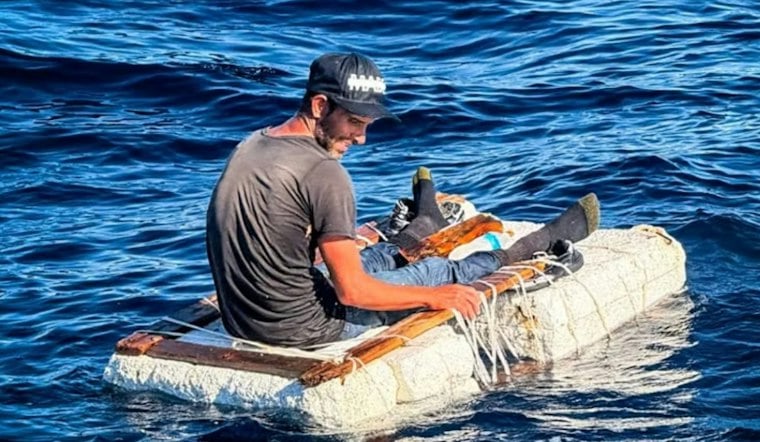
A Cuban man was pulled alive from the open water Monday after spending time adrift alone on a makeshift raft roughly 16 miles east of Key Biscayne. U.S. Customs and Border Protection reported finding him on October 12, with the rescue unfolding only after a passing boater happened to spot his small vessel bobbing in open sea.
That boater broadcast an alert over VHF marine radio Channel 16, the internationally designated distress and hailing frequency monitored around the clock by the Coast Guard and nearby civilian vessels, according to a Facebook post explaining the channel's role. CBP Miami and Fort Lauderdale marine units responded alongside U.S. Coast Guard crews, as first reported by the Tampa Free Press. Those Miami and Fort Lauderdale units fall under CBP Air and Marine Operations, which keeps specialized Coastal Interceptor Vessels staged for offshore interdictions and search-and-rescue missions, per a separate Facebook video describing the unit's capabilities.
Medical Care and Transfer to a Federal Cutter
Responders brought the man aboard and provided initial emergency medical care before Miami-Dade Fire Rescue paramedics evaluated him on the water and cleared him medically, the Tampa Free Press report said. Federal authorities then transferred him to Coast Guard Cutter Melvin Bell for administrative processing. The Melvin Bell is a 154-foot Sentinel-class Fast Response Cutter commissioned in March 2024, built by Bollinger Shipyards and capable of speeds up to 28 knots, according to the Coast Guard Foundation; the cutter is homeported in Boston, Massachusetts.
CBP said the incident underscored the extreme danger of attempting illegal maritime migration, adding that open water is unforgiving and sea journeys can quickly become fatal, the Tampa Free Press noted. The Florida Straits has served as a common migration route from Cuba to the United States for decades, spanning roughly 90 to 100 miles of open sea. Travelers attempting the crossing contend with powerful Gulf Stream currents, sudden weather changes, and vessels that are often unseaworthy to begin with.
Why the Gulf Stream Makes Rafts So Vulnerable
The Gulf Stream current flowing northward through the Florida Straits moves at average speeds of 3 to 4 miles per hour, with maximum surface speeds reaching up to 5.6 mph, according to NOAA's National Ocean Service. That current can rapidly carry unpowered, makeshift craft far off course into open Atlantic waters, compounding the risks facing anyone attempting the crossing without reliable navigation or propulsion.
This rescue happened under an operational and legal landscape shaped by years of policy shifts. The United States ended the wet foot, dry foot policy in January 2017; under that earlier approach, Cuban migrants intercepted at sea were typically returned to Cuba, while those who reached U.S. soil could stay and pursue legal permanent residency. Current federal guidelines instead subject Cuban nationals stopped at sea or arriving without legal authorization to repatriation, and the Coast Guard routinely returns interdicted rafters to Cuba.
Parole Restrictions and the Five-Year Re-Entry Bar
A Department of Homeland Security regulation issued in April 2023 strictly disqualifies Cuban nationals interdicted at sea after April 27, 2023, from applying for the U.S. humanitarian parole program, according to the Federal Register. Migrants interdicted at sea who fail to establish a legal claim for asylum face repatriation and are subject to a five-year bar on future legal admission to the United States, as Hoodline detailed in its prior coverage of at-sea interceptions.
The rescue also lands amid broader scrutiny of Coast Guard capacity. A January 2026 report by the U.S. Government Accountability Office found the Coast Guard missed its primary migrant interdiction performance target in six out of ten years between fiscal years 2015 and 2024 due to resource constraints, and recommended that DHS develop updated performance metrics.
The response fits within Operation Vigilant Sentry, the federal plan approved in 2004 that coordinates joint air and sea assets across the Florida Straits to prevent unlawful maritime migration, managed under Homeland Security Task Force – Southeast. That task force, established by DHS in 2003, brings together the Coast Guard, DHS, Defense Department, and state and local law enforcement to monitor and respond to maritime mass migration events, according to USCG News. The rescue also comes about three weeks after Hoodline's report on a smuggling bust near Key Largo, underscoring how frequently South Florida waters see these interdictions play out.





